Tube Trends: What Media Companies Can Learn From The World Cup
Spain’s 1-0 nail-biter of a win on Sunday put a bow in the biggest World Cup yet. And even if the event does expand yet again to a stunning 64 teams in 2030, there’s still plenty that media companies can learn from this year’s World Cup. Especially when it comes to how the tournament was covered on YouTube.
Globally, Tubular Labs (powered by Chartbeat, Inc.) data shows that publishers accounted for over 13% of World Cup-related views on YouTube during this year’s FIFA Men’s World Cup.
Media vs. Creators
That’s nearly six times less than what individual creators earned during the tournament. However, media companies actually operated at a similar efficiency, generating 64.5K views per video, compared to 67.6K for creators (a relatively negligible difference).
Also worth considering when comparing the two: Some of the biggest creator videos — including those from the likes of Celine Dept and iShowSpeed — were captured with significant involvement from FIFA.
Lacking media rights — as Fox possessed in the U.S. — that’s not something media companies can easily imitate for events like the World Cup. However, content capture also doesn’t have to be limited to what happens on the field of play.
Working directly with creators and co-opting aspects of their audience allowed FIFA and Fox to be engage with digital audiences where they already were (YouTube), with faces they already knew, without having to invest in highly-produced introductory content.
Yes, there’s still an investment component just in terms of the talent. But the result here can be more successful because it feels and appears more endemic to the platform it’s being delivered on.
Media companies (and brands) can also take similar approaches to major events by using creator talent as fan perspectives beyond the game.
Whether that’s tailgating beforehand, out at watch parties, or hosting their own event, publishers can use social video to present additional perspectives around something newsworthy. Something that the written word can sometimes just take longer to capture for audiences.
Not-So-Short
YouTube coverage of the World Cup didn’t lean all the way into Shorts.
Tubular data shows that 71.7% of YouTube World Cup views were on videos shorter than a minute, and 80.9% were on videos shorter than two minutes.
FIFA itself was actually the biggest Shorts producer by views around the World Cup, and their approach (having all of the footage and rights) is not a replicable approach for any media company.
But there’s white space elsewhere in that 19.1% of views that weren’t from shorter videos.
During the tournament, 9.3% of YouTube views came from videos that were over 20 minutes long, and those videos were more engaging than those running from two to 20 minutes in length.
Media companies by not always be equipped with the ability to churn out engaging short videos (though many digital-first creators can). But they do have a clear advantage when it comes to longer-form content.
For World Cup videos on YouTube that were over 20 minutes long, media companies’ uploads were 1.4x more engaging on a per-video basis. And despite five times more uploads, creators’ long World Cup videos only generated 3.5x the views vs. media companies.
(via Tubular Labs, powered by Charbeat, Inc.)
Read The Room
One of the bigger takeaways from the World Cup were the unique fan interactions and cultural exchanges across cities in the U.S., Canada and Mexico. And those that managed to jump in on those trends with video content were able to benefit.
According to Tubular data, fandom-focused videos accounted for 10% of World Cup-related YouTube views globally. But just 1.6% of uploads.
Fandom videos also had more views per upload (429K) than most teams. The only topic to really outpace that content were those about specific star players.
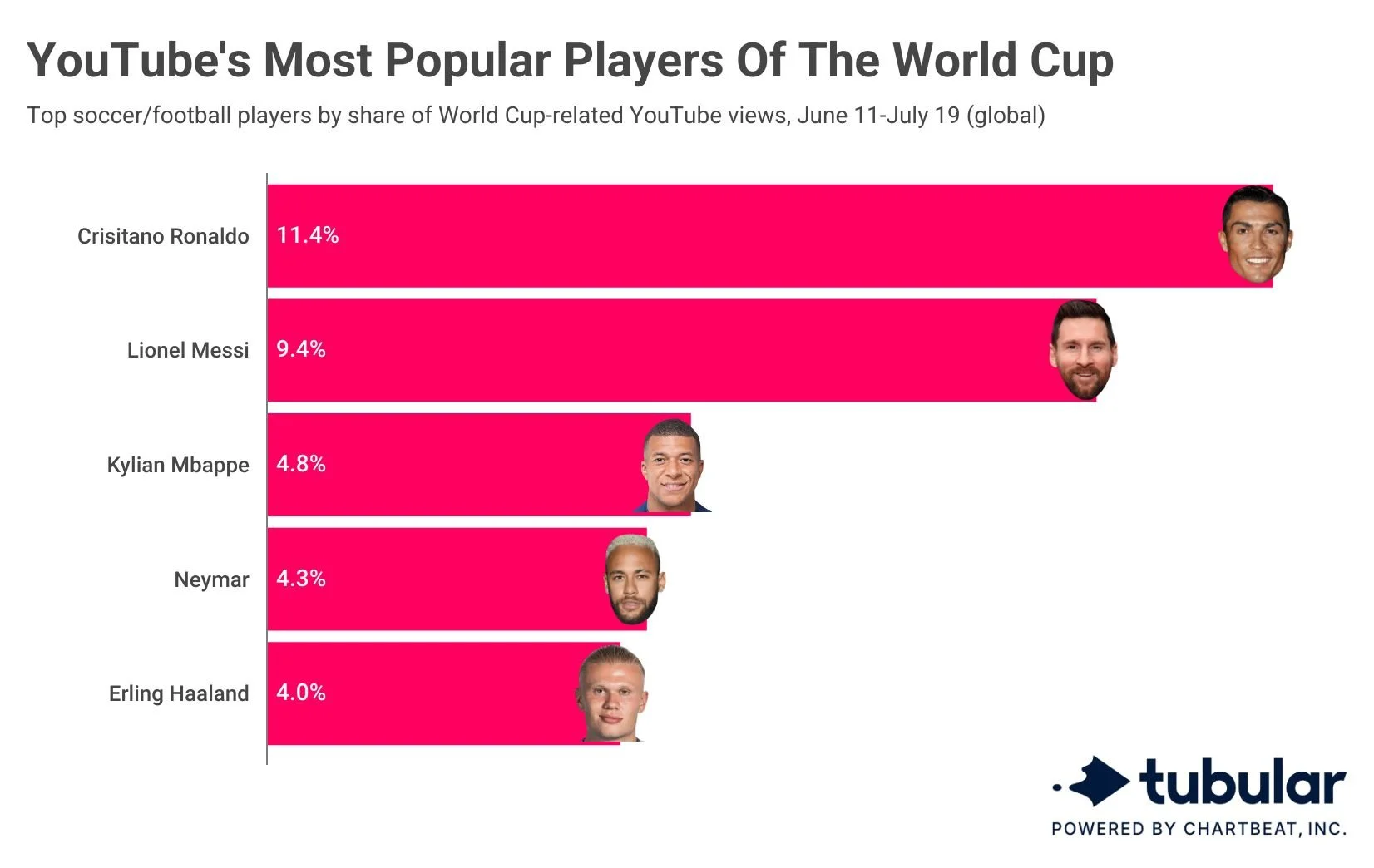
Portugal’s Cristiano Ronaldo generated the highest share of views by any individual player (11.4%) — more than Lionel Messi (9.4%), Kylian Mbappe (4.8%), Neymar (4.3%) or Erling Haaland (4.0%).
Media companies that understood these dynamics in real-time and adapted content according stood to benefit; maximizing their per-video reach and as a result, potential monetization opportunities as well.