Tube Trends: On YouTube, Colbert Lands Where Fans Already Are
Not even three months ago, this space talked about where late night TV was headed in the wake of increasing pressure and decreasing ratings.
As discussed then, YouTube was not only a liferaft, but already a vibrant digital space where these traditional TV properties had been developing engaged and enthusiastic audiences — which only grew more true as programs like Jimmy Kimmel Live (via the White House) and The Late Show With Stephen Colbert (cancellation) found themselves under fire.
The nature of video viewing being less about live TV audiences and more about online clips is part of that shift. But that was brought on by the success of digital creators doing things faster and with less production value than their traditional predecessors.
However, where digital-natives have succeeded when it comes to speed, traditional TV creators have a distinct advantage in terms of resources and video volume. They can simply do more. And most of the time, make it look better as well because of the budgets and talent involved. The Wrap’s Kayla Cobb did some excellent work digging into it all here, for those interested in reading more.
Now comes a new test of these dynamics, though.
Within days of his final show airing on CBS, Colbert announced he’d be appearing on a new home — but one that the majority of his fans will be very familiar with: YouTube.
Colbert’s new YouTube channel’s first video, “Only in Monroe” has a run-time over an hour, yet has still attracted neary 900K views. According to Tubular Labs, that figure would make it among the 10 most-watched long (20+ minute) U.S. news or entertainment videos published during Memorial Day weekend. And that’s without any real promotion or audience built up around the new channel — which is not linked to the show-specific channel at all.
Depending on how Colbert approaches YouTube going forward, he could scoop up a good portion of his Late Show audiences from that platform — even if with a lesser promotional budget.
Tubular data reveals that in April, his last full month hosting the show, Colbert was No. 3 among late night shows by U.S. YouTube minutes watched (279.4 million), and No. 4 by unique U.S. viewers (8.3 million). Those figures were up significantly year-over-year as audiences flocked to YouTube to watch his send-off shows even a month before the finale.
He’s not the only late night host to effectively utilize YouTube, either.
Below, Tubular data shows how most of those programs are reaching more domestic viewers year-over-year.
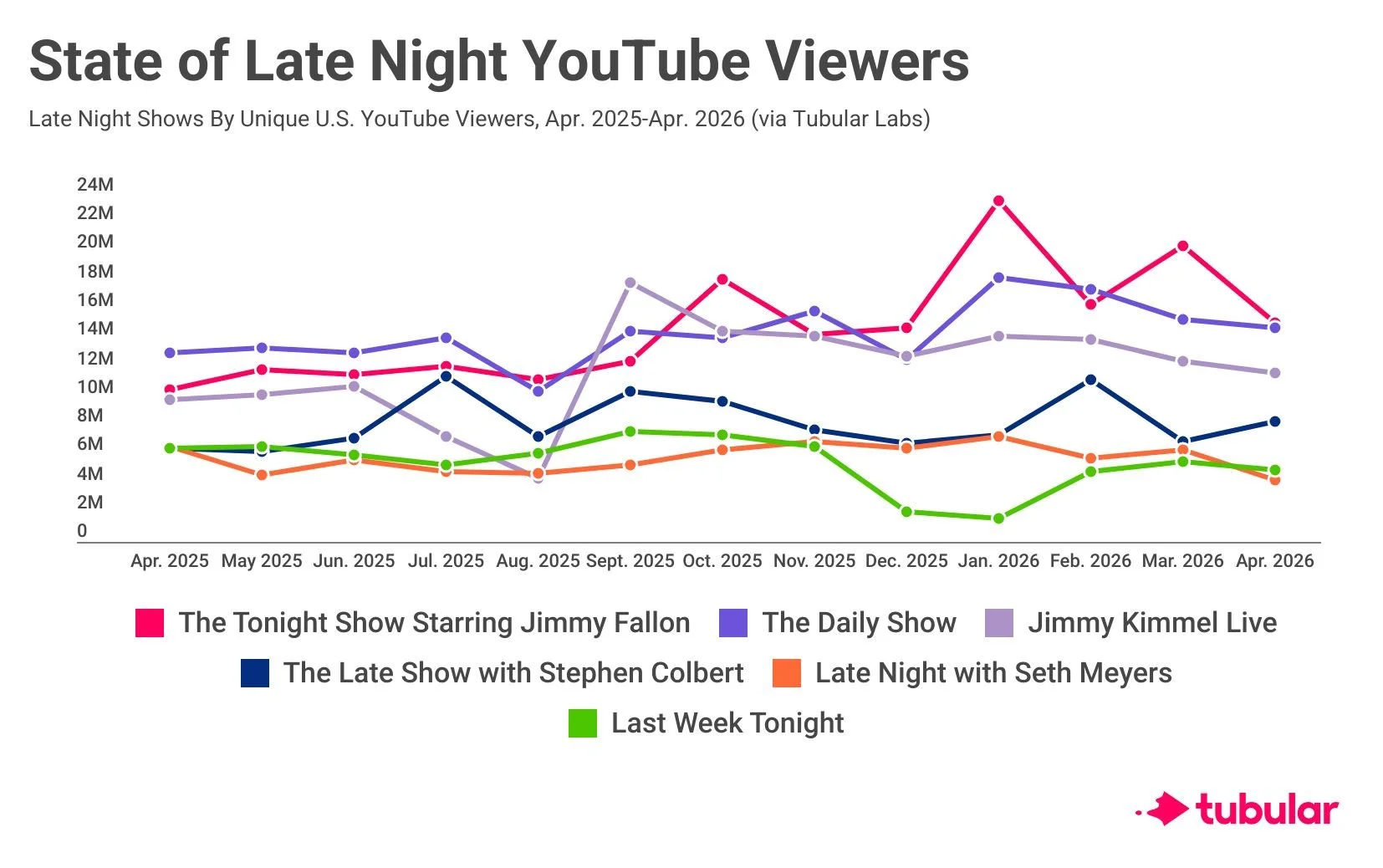
(via Tubular Labs)
Free of broadcast TV limitations now, Colbert has increased freedom to handle comedy differently, experiment with new formats, and most importantly, just upload entire “episodes” (however they may look) to the platform whenever he wants to.
There are drawbacks from a resources standpoint, sure. And it seems unlikely that any next iteration of Colbert would feature the same monologue approach or the lengthy collection of A-list guest every night. Plus, it gets harder for a person to reach 8 million people per month on their own than it is when attached to a network.
But without the traditional TV structures in place, Colbert can also get more creative with brand partnerships (if he wants them at all), push a subscription model, take the “show” on the road, and/or even make himself a primetime entity if he so chooses — instead of being parked in a specifically late-night window.
There’s also a chance that this plays right into where the ball is going for YouTube’s individual creators, who are already using longer videos to compete effectively with TV.
To-date, the most successful implementations of those ideas have come from the likes of MrBeast, who plays to a younger audience than Colbert. Yet, the platform’s podcast revolution is not that dissimilar from the late night talk show format. A big name like Colbert could lift all boats if branded as the headliner of a larger collection of personality-focused shows (if that comes to fruition, of course).
Whether it does or not, however, Colbert’s future on YouTube will be a significant area of focus for the entertainment industry as it rethinks what live TV really is. If he can draft off of his network success and name recognition to even some positive results on YouTube, it’s a brand new roadmap for a platform (YouTube) that’s always eager to create new ones. Especially when they seemingly take attention away from traditional TV.