Tube Trends: Late-Night Fights Headwinds With YouTube
“Late Night TV Isn’t Dying — It’s Been Murdered,” declared Vanity Fair in late 2025.
The headline was meant to draw attention to the publication’s very thorough reporting around late-night’s struggle to survive in the current corporate media landscape. But just because it felt like an extreme reaction didn’t make it any less true.
The institution of late-night TV and its importance have ebbed and flowed, but only recently has it truly appeared to be under attack by the various powers-that-be.
President Donald Trump has been waging war on late-night for some time, and looked like he’d actually claimed a pelt (Jimmy Kimmel) last fall, before the long-time host returned less than a week after his suspension began. CBS will not only remove Stephen Colbert from his Late Show post in May, but say goodbye to the show altogether.
As The Wrap’s Kayla Cobb covered effectively on Friday, the coming Paramount acquisition of Warner Bros. Discovery now imperils the long-term prospects of Last Week Tonight With John Oliver (currently airing on WBD’s HBO).
Given these various headwinds, it’s reasonable to assume the sky is falling for late-night TV. But there’s a life raft hidden in plain sight: YouTube.
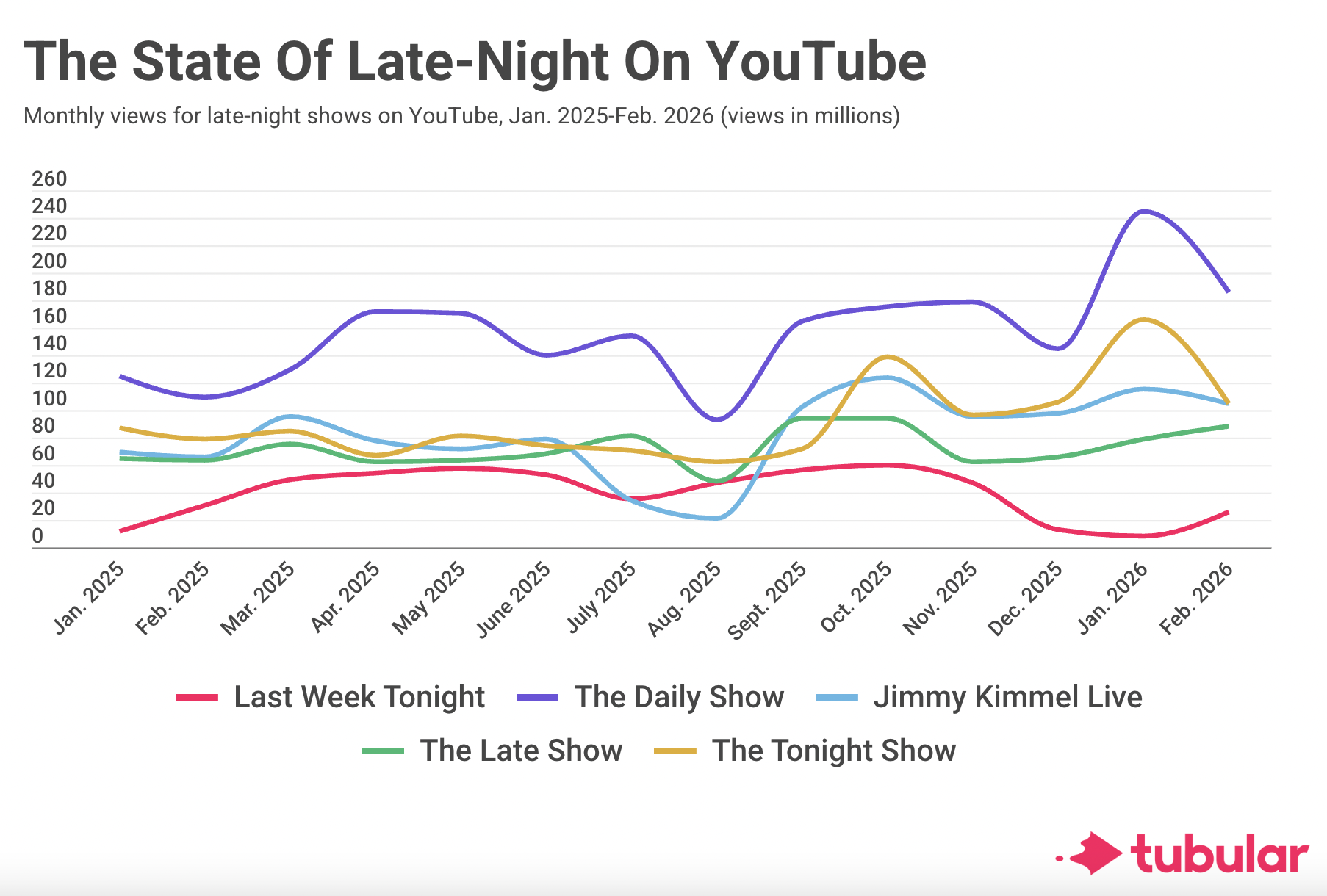
Since the heat starting cranking up around late-night in fall 2025, most of the programs have been staking out even larger claims to a strong social video audience. Data from Tubular Labs looks at how five of the top late-night shows have performed in terms of YouTube views since the start of last year:
(via Tubular Labs)
Jon Stewart and The Daily Show has been soaring on YouTube since the fall, with views up considerably versus the first half of 2025, hitting a high of 244.9 million views in Jan. 2026. Colbert directly confronting hot-button issues (including his axed interview with U.S. Senate candidate James Talarico) has spurred an early-year surge. Kimmel, to the host and his team’s credit, has consistently seen views 25-30% higher per-month since returning from suspension. Jimmy Fallon has also been up at least 20-30% every month since October, versus the nine months prior.
Notably, Oliver’s show is not hitting those high marks on a total views basis. But The Wrap points out, with Tubular data, where he’s still excelling on YouTube.
Last Week Tonight uploads far fewer videos than late-night peers do, yet virtually every video hits the mark. In Feb. 2026, the channel’s 14 YouTube uploads averaged about 1.9 million views per. Fallon, as one point of comparison, averaged about 686K views per video on over 150 uploads for the month.
The fact that Oliver himself fights for next-day YouTube uploads — despite the potential negative impact relative to live HBO viewership — shows where the ball is moving for his show and the future of late-night TV.
Is that a sustainable strategy for the shows in their current form? Perhaps not. But it’s at least a roadmap for how they’re likely to get around the mounting challenges to their very existence and grow their footprints with younger audiences not prone to watching on traditional TV in the first place.