Tube Trends: How Sports Super-Charges YouTube’s TV Pitch
This week, Tatari’s Dana Delle wrote a great piece here on TVREV asking why ad buyer behaviors on YouTube fail to mimic the platform status as an audience behemoth.
It’s a reasonable question, especially when you look at how much ground YouTube proper (not YouTube TV) has gained on actual television screens in recent years. Even as the social video platform leans into shorter-format viewing, it hasn’t stopped viewers from watching more from their living rooms.
So why haven’t advertisers followed, especially when mechanisms to buy in YouTube’s premium environments exist?
Part of that simply comes via the inventory available.
In the U.S. alone, 51% of videos uploaded in 2026 were less than one minute long, according to data from Chartbeat Inc.’s Tubular Labs. And 76% of views on U.S. content came from those short videos — where there’s limited to no opportunity for ad placements given the brevity of the content.
Still, media companies have built up significant audiences on YouTube, with Disney, Paramount, NBCUniversal and Warner Bros. Discovery all reaching over 100 million Americans through YouTube each month (according to Tubular data). Fox, meanwhile, was a top-10 property by minutes watched on the platform, at over 2.5 billion in July.
That’s real time with audience attention and real audience reach. So where’s the lag?
In all likelihood, it stems from sports. And particularly live sports, an area where YouTube has only dabbled domestically so far.
Just Scratching Surface With Sports
Sports are an enormous part of the traditional and SVOD streaming TV ad ecosystems, on track to take up a third of linear ad spend in the next couple years, according to data cited by eMarketer.
The most-watched events on TV each year are always sporting events. Rights fees that networks are willing to pay to air live sports have ballooned, and that will likely continue as streaming services continue to get involved. The idea is that live sports are the most bankable programming for big audiences, so it all comes out in the wash when charging more for ads.
On YouTube, sports is important, but far from the end-all, be-all, though.
Tubular data shows that sports-related videos accounted for just about 6% of YouTube views from U.S. pages this year. That, despite the fact that the Winter Olympics were in February and the FIFA Men’s World Cup (the largest one yet with 48 teams) took place here.
These videos wind up in the same boat as the other uploads on YouTube, however, with shorter content — videos that ultimately point you elsewhere for longer viewing experiences — as the goal. For 2026 so far, nearly two-thirds of U.S. sports videos have been under one minute long, along with 76% of views.
Intended or not, the consequence there is an environment where the programming genre that powers TV, sports, has supremely limited opportunities for advertisers to invest on YouTube. So they don’t.
But they could, if YouTube’s live sports footprint grew in the U.S.
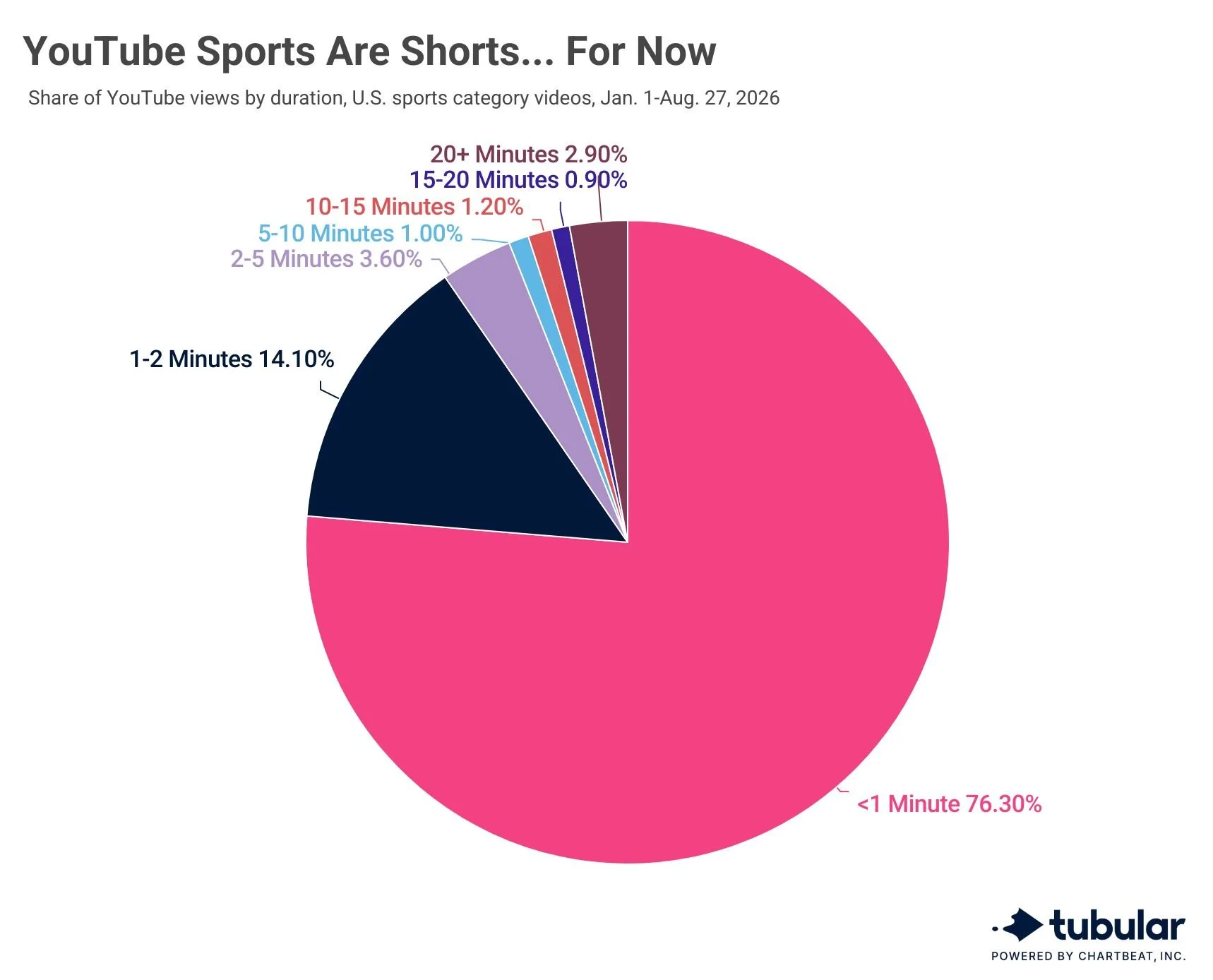
(via Chartbeat Inc.’s Tubular Labs)
Growing live viewing with longer content
“Highlight culture” is absolutely a thing in sports. But part of that comes from audiences not necessarily seeing YouTube as a place to get more than that from it. And as shown above, the content length and substance reinforces that idea.
However, it doesn’t have to be highlights alone that drive the bus.
YouTube has already experimented with aspects of longer-form sports viewing and live games in the past here, with the platform serving as the ultimate destination for the content audiences are most interested in: The events themselves.
Last year’s free-to-watch stream of the Kansas City Chiefs and Los Angeles Chargers week one NFL game drew a reported 18.5 million people. The 10-minute previews YouTube aired during the World Cup were a hit by all accounts, and at one point, YouTube’s official broadcast of the World Cup Final hit over 27 million concurrent viewers.
But those are one-off occasions, event-ized by their scarcity and uniqueness. Since audiences understand that, it doesn’t change their long-standing behaviors. Just what they’re doing for the one game.
Where that could change is if YouTube’s approach to live sports changes.
Thinking for months was that the platform was going to get a five-game live NFL package this year, but that deal fell apart late. Just because it didn’t work for 2026, though, doesn’t mean it won’t for future seasons.
Media consolidation and the squeeze around the sheer cost of sports rights in the U.S. also favor YouTube’s ability to add more live games, if they so choose.
MLB, MLS and NHL rights will be on the market in the coming years, and the NFL already wants to get back to the negotiating table on its deals. There are only so many networks and so much money to go around from traditional media. YouTube could be a landing spot for multiple sports properties trying to rethink distribution and appeal to younger audiences.
If that happens, YouTube is suddenly home to hundreds of hours of long-form sports content and is seen as the destination for the sports viewers are looking for, instead of the place where it’s clipped up for them.
Then there would be no ignoring the allure of YouTube for advertisers, who gain an influx of premium, live inventory they can better target as well. Much like what we’ve seen on SVOD platforms before (remember when Amazon Prime Video wasn’t a major player in TV advertising?), it’s sports that force behavioral changes.