YouTube Is TV. So Why Is Almost No One Buying It That Way?
Ask anyone in advertising today whether YouTube is TV, and you'll get the same answer: “obviously.” It's the most-watched platform on the television screen in the U.S. It carries the same premium, professionally produced programming brands have trusted for decades. Nielsen counts it as TV. Consumers watch it exactly like TV — sitting on the couch, screen in the living room, remote in hand. To be clear, this isn't about YouTube TV, Google's live-TV subscription replacement for traditional cable or satellite. It's about YouTube itself, the free, ad-supported platform where clipped TV moments and premium creators already live, and where most
TV-screen viewing actually happens.
And yet, when it comes time to actually carve out the ad budget, that consensus falls apart. YouTube still gets bought like a digital channel: chased on CPMs, planned in isolation from the rest of the TV buy, blind to the seasonal and tentpole moments that shift where its audience is, and optimized against whatever the algorithm finds easiest to deliver, instead of full-funnel outcomes that actually move the needle. The platform everyone agrees is television gets a media plan designed for search and display.
The scale is easy to see once you put the same top linear networks side by side. CNN draws roughly 550,000 primetime viewers on linear, but pulls in around 240 million monthly YouTube views.
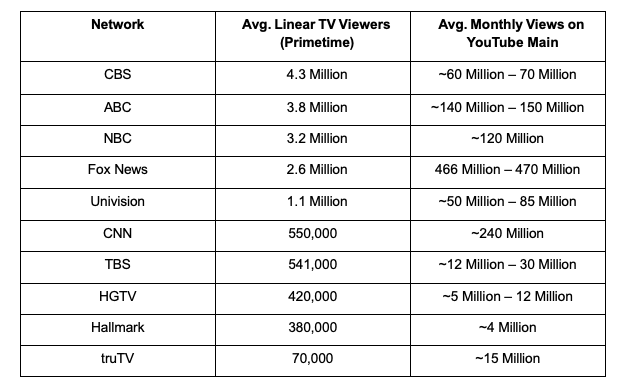
These are the same networks, the same brand-safe programming brands already trust, reaching a dramatically larger audience on YouTube than in the time slot advertisers are paying to be on TV.
Why the Disconnect Persists
Part of the disconnect is structural, and part is just habit. YouTube has historically lived in the "digital" line of the media plan, run by tools built for programmatic and Google buying, built to answer bidding and targeting questions. It's simpler to keep buying that way, through the same seats, KPIs, and reporting, than to rebuild the workflow, so brands leave reach and effectiveness on the table not for lack of opportunity, but because the infrastructure hasn't caught up.
Then there’s the structural factor of the platform itself. YouTube's business depends on supporting as broad a creator ecosystem as possible: every channel monetized, every category given a fair shot at discovery. That's good for creators and for YouTube's marketplace, but it isn't the same job as finding the brand-safe, premium inventory that fits a given advertiser. Left to the platform's own defaults, a plan optimizes for what keeps the ecosystem healthy, not what a specific brand needs — which is exactly why the buy has to be deliberate, not default.
If It Looks Like TV and Sounds Like TV…
Treating YouTube as television isn't a branding exercise. It starts with buying similar content that brands already trust, on YouTube, rather than treating the platform as an undifferentiated pool of inventory.
From there, it means planning YouTube alongside linear and CTV as part of one plan, not carving it off into a separate digital line item with its own budget and its own rules. It means developing a framework that looks across all metrics and doesn’t optimize to one KPI, but across many. Our own framework for buying YouTube judges a buy on whether people actually watched (video completion, not just a served impression), how it moved brand lift and product search, and its down-funnel conversion efficiency, the same standard we'd hold any linear or CTV buy to.
And it means planning around the calendar. Every experienced TV buyer times a flight around awards season, Back to School, the playoffs; YouTube has the same seasonal swings, but almost no one buys them. Take the Emmys: CBS's 2025 telecast hit a four-year ratings high, but the cultural moment increasingly lives in what follows, red carpet arrivals and highlight reels, consumed on YouTube by a bigger, longer-tailed audience than the one that watched live.
Buying it like TV means scouring those moments for fit, reading whether a target network gains or loses reach from one, and adjusting the buy accordingly.
The Proof Is in the Tactics That Win
At Tatari, this isn't theoretical. The tactics that consistently perform best for our clients share the same pattern: they buy YouTube's premium channels and programming directly, plan them with linear and CTV, and look at the results holistically, both reach and down-funnel performance, not one traded off for the other. The outcome is inventory that fits the brand, not some random inventory mix that an algorithm wagers is performant for your audience.
Every buyer in the market will tell you YouTube is TV. Very few are willing to rebuild their process to prove they believe it. That gap is exactly where the advantage sits right now, and it will close as more of the industry catches up. Until it does, the brands already buying YouTube like TV, or even a portion of it, are already getting more reach, better inventory, and lower costs than the ones still buying it the same way they did 10 years ago.
Download Tatari’s latest report: Lessons For Brands To Win The 2026 Holiday Season, From The Advertisers Already Doing It