This year’s World Cup is the largest yet, with 48 teams invited (up from 32 in the previous format).
And with the tournament taking place partly in the United States — along with neighboring Canada and Mexico — there’s real expectations that the event could set records for TV viewership stateside.
So there’s understandable focus on how the U.S. tunes in. But for many sponsor brands, that audience is just part of the larger equation as they’ve rolled out ads that aim to appeal to a truly global audience.
According to data from Tubular Labs, Spanish-language brands have been extremely active on YouTube going into the World Cup, accounting for nearly 40% of brand World Cup-related views this year.
Mexican-based accounts have also contributed three of the 10 most-watched brand World Cup videos (including No. 1, from AXE Mexico). Nearly all of the most-seen brand World Cup videos this year are from outside the U.S., and are not in English.
That doesn’t mean the U.S. has no place at the table, though.
Tubular show the U.S. accounts for the highest share of brand video views on YouTube, but at just 24.6% of the 2.3 billion total this year. The United States is followed by brands from Mexico, Vietnam, India and Argentina. And brands from 24 different countries have generated at least 1 million YouTube views around the World Cup so far this year.
The diversity of brands follows with the overall diversity of soccer/football fandom, which is what makes the World Cup such a unique event, and unique opportunity to create global connections with audiences.
For instance, this year, Tubular reveals that YouTube pages based in Brazil account for the most soccer/football-related views this year, at 22.1%, which makes sense for the soccer-mad, global soccer power.
But past Brazil, the U.S. is a close No. 2 (21.9%) and United Kingdom is No. 3 (8.5%). India, whose men’s team has never made the FIFA World Cup, is No. 7 at 3.7%.
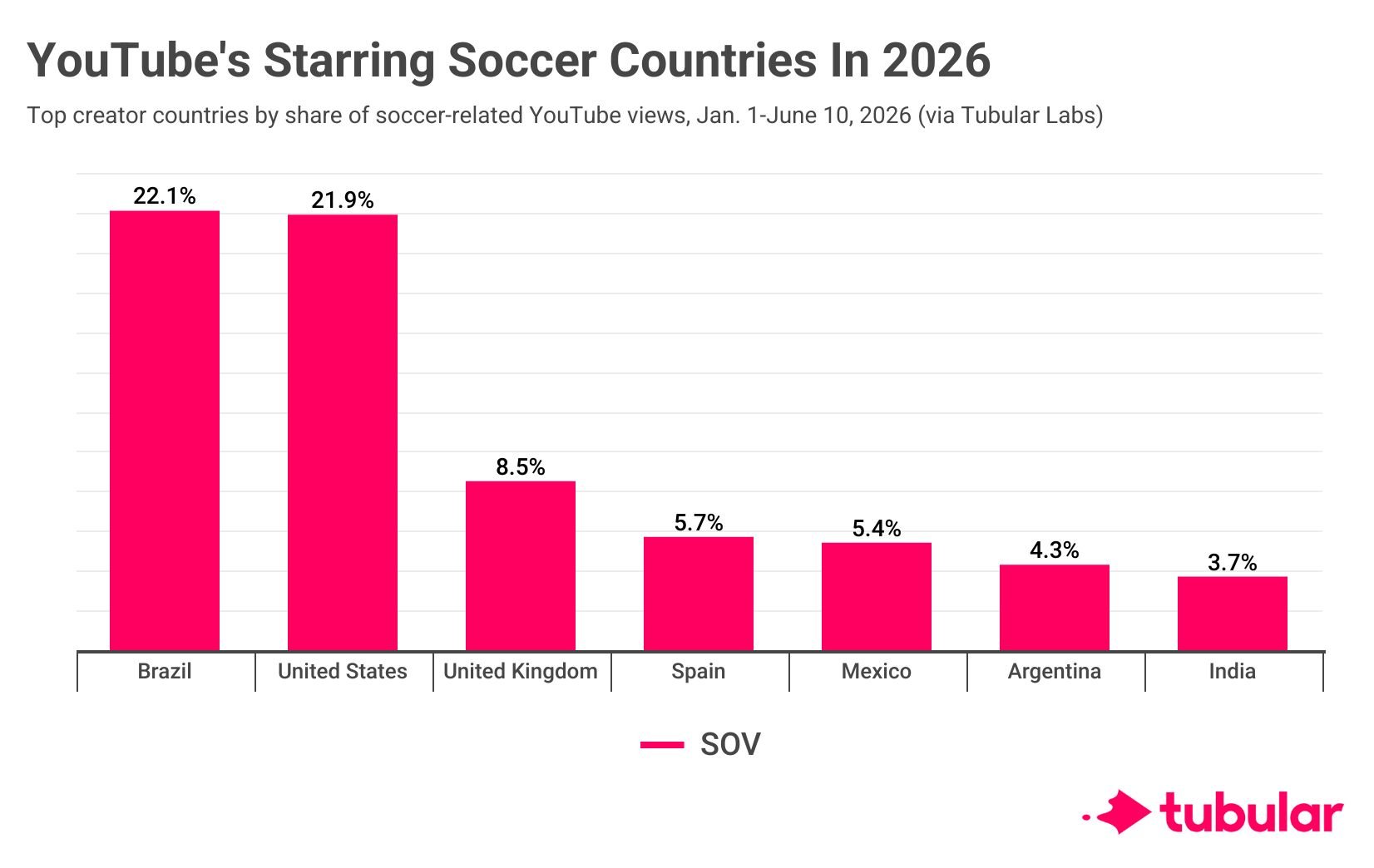
(via Tubular Labs)
Understanding the nature of soccer audiences and creators is key to effectively mobilizing around an event like the World Cup.
When advertisers are looking to do activate around an event like the Super Bowl, it’s a simple equation: Create traditional TV and social content that primarily speaks to the U.S. market. Some of that creative work can go abroad, for sure (XR: Extreme Reach data highlights that over the last several years those Super Bowl ads are distributed to an average of at least three countries).
The World Cup’s ability to appeal globally, though, via soccer’s (and the event’s) global audience increases the opportunity for brands to connect across borders.
This year’s World Cup spots from brands like Adidas, Nike and Michelob Ultra feature many players from numerous countries, and are effectively optimized for global distribution across YouTube and other digital platforms.
AXE, for instance, has already posted World Cup YouTube videos localized for four different countries (Mexico, Germany, Uruguay and Spain). PepsiCo has published soccer videos specific to audiences in Argentina, the United States, Mexico, Chile, Ecuador and Honduras.
Following the World Cup too, the engagement that brands are able to cultivate globally via soccer can continue to be nurtured. That may not be as easy without the excitement of the World Cup or the potential use of national soccer stars. But at least the tournament helps open the door for these global audiences in a way no other sporting event (including the Olympics) can.