Why The TV OS War Is Bigger Than The Streaming War
Not long ago, the television business had a relatively simple power structure. The networks made the content, the cable companies delivered it, and the manufacturers built the screens it all played on. Everyone knew their role. Everyone knew who was in charge.
That world is gone.
What's replaced it is something far more complicated: a fragmented media landscape where hundreds of streaming services compete for attention, where viewers toggle between apps, live TV, FAST channels, and YouTube, not to mention TikTok, Substack, Spotify, Twitch, Instagram and dozens of other platforms, and where the old gatekeepers, the cable bundle, the network schedule, the appointment viewing habit, have largely lost their grip.
At TVREV, we've been calling this moment Feudal Media: the fragmentation of the media monoculture into thousands of disconnected bubbles, each with its own celebrities, in-jokes, favorite brands, source of truth. All largely unaware of anything outside their bubble.
You may also just call it chaos.
In the middle of all this chaos sits something most consumers barely think about: the TV operating system.
The OS is the software layer that runs the smart TV. It is the home screen viewers see when they turn on the set, the interface that organizes their apps, the recommendation engine that tells them what to watch next, the ad platform that determines which brands get in front of them and how. It is, in short, the gatekeeper for the entire television experience.
And as television has fragmented, the OS has quietly become one of the most powerful and most valuable pieces of real estate in media.
That is because the TV OS now sits at the point where discovery, advertising and data all come together. It determines which streaming services get prominent placement and which get relegated to a back row. It decides which FAST channels are front and center and which get tucked away. It controls the ad inventory on the home screen, an increasingly valuable piece of real estate as viewers now spend more and more time there deciding what to watch. It collects valuable first-party data on viewing behavior via ACR on both streaming and linear. And it strongly influences, through its recommendation algorithms, what shows viewers are watching, a decision that translates directly into billions of dollars of content value.
The companies that control the OS understand all of this very well.
Which is why each has built their OS strategy around the same basic insight: whoever controls the interface controls the experience, and whoever controls the experience controls the money
Why It Matters
The TV OS matters because it does not merely organize the user’s experience. It prioritizes the various components of it.
It is the front door to television. It is the first thing viewers see when they turn on the set and, increasingly, it is where they begin their viewing journey. Sometimes that journey is direct: they know they want to watch Severance or the Knicks game or the latest episode of The White Lotus, and the OS just needs to get them there quickly.
But often it is not. Often they just want to watch something. And in that moment, the TV OS becomes enormously influential.
It decides which apps get top billing on the home screen and which are buried three rows down. It decides, often because someone paid for it, whether the viewer is greeted by a giant hero image from the OEM’s own FAST service, a recommendation from Netflix, YouTube, a live sports hub or an ad for a new truck. It decides whether discovery is built around apps, around shows, around channels, around genres or around whatever the OS owner most wants the viewer to engage with that day.
That may seem like a subtle distinction. It is not.
In a fragmented market, the company that controls discovery is in the proverbial catbird seat. If viewers have to actively seek something out, many of them won’t.
People are lazy, especially when it comes to TV. So they will watch whatever is in front of them. Or what looks familiar. Or whatever starts playing as soon as they turn on the TV.
It is also why the home screen has become such valuable real estate for advertisers.
What used to be little more than a menu is now premium inventory. There are promotional slots, sponsored placements, branded rows, recommendation units and all manner of opportunities to steer viewers toward one destination or another.
Mostly though, the home screen is attractive because it offers advertisers an opportunity to reach the user before they’ve started watching. So it feels less interruptive. For content owners, it creates a new form of gatekeeping: not whether they are available on the TV, but whether they are actually discoverable once they are.
And then there is FAST.
One of the biggest shifts over the past few years is that FAST is no longer just an app-based experience. On most OS platforms it has become native to the operating system itself, the centerpiece of the home screen, surfaced through a high-level guide, integrated into recommendations. That matters because it gives the OS owner even more influence over where viewers wind up. A FAST service that is deeply integrated into the OS has a very different strategic position than one that lives two clicks away inside an app.
It is also what makes the market so contested.
The old television gatekeepers controlled access through distribution. The new ones control it through the interface. And in a world where viewers are faced with an endless supply of content, controlling the interface is the power move.
The other major reason the TV OS has become so valuable is data.
The digital nature of streaming means that unlike broadcast TV, TV operating systems are able to collect a range of data on viewer behavior, data that is valuable to advertisers and programmers alike.
Viewers must, of course, consent to having their viewing monitored, but most do. Partly because of the promise of receiving better targeted advertising, partly because they want better recommendations and partly, TVREV has learned over the years, because they feel Google knows everything about them from their browser and so what do they care if their TV OS knows they like watching Monday Night Football, Industry and reruns of American Dad.
For advertisers, the data enables them to target users based on their full diet of television shows on both linear and streaming, which allows for better targeting and more relevant ads.
It can also help with frequency capping, giving the OEM a window into which ads a consumer has seen across both linear and streaming. And while overfrequency is still far from being solved, the ability to make use of all that ACR data helps make it less of a Code Red issue.
As TV becomes more measurable, TV advertising is now able to become a performance vehicle rather than just a branding vehicle. Which makes the data the OS collects even more valuable.
For programmers, the data has a similar value. It lets them know what content people are watching, which shows they’re spending the most time with. It gives them insight into viewing patterns: are most of their viewers on linear with only occasional forays into streaming or are they mostly on streaming? How are they finding the content—from a recommendation engine or are they going directly to it?
That helps programmers make more of the types of content that is working and also understand the makeup of the audiences who are interested in their shows and what else they are watching.
It’s why you often hear complaints about a lack of transparency from content owners—they need viewership data to make better decisions.
It is the power to share that data and to charge for the privilege of doing so that reaffirms the TV operating system's role as TV’s last gatekeeper.
For a while, the battle over the TV OS only seemed important in theory.
But as it assumes its role as TV’s primary gatekeeper and revenue driver, it’s become important in practice as well.
What You Need To Do About It
If you are a US-based media executive, understand that while the US market is pretty much tied up, the rest of the world is wide open. A recent study by Counterpoint estimated that 49% of the market is still not spoken for. Meaning there is a whole lot of opportunity out there and the winners are far from certain.
Understand too, that even within the US market, things like home screen ads and AI-based discovery tools are still shaking things up and so there is much for you to keep an eye on.
If you are in one of those non-US markets where competition for the TV OS is fierce, this is something you need to keep your eye on right now. Pay special attention to innovations that may impact consumers as well as advertisers and distributors, as they are the ones ultimately using (or not using) the OS.
If you are anyone in the industry, pay heed to V’s Guy Edri when he says that “TV is TV.” Meaning that the distinction between CTV and linear is an artificial one that may have made sense when streaming was new, but today’s consumers just see it all as “TV” and you should too.
If you’ve been wondering what is happening with shoppable TV, pay attention to this space. With Walmart’s acquisition of VIZIO and other operating systems launching their own shopping tools, the market is about to heat up.
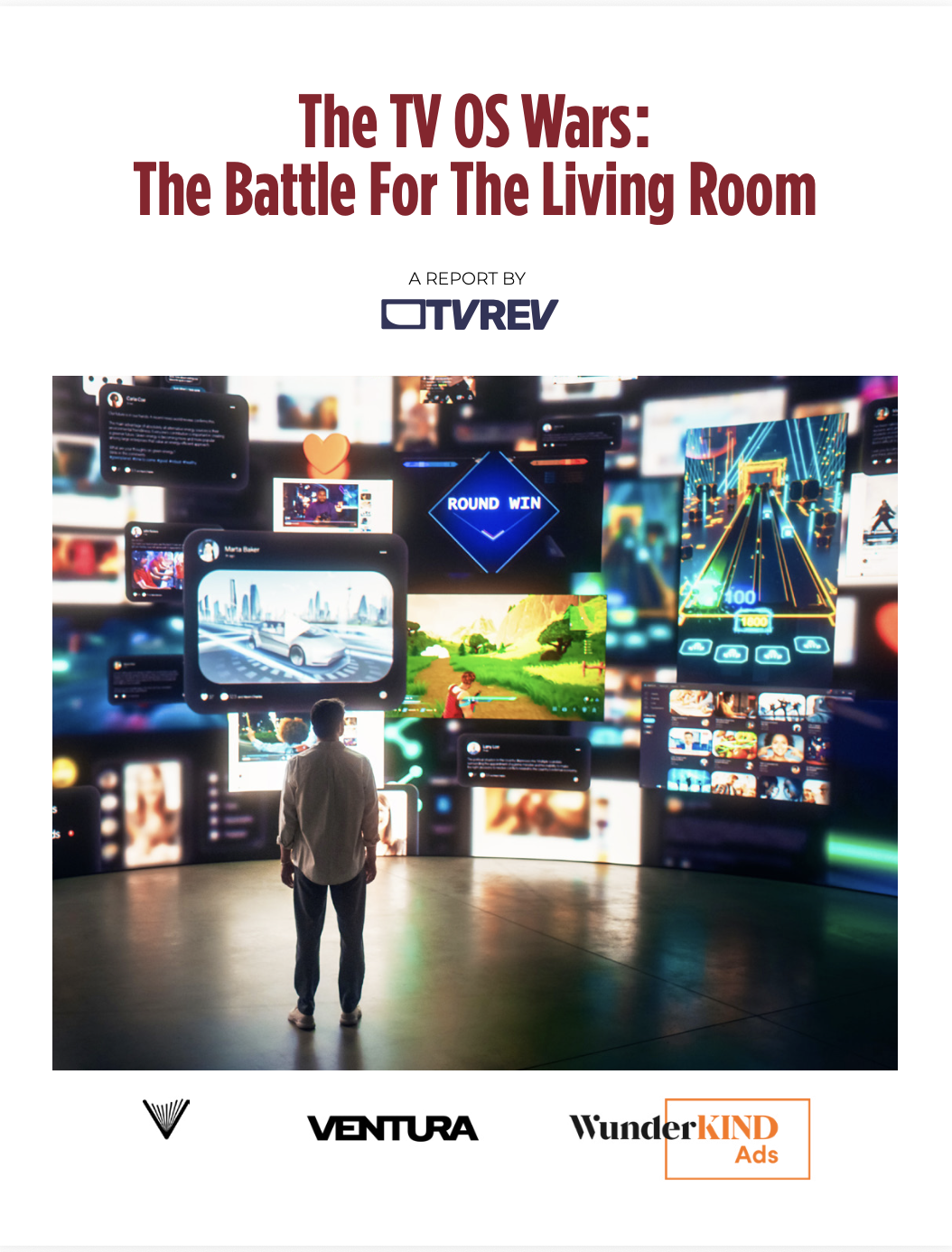
If you’re a curious person and you want to learn more about the TV OS in a report that is eminently readable without dumbing things down, allow us to present our latest TVREV Special Report: The TV OS Wars: The Battle For The Living Room.