Tube Trends: How YouTube Has Turned Itself Into a Sports Hub
At one point, social video was a distraction from live sports, with so-called “highlight culture” serving as a key reason why fans weren’t watching as many live games.
But times have changed. And now sports media partners and professional leagues have a better handle on how social video – and YouTube, particularly – can be utilized as an effective means for fan engagement and driving audiences toward more viewership.
In essence, YouTube has become a hub for sports content that can’t be ignored.
The NFL already has designs on making YouTube a larger part of its own strategy. But that’s just part of the platform’s larger evolution in recent years.
Growing Into A Sports Destination
YouTube’s sports content has ballooned in recent years as leagues, networks and streaming services embrace its reach capabilities.
Data from Tubular Labs showcases the immense growth sports has undergone on YouTube.
Globally, sports videos saw views grow from 1.2 trillion in 2024 to 1.7 trillion in 2025 (up 42% year-over-year). In the U.S., the increase was even larger, with 50.6% more sports video views year-over-year.
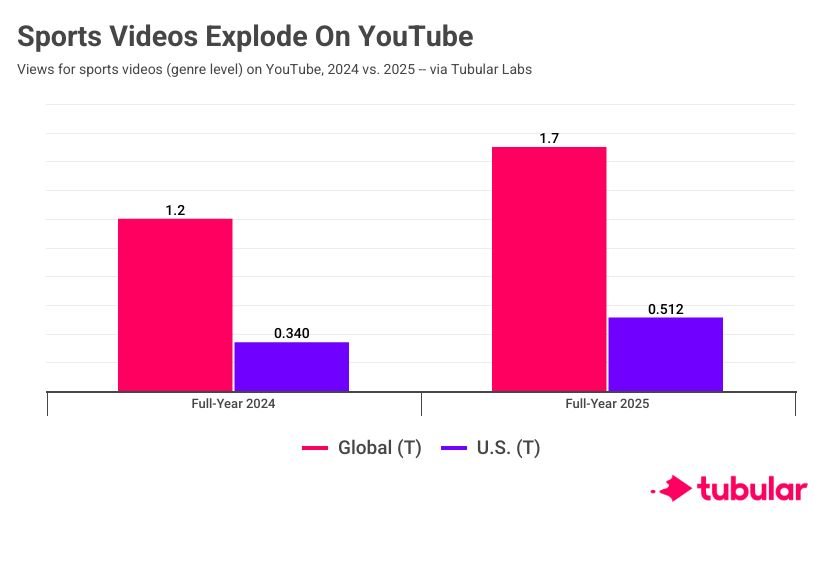
(via Tubular Labs)
That was due in part from increased investment from major sports entities. ESPN’s YouTube views grew by 19% year-over-year. The NFL was up 58%, while the NBA climbed 20%. Creator sports videos also soared by 56% globally year-over-year, opening up a burgeoning area for individuals to cash in on the continued sports content gold rush.
Shorts Supply
Given the prevalence of YouTube Shorts, it stands to reason that the impressive increases in sports content come from those shorter-length videos.
For 2024, Tubular data reveals that over 71% of global sports videos on YouTube stemmed from videos that ran for a minute or less. In 2025, that figure was up over 78%.
The emphasis on Shorts lowers the bar for sports creators (hence the increase in creator views year-over-year). But it also makes it harder for creators, leagues and media partners to cut through.
Traditional media and the leagues/teams themselves are also put into an unenviable position when it comes to short-format videos (and one that NBA commissioner Adam Silver touched upon last fall):
How do you keep up with these trends while not appearing disingenuous on digital platforms? (these are more polished, billion-dollar business after all)
How do you balance being “always on” with short content while still encouraging your fans to watch the games themselves?
For teams that are constantly sharing Shorts highlights from the most recent (or current) game, it does sort of play right into the narrative that younger audiences watch sports in bite-sized increments. And the more teams and leagues – and the creators they partner with – produce this sort of content, the more true it becomes.
The counterpoint, however, is that avoiding sharing from an official team or media account just means someone else will. So might as well own that audience instead of giving it to another creator.
SportsCenter may have created highlight culture. But what the dynamics around highlights have transformed into is always on and no longer requires the full-game context. That’s the big challenge for traditional entities as they attempt to keep up with digital-native peers, despite clear advantages when it comes to the actual rights to the game clips.
Marrying Traditional Sports To The New Way Of Consuming Content
The tightrope YouTube is now walking comes via balancing these new, Shorts-focused dynamics and its aspirations as a larger media company that needs longer-form content to keep audiences and advertisers engaged.
YouTube has already aired a live NFL game (last year’s Chargers vs. Chiefs contest from Brazil), and could potentially add more games for the 2026 season if it buys up the league’s five additional games that it’s been shopping for months.
The platform’s vMVPD service, YouTube TV, also houses NFL Sunday Ticket – unrelated in terms of highlights and games airing for free on YouTube proper, but not in terms of generating brand association.
As covered previously in this space, YouTube’s Sunday Ticket deal likely helps spur these free-on-YouTube experiments. The NFL’s increased investment in content on the platform probably comes with that as well.
Because the successful merging of behaviors – game viewing and highlights – would hinge on YouTube and the league blurring the lines between them as separate ideas. If they do it successfully, it’s hard not to see YouTube as the successor to the current TV environment.