As The NFL Returns, Its TV Ad Impact Remains Unmatched
The NFL season is nearly underway, answering the prayers of TV executives, advertisers and football fans everywhere.
Because the return of the NFL means the return of huge audiences and ad reach, escalating TV ad revenues, and importantly, business outcomes at scale for brands — as iSpot details extensively in its new (free) report, The Unified NFL TV & Video Ad Playbook.
The NFL’s Big Footprint
Over the course of 2024, the NFL accounted for 3.28% of all household TV ad impressions, making it the No. 1 program, according to iSpot. Even more impressively during the season, the league delivered 23.22% of TV ad reach across the Big 4 broadcast networks; this despite going up against other live sports, an election year and new primetime programming in Q4 last year.
That reach amounted to dollars as well. NFL games across ABC, CBS, Fox and NBC combined for $6.76 billion in est. national linear TV ad spend from week one through the Super Bowl. NFL games aired nearly 30K ads during that time, amounting to over 11K minutes of advertising.
Where that extensive reach matters even more is when it comes to business outcomes.
Any program or network generating outcomes for advertisers is valuable. But it’s even more meaningful at the scale networks see during the NFL season.
During Q4 2024 — where Big 4 networks lean most heavily on the NFL — iSpot shows significant lift for key industries that advertise during games. On NBC, wireless carriers saw an average seven-day lift of 41.79%, while insurance brands enjoyed 37.88% lift on CBS. Food delivery brands (many of which are aiming for immediate conversions) saw lift of 29.76%.
While the price tag to advertise during NFL games is high. You could argue that outcomes like those make it much more palatable.
Star Power Behind NFL Ads
Ads during NFL games are full of celebrity endorsers, and especially current/former players.
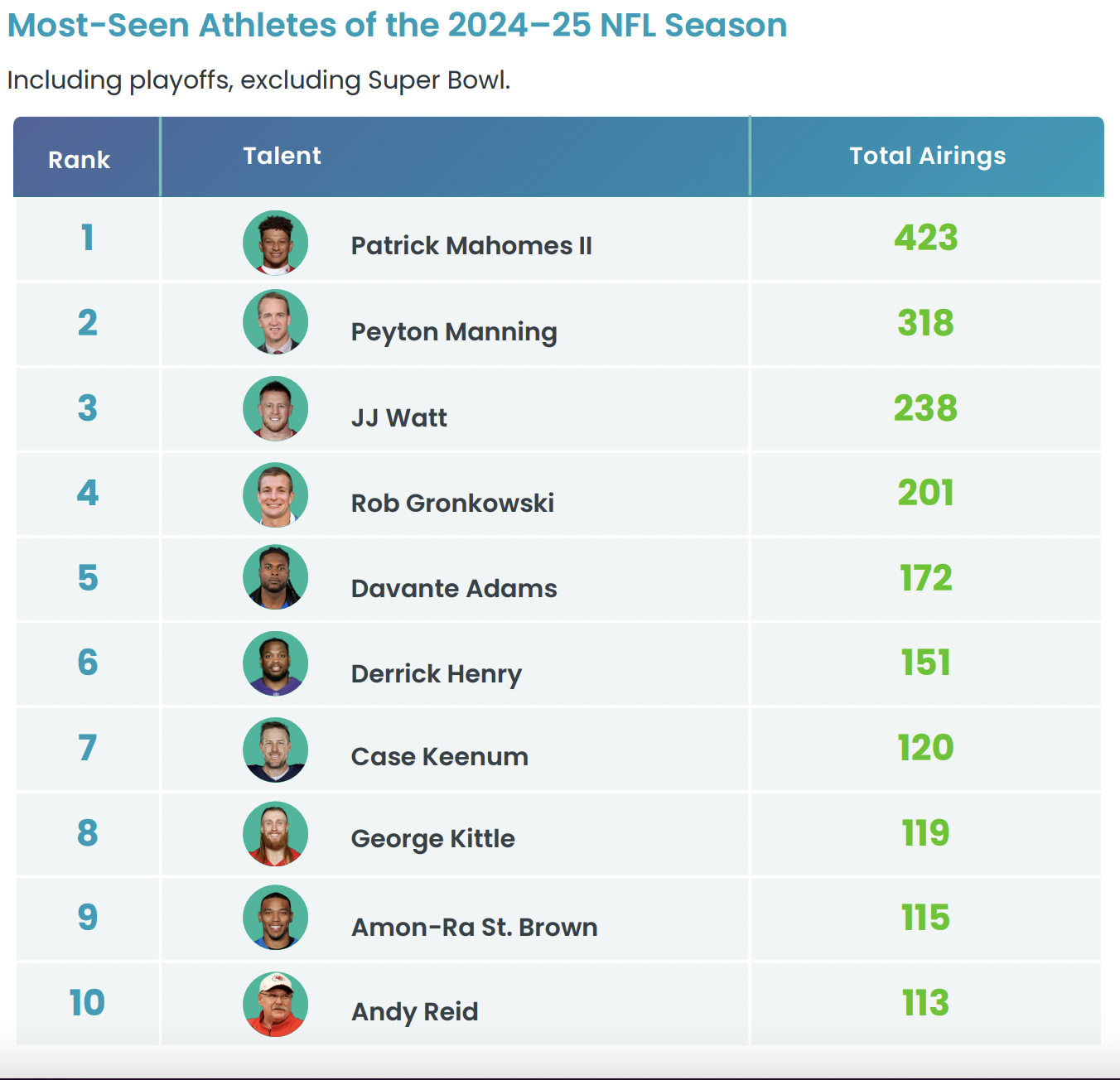
Kansas City Chiefs quarterback Patrick Mahomes was the league’s dominant ad face, with 423 ad airings during NFL games prior to the Super Bowl — 100 more than the nearest competitor. He was also one of just two current players in the top five (the other being Davante Adams). The rest were retired stars and seasoned pitchmen like Peyton Manning, Rob Gronkowski and J.J. Watt.
Perhaps more surprising than Mahomes leading the way again was Travis Kelce not being present among the top 10. Taylor Swift’s fiancee was just outside with 99 airings, trailing his coach Andy Reid, who had 113.
Not all brands leaned into NFL players for spots during games, though. Kevin MIles (Jake From State Farm) appeared more than any one person not named Mahomes, while the GEICO Gecko appeared more times than Gronk.
Players were still helpful when it came to ad likability and generating intent-to-purhcase, though.
iSpot data shows that every one of the five most likeable NFL sponsor ads last season featured a current/former NFL player or coach. The same was true of four of the top five ads by highest positive purchase intent — and the fifth, from JCPenney, had Gabrielle Union, Martha Stewart and Shaquille O’Neal.
NFL Ads Are Great, But Be Wary of Blowouts
Significantly, iSpot also points out that while NFL games are great at delivering high reach for the money, there’s significant risk for lopsided contests shedding audience. And that means advertisers not getting what they paid for when it comes to ad exposure.
In one particular primetime NFL example from the past couple years, ads that ran from the 14th pod on fell short of the game’s average-minute audience by a combined 209 million TV ad impressions as viewers fled the blowout. That under-delivery hit 18 different advertisers (36% of the total that appeared during the game) particularly hard, as those ONLY appeared in those later pods.
Highlighting where blowouts can blow up for brands isn’t to say NFL games aren’t worth the money, either. It goes the other way as well, as competitive games can lead to late-game surges that outperform averages that ads are bought and sold on. Rather, it speaks to the strength of second-by-second ad measurement to make sure both networks and brands are making the most out of that NFL (or other live sports) inventory.
Given how essential the league is to TV, it seems like a no-brainer to maximize its value, for all parties involved.