Tube Trends: What The Oscars Moving To YouTube Means
Wednesday’s news that the Oscars will move to YouTube — from ABC — starting in 2029 is a huge shift for the event. And a bit of a concession that broadcast networks (and linear networks overall) have lost the war for TV.
Throughout 2025, YouTube has been telling the industry that it is taking over TV devices. Tubular Labs watch-time data from this spring showed that TV accounted for 42% of YouTube minutes watched. And the NFL believes in YouTube so much that it gave the platform a standalone Friday night game in week one this season, to air for free to audiences.
There has been no indication just yet that similar free game streams will be the norm. But the fact that the NFL went that route over a paid streaming partner or its own service (NFL+) shows that it very much understands the long-game here.
YouTube, eventually, will likely supplant much of what we consider “TV” to be today. And everyone from advertisers, to networks, creators and pro sports leagues, will need to adapt or perish.
The Oscars are no exception to this clash between traditional media and digital consumption.
Movie studios have found the post-COVID landscape to be a difficult one on just about every front — including the ability to put on an Oscars broadcast that has broad enough appeal for a large TV audience. Part of that comes from growing U.S. viewership shifts along political lines, but another is the simple fact that there aren’t enough people seeing many of the movies covering the Oscars to drive award show tune-in.
Having YouTube air the Oscars won’t necessarily fix those problems. But it will at least address the issue of availability, putting the award show front-and-center for the millions of households that use YouTube as a sub for traditional TV.
It’s also putting the show on a platform where there’s an active conversation already in progress around the Oscars year-round.
Data from Tubular shows that videos about the Oscars have generated 1.8 billion views this year alone. And while nearly 400 million views occurred in March 2025, when the event took place, that still means another 1.4 billion were spread across the rest of the year. And the Oscars have averaged well over 100 million views per month during the second half of this year, despite the event not happening until next year.
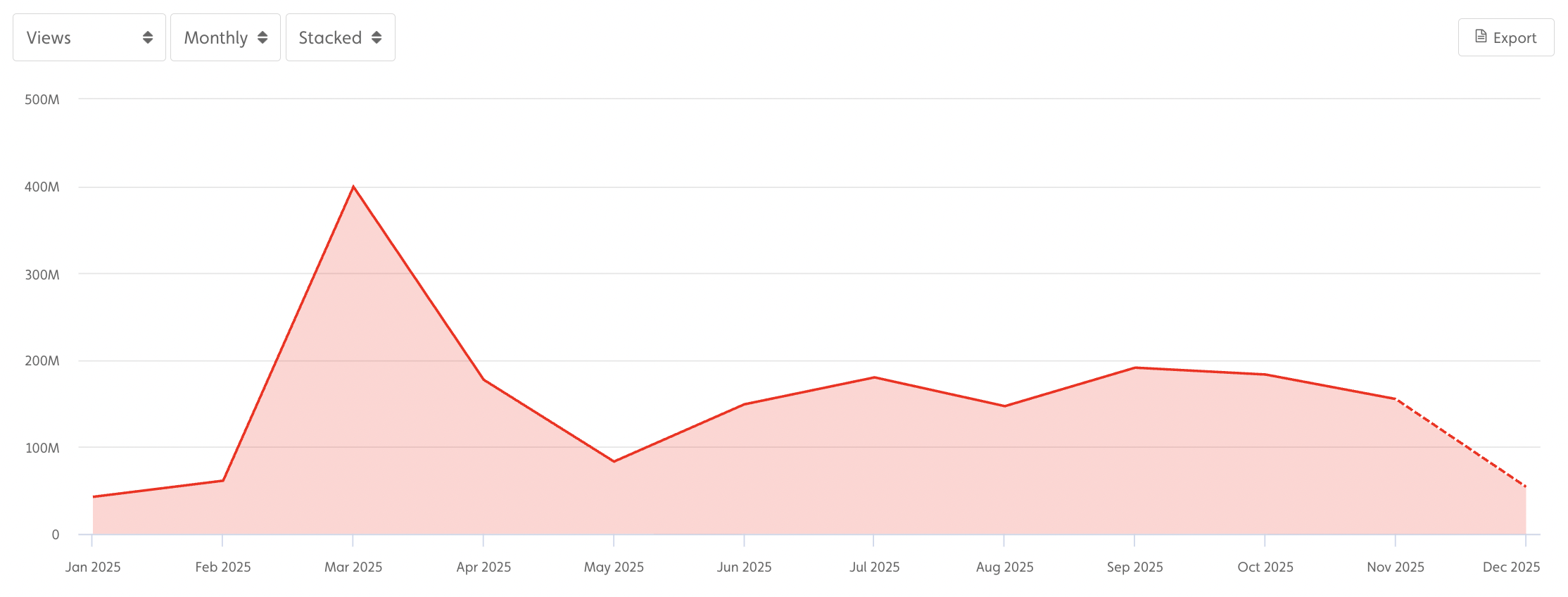
(Oscars-related YouTube views, via Tubular Labs)
What It All Means
Having the Oscars available for free, in a central place where everyone understands it is — something they’ll need to use ad promos to do — is a win for the show, even vs. a broadcast channel like ABC.
Pew Research from earlier this year showed that over 90% of U.S. adults 18-to-49 years old use YouTube. And 73% of teens 13-to-17 years old use it daily.
Assuming YouTube promotes the show accordingly on its platform and traditional TV, that’s a large number of viewers who will at least have some passing awareness that the Oscars are appearing on YouTube. And many of those people (especially the teen group) who may not have even watched the event otherwise had YouTube — their primary source of TV — not told them to watch on that platform.
It also recreates the “water cooler” moment for the Oscars, when it’s had a limited number of them in recent years — save for the incidents it would rather never happened like Will Smith’s slap and the Moonlight/La La Land fiasco. But instead of audiences being united around seeing the unfortunately surprising moment, they would be united around all watching what happened at the same time again.
While the Oscars’ move to YouTube is still several years out, even the fact that it’s happening can also help fuel similar moves for other events struggling to gain enough traction on traditional TV.
Award shows are the prime example of something that could soon move exclusively to streaming environments — be they YouTube, FASTs or SVOD/AVOD — because they’re high-profile single events that don’t require as much longer-term investment on the part of the streamer, and can drive sign-ups.
The Oscars are the biggest fish there, and one of the last award shows to actually make the shift. But along with the NFL, they’re also among the loudest properties to show a willingness to make a change as drastic as this one.
If it really means anything long-term, beyond award shows, those signs probably come from more sports carve-outs for YouTube from bigger leagues — or smaller leagues’ complete moves to YouTube as a way to maximize reach (something that may already be in progress with Mark Goldridge’s Bundesliga UK streaming deal).
The genie is out of the bottle, though. And YouTube stands to win big as a result.