Most Efficient, Most Volatile, Most Fragile: A Genre-By-Genre Look At Conversion

If the people in my life know one thing about me, it’s that I love random fun facts. Whether it’s to their fascination or complete annoyance (usually the latter), I’m prone to spouting off tidbits both relevant and entirely tangential. Are these helpful or practical? It depends. At first glance, finishing an article about divergent evolution — when related species develop different traits — didn’t seem to offer much real-world application. But as usual, my brain immediately started mapping the concept onto the entertainment industry.
Film genres all fall under the larger umbrella of movie entertainment, but do they behave differently when you examine how audiences respond to them? A recent Greenlight Analytics study of mine looked at 36 recent theatrical titles (12 comedy, 12 romance, 12 horror) in the final month of marketing before release, analyzing audience Awareness, Interest, Theatrical Intent, and conversion efficiency. Much like the animal kingdom, each genre revealed its own evolutionary advantages and vulnerabilities.
Comedy is the most consistent genre late in a campaign. Horror is the most efficient at converting awareness into intent. Romance is the most fragile, prone to weakening late-cycle shifts. And each offers practical takeaways.
Awareness
Though comedy (+12%), horror (+11%), and romance (+9%) all enjoyed similar Awareness lifts in the final four weeks pre-release, the timing of their surges proved more revealing. All 12 romance films hit peak Awareness within one week of release or on release day. Horror was similar, with 10.5 films doing the same (the “.5” reflects one title that briefly peaked earlier but matched its peak again at release). Comedy, however, saw only 7.5 films peak that late.
This suggests romance and horror rely heavily on late-cycle pushes, while comedy campaigns need to be built earlier. That’s notable for a genre that has struggled at the box office; comedy is less dependent on last-minute blitzes. Awareness also plays a major role in downstream value when titles hit VOD and streaming. As we’ve seen repeatedly, movies that underperform theatrically can still become heavy engagement drivers thanks to pre-existing familiarity.
Interest
Average change in Interest was once again close between comedy (+5%), horror (+4%), and romance (+3%). But Interest Among Aware audiences told a different story: comedy (+10%), horror (+6%), romance (-4%).
Romance was the most vulnerable to overexposure. When Awareness goes up but Interest drops, you have a problem. Conversely, comedy’s appeal improves among those already aware of it (which also bodes well for at-home viewing). And horror was more volatile than expected: five films generated negative Interest Among Aware movement, while five posted double-digit gains. This suggests the genre is highly sensitive to marketing, reviews, and buzz (RIP, M3gan 2.0).
Theatrical Intent
Theatrical Intent — audiences planning to see a film in theaters — shifted similarly across comedy (+5%), romance (+4%), and horror (+4%) during the final month. Horror (9.5 films) and comedy (8 films) were more backloaded, hitting peak Intent in the final week or on release day, compared to romance (7 films).
Given the communal nature of horror, it’s unsurprising that its intent is the closest-in and tied to reviews and social buzz that build urgency. Comedy’s intent growth is steady and predictable. Romance remains softer late, relying more on programming and positioning (hello, It Ends With Us) than hype.
Conversion Efficiency
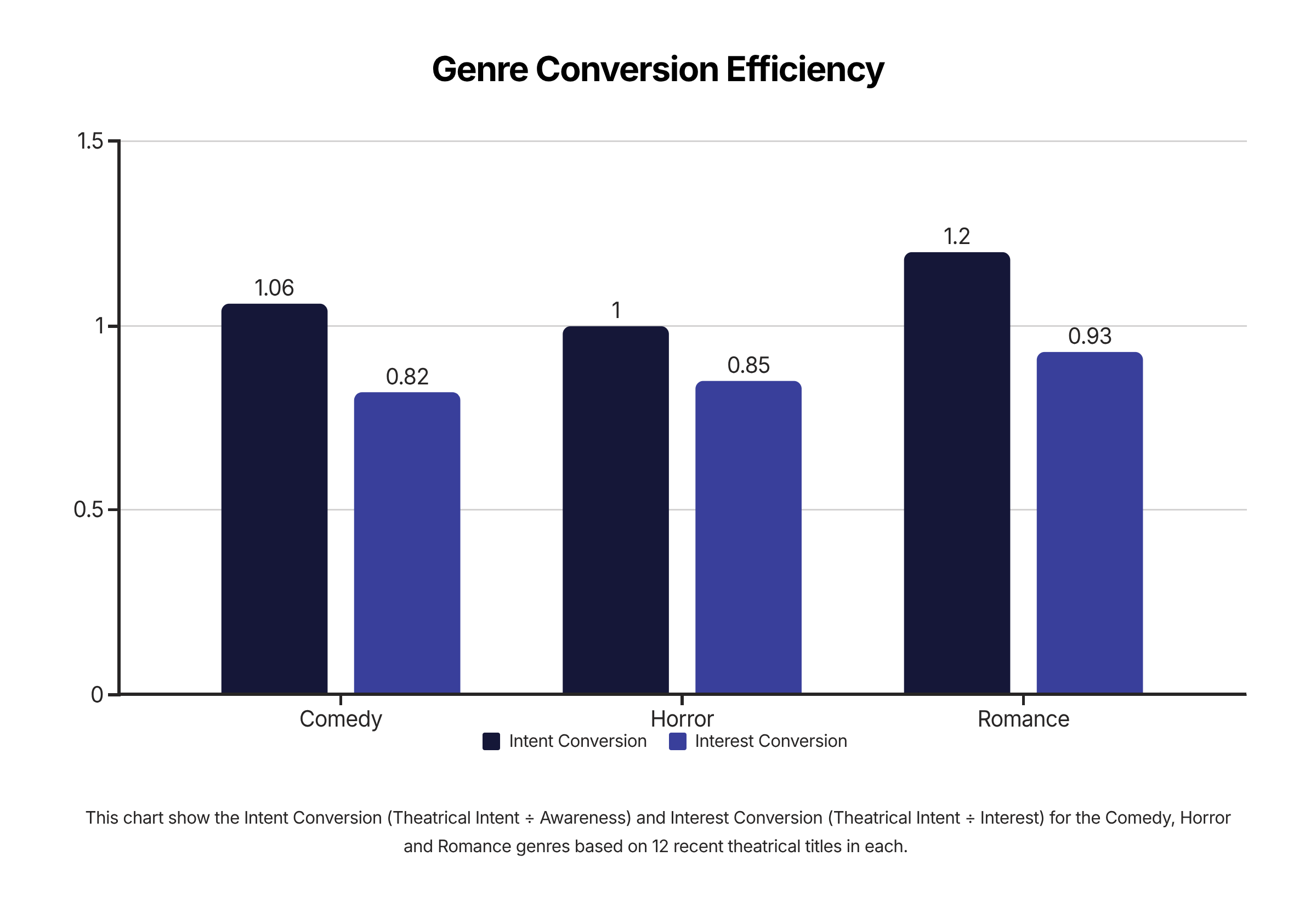
Intent Conversion is found by dividing Theatrical Intent by Awareness, and Interest Conversion by dividing Theatrical Intent by Interest. Ratios closer to 1.0 indicate more efficient activation — the audience sees the marketing, likes what they see, and decides to buy a ticket.
Horror (1.0) posted the strongest Intent Conversion, ahead of comedy (1.06) and romance (1.2), meaning horror marketing most efficiently converts awareness into planned ticket sales. Romance can generate solid Awareness, but struggles to consistently convert those audience members, which is often a sign of promotional under-activation.
Yet romance (0.93) leads both horror (0.85) and comedy (0.82) in Interest Conversion. Once someone is interested in a romance film, they’re more likely to want to see it in theaters than comedy or horror fans. The challenge is sustaining that interest long enough to get their money.
So what does this tell us about the divergent evolution of these genres?
Horror is the most efficient but contends with streaky Interest Among Aware swings. Even so, its strong late-cycle intent peaks and multicultural appeal give it a high ROI floor. Romance suffers from the worst late-cycle movement, making it the most likely to oversaturate and lose audience enthusiasm. But when hits emerge, they often overperform thanks to underserved female audiences and stronger Interest-to-Intent conversion. Comedy is the most consistent across all metrics, offering predictable stability even as it hopes to punch through a limited ceiling.
Now go forth and use these insights to both intrigue and bore the people in your life!