Major League Baseball’s short-term TV future remains in flux, as is the impending labor issue due in December 2026. But the league is still considering radical changes to build a bigger, better national TV product when its media rights contracts expire in 2028.
League commissioner Rob Manfred spoke on-air with ESPN this Sunday, covering a range of topics. Among the bigger items to make headlines: Expansion and resulting realignment of the sport’s divisions.
“I think if we expand, it provides us with an opportunity to geographically realign,” said Manfred. “I think we could save a lot of wear and tear on our players in terms of travel. And I think our postseason format would be even more appealing for entities like ESPN, because you’d be playing out of the East and out of the West.”
… Perhaps I’m just reading too much between the lines, but that certainly sounds like there’s something still in the works between ESPN and MLB for game rights from 2026-28.
On the realignment front, though, this strongly suggests that you’ll see one of a couple possibilities play out:
Geographic realignment within the existing American League and National League structures (and a possible divisional playoff format akin to the NHL’s).
Completely scrapping the century-old AL/NL divide in favor of the sort of Eastern/Western conference split that the NHL and NBA already have in place.
Here’s what those could look like, for those that would prefer the visual:
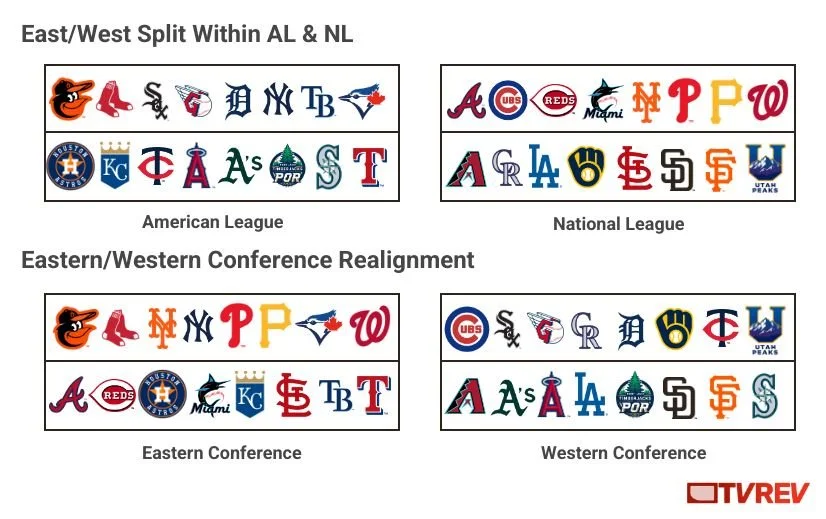
In the interview, Manfred mentions gaps when it comes to West Coast (10 p.m. ET) timeslots, so the fictional teams included above — in Utah and Portland — are reflective of the desire to fill more of that inventory. Having a full “Pacific Division” in the second option above provides the league and its TV partners anywhere from four to eight Pacific Time primetime starts during any given game day. Currently, that number’s not much lower, but league and divisional schedule splits also create a lot more games outside of Pacific Time for West Coast teams.
Counterintuitively, where these regional hubs help most is potentially with regard to MLB’s national TV product.
Right now, the national TV deal is split several ways. ESPN is in the final year of its current deal after opting out for 2026-28. Fox and Warner Bros. Discovery are in through 2028. Apple TV+ and Roku have carve-outs as well that run through 2028.
By having clearly defined geographic windows, more West Coast teams and a greater emphasis on rivalries via divisional play, it may also help split these packages up in a way that resembles what the Big Ten does across Fox, CBS and NBC, with each having a specific section of the Saturday schedule.
With games every day from April through September, this sort of package would be a larger entity, for sure. But you could envision a reworked MLB media rights deal that sees national games every day in multiple time slots, and always utilizing marquee matchups to an extent.
It’s not that you can’t get people outside of those fan bases to watch Marlins at Angels. But it certainly would be easier if those Marlins/Angels games were significantly outweighed on the calendar by the number of Angels clashes with the Dodgers, Giants, Athletics, Padres and others that create stronger regional branding.
Because that’s arguably where MLB has faltered in the 20-plus years of regional sports network hegemony.
While the league has become more regional, it’s susequently become more local. Its 30 distinct spheres of RSN influence and a declining number of games against regional foes (the imbalanced schedule and periodic interleague play was replaced a few years ago) arguably lending to more fans solely interested in their own team over their respective league or division.
Whether expansion is viable right now is up for debate, but will be ironed out by whatever happens with the collective bargaining agreement negotiations.
So assuming that happens (likely), the next question is how many different ways MLB can split this pie.
An ideal setup is four partners (interested parties now include a minimum of Fox, WBD, ESPN, NBC, Apple TV+, Amazon Prime Video, Netflix, Roku), with East and West primetime slots Monday through Friday, three games on Saturdays, and then an evening showcase on Sunday.
With that sort of deal, the league could partition out those 14 weekly games in a way to eventize all of them (unlike now when there’s limited fanfare beyond Sunday Night Baseball), offering.
When it comes to the league’s major complaint with ESPN, that it wasn’t getting enough shine on its product in recent years, this would conceivably fix a lot of that — even if across multiple networks and streaming services.
There’s no magic bullet here for MLB. And all of this has to coincide with whatever creative solution(s) it comes up with to solve for the RSN issue. But Manfred has put a stake in the ground on change throughout his tenure. And it seems like his final acts as commissioner may wind up ushering in the biggest — and most financially impactful — of all.