Tube Trends: Disney's Short-Form Focus Puts Spotlight On Owned Video
The Walt Disney Company is one of the most prolific long-form video storytelling entities in the the world, and has been for over a half-a-century. Acknowledging that, though, the company will be increasing its streaming emphasis on vertical video.
One of the larger announcements at CES last week was the fact that Disney+ would be adding vertical videos in an effort to compete with digital platforms’ daily engagement.
However, Disney Entertainment and ESPN EVP of Product Management Erin Teague told Deadline that these would not be teasers for longer content. But instead be enhanced, new programming for the service.
ESPN’s standalone streaming app already launched with “Verts” as a key content offering that’s not just top-of-funnel, but aimed at delivering snackable highlights. The vertical video feature that will be added to Disney+ later this year is supposed to be its own unique content as well (though some may wind up being clips and edits refashioned for vertical video instead).
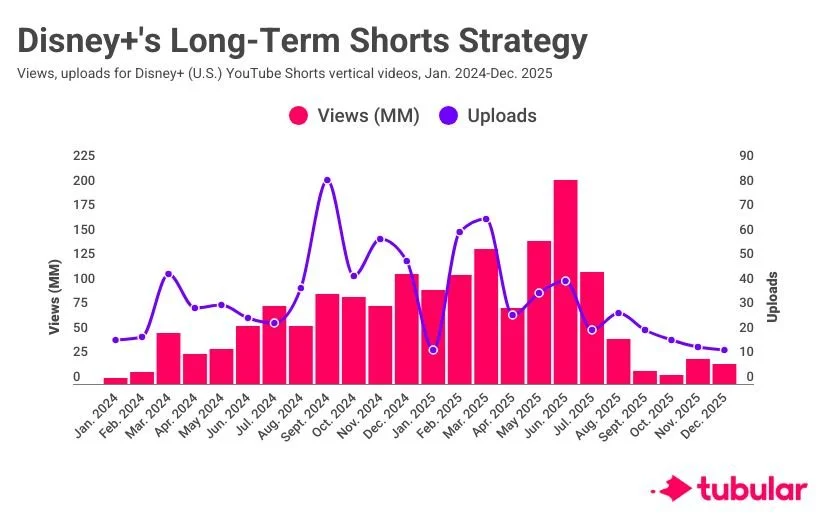
Data from Tubular Labs shows that in the U.S., Disney+ has uploaded 843 YouTube Shorts since the start of January 2024 — amounting to 1.7 billion views. Those numbers have seemingly trailed off lately, perhaps (your author’s opinion) helping prep audience behaviors to seek these sorts of videos on Disney’s owned properties.
(via Tubular Labs)
Still, Shorts did account for 68% of Disney+’s (U.S. channel only) YouTube views in the timeframe. Even while not utilizing Shorts much beyond teasers into longer-form content off-platform, the service still has a credible sample size to make decisions from here.
One particular finding just from looking at the chart above: At the high end, high uploads didn’t necessarily equate directly to higher view counts — and vice versa.
Understanding how views and video volume are related (paid videos aside, of course) allows streamers like Disney+ to gain valuable insights on social platform engagement and behavhiors that can then be applied on owned channels.
It’s somewhat of a trend for 2026 already, really. Disney hasn’t announced any sort of intention to leave YouTube or other social platforms. However, if they’re trying to boost engagement and viewership with vertical videos on their own streaming app (Disney+), why would they go out of their way to publish similar content on YouTube, where audiences can watch those videos without paying Disney to do so?
There is a similar question coming for the podcast industry, too.
As Spotify podcasts start hitting Netflix early this year, there’s limited value for both parties to post those episodes on social platforms as well, beyond using them as engines to drive tune-in.
Many podcasts — from Spotify and others — have posted lengthy clips and even full episodes on YouTube in recent years in an attempt to go to where their audience seems to be (the largest video site in the world).
But if a large streaming service like Netflix (or Disney or Amazon) is willing to pay to house the video versions of these podcasts exclusively, then it’s accomplishing something similar while making more money for the podcast owners — and potentially providing these podcasts and their parent companies with more audience insights which they possess.
Moves like these aren’t going to kill off the value of social platforms, though.
Rather, it puts a greater emphasis on the value of owning audience data; something that YouTube and other platforms can also leverage with creators in an attempt to build (and rebuild) their own lanes of content exclusivity.
Social’s pitch, too, is global reach and the ability to keep users on-platform from initial Shorts viewing to longer-form tune-in.
The success of Disney’s short-form shift will be educational on where things go next across streaming. If it works for their audience, we could be seeing even more short-form silos pop up around the streaming landscape as media companies try to maintain the content ownership they still have.