Tube Trends: Despite Competition, Retail Still Gets Best YouTube Reach In Q4
YouTube has numerous differences with traditional TV. But also significant similarities as well — especially when it comes to how brands can leverage the platform at key times of year.
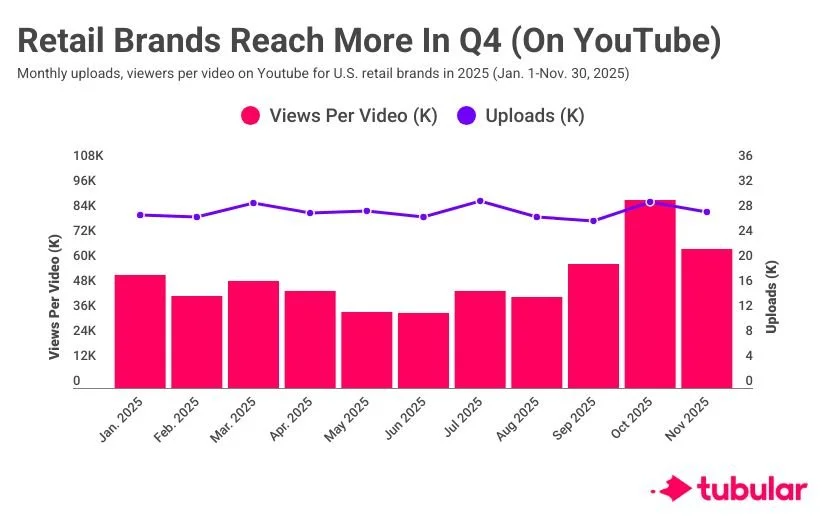
Data from Tubular Labs details how Q4 is still prime time for retail brands to generate reach on YouTube, despite the immense competition for eyeballs as holiday shopping season ratchets up (much as it is on traditional TV).
(via Tubular Labs)
Reach Soars In Q4
In the chart above, October shows brands getting particularly strong viewership per upload despite a limited jump in the number of videos from these retail brands (October wasn’t even the biggest month of the year). And while this can be influenced by paid engagements in many cases, it still shows how YouTube can work as a targeted reach vehicle for these brands late in the year.
From a volume perspective, that October spike is 90.4K views per upload, amounting to 2.7 billion views total (on 29.8K uploads). A good deal of it is fueled by major advertisers in the category as well, as they spent the month both capitalizing on Halloween, while also getting ahead of holiday shopping.
Kohl’s was the No. 1 U.S. retail brand for the month by YouTube views, with 435 million, followed by Walmart (210 million views), Nordstrom Rack (157 million) and Michaels Stores (147 million) leading the way. Those brands alone account for about a third of the views included here, and all significantly grew their October YouTube views year-over-year.
Opportunities Remain
While the story here is a positive one for retail brands trying to get on consumers’ radars during a key part of the calendar, the data provides learnings for new improvements as well.
Though reach was enormous for these retailers in October, engagement was not in most cases — another sign of probable ad spend on many of these uploads.
This is where creator marketing can play a role in further building reach beyond what audiences can see as simple “ads” and turn them into greater expereinces on a more personal level.
For its own approach, Kohl’s embraced aspects of creator partnership, and saw far more engagement in October than competitors on its videos. Leaning into creators can also take various forms, and some of that engagement will occur away from brand social channels — with the hopes of spurring sales activities directly from those posts. For the data presented here, those posts are not included. But we can get an idea of the success of those posts by digging into sponsored video results.
From Oct. 1-Nov. 26, U.S. retailer brands sponsored 1,257 YouTube videos, amounting to 143 million views (per Tubular Labs) and 5 million engagements. But just like the brands’ own posts, upload volume didn’t correlate directly to how many viewers engaged with the YouTube content. Below are the top five retailers by volume of videos in the timeframe:

But results look a bit different when sorting by engagement instead. Helix Sleep is still on top. But the rest of the top five shift around, with Helix followed by Quince, ThredUp, WhatNot and Upside.
Much as TV can be utilized as a vehicle for both broad reach and targeted outreach toward more engaged audiences, the same is true on YouTube for retail brands. For many, the brand-owned pages can function as broad reach, with ad buys targeting them toward likely buyers, but not necessarily engaged audiences. The creator partnerships are what function as the buys to get in front of engaged viewers who may be more probable to take a sales-related action (like visiting a website).
As retailers respond to a rapidly evolving shopping ecosystem, how they use YouTube (and other social video platforms) this holiday shopping season could prove to be a crtical pivot for the industry.