The dust has (mostly) settled on Election Night 2026. And along with the obvious takeaways around Democrats winning resounding control of both the Senate and House of Representatives (plus governor’s offices as well), another comes via YouTube.
Specifically: How traditional news used the platform to cover midterm results and the immediate aftermath of a Blue Wave.
Data from Chartbeat video intelligence shows U.S. YouTube pages generated over 362 million election-related views from Nov. 3 and 4, with 65.5% of those coming via media companies.
In an environment where media companies are increasingly getting crowded out for Shorts and creator content, despite media expertise, Election Night remains a domain that has limited import for brands. And creators lack the same resources to cover the actual results the way media outlets (and especially traditional TV outlets) can.
To that end, election coverage was less about volume — though there was plenty of it with 19.5K U.S. uploads across all accounts — and more about quality.
Of the top 10 U.S. pages by midterm-related content during those two days, seven were tied to either cable or network news.
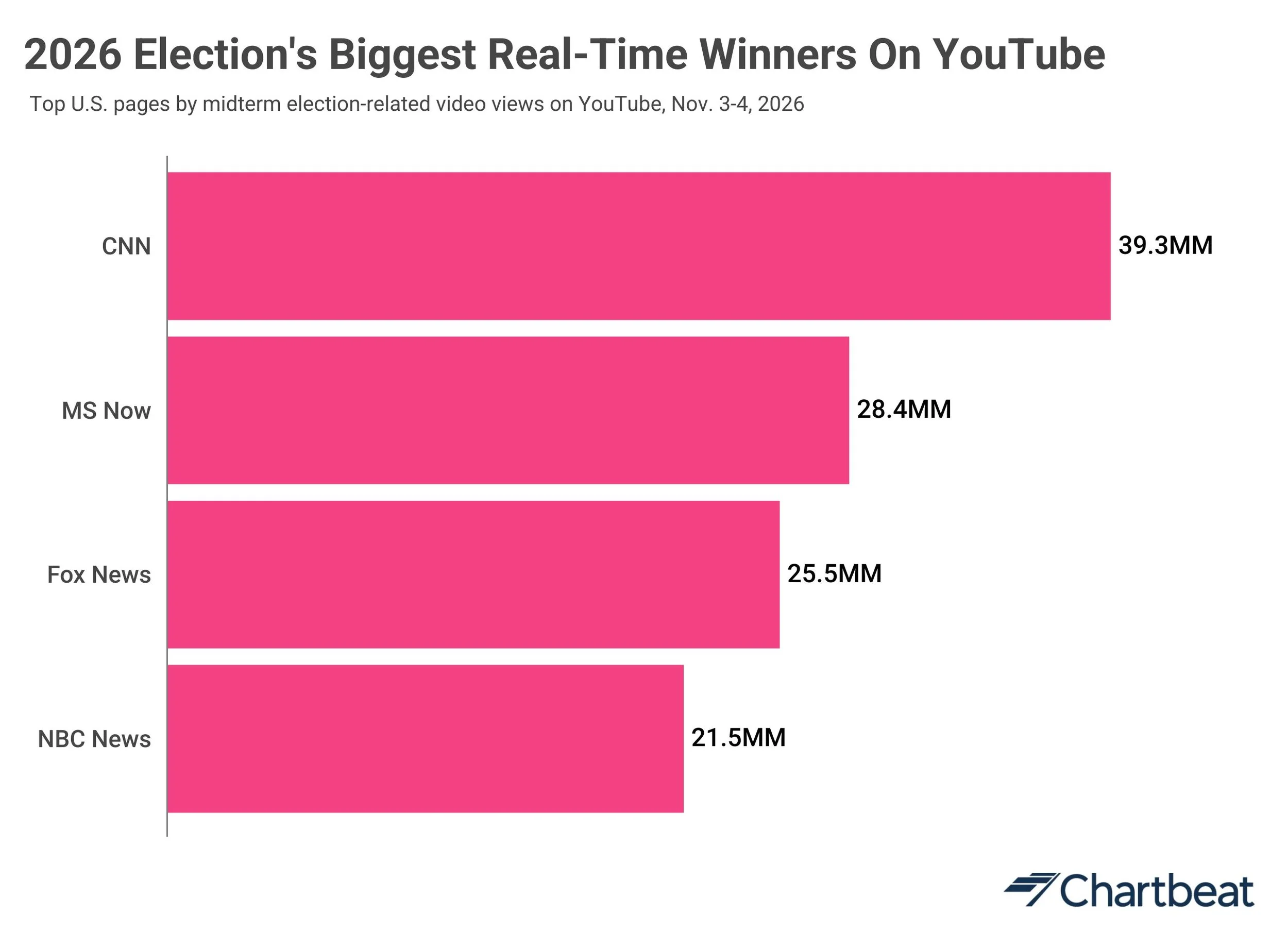
(via Chartbeat)
Audiences also indexed more heavily on longer videos than they typical would when it comes to news & politics content.
Over the course of 2026, just 10.7% of news & politics videos on U.S. pages came via videos 20 minutes or longer, according to Chartbeat. Over Nov. 3 and 4, 45.6% of midterm-related views were for videos 20 minutes or longer. And 81% of those long-format views were for videos at least 30 minutes long.
Election night didn’t just encourage longer viewing sessions. But for those that may utilize YouTube as a substitute for traditional TV — and even those that don’t, in your author’s case — YouTube effectively was TV for the night.
The key there was networks’ emphasis on live feeds, foregoing clipped segments and Shorts in favor of just airing their live content in full.
Over the two-day stretch, 42.5% of midterm-related views on U.S. YouTube pages came from live videos. On election night specifically, that number was 48.9%.
Though a Daily Show video about Haley Stevens was actually the most-watched about the midterms during those two days, the next seven were all live streams from the likes of NBC News, MS Now, ABC News, Fox News and AP.
Amusingly, the live video with the most views wasn’t even a main feed. It was NBC News’s now-famed Kornacki Cam, which was focused exclusively on map and results analysis from correspondent Steve Kornacki.
The alternate format doesn’t always work for major events (sports has been trying this for years with smattering success). But for an event like election night, where the only truly important thing is the results, having a camera on the guy reporting those results with an interactive map is now the proven way to go.
Mimicry of that format works to an extent. The bigger takeaway around it, though, is the impact it can create as a live-viewing entity. Which is what all of the broadcast and cable networks harnessed well on Tuesday night.
Audiences are not going to social video that night for segments or clips at first. They’re going to social video to watch TV, in the traditional sense.
Once the results are in, then yes, the Shorts and memes come out, along with reaction videos from wins. The news doesn’t have to be part of that portion of the election cycle, though. And by and large, they benefited from keeping to their lane and succeeding in it with election coverage this year.