Tube Trends: The Math For Brands Behind YouTube Shorts, ‘Longs’
YouTube Shorts remain an immensely popular format, with snackable (one minute or less) video the overwhelming choice for viewers on the platform.
However, with so much Shorts content out there and YouTube’s viewership on TV devices growing, there could be ample space to explore longer formats as well — especially for brand videos.
Data from Tubular Labs digs into that idea a bit, and finds at a bird’s-eye view, brands aren’t necessarily getting the squeeze required to make longer (“Longs?”) videos worthwhile when compared to Shorts.
In 2025, U.S. brands have published over 5.5 million YouTube videos already, with 15.1% of those running 20 minutes or longer. Those longer videos have amassed 6.3 billion views so far, or just 3.02% of the total for domestic brands. So the volume indicates there’s room for growth within that space, but the results show there’s limited performance upside there, even if successful (on average, brand videos of 20-plus minutes hit about 7.6K views per video).
Audiences are simply not tuning into brand content in longer YouTube formats the same way they are Shorts. The data for U.S. brand Shorts also bears that out.
Through the end of October 2025, Tubular’s data reveals that videos running for 1-60 seconds account for 47% of U.S. brand YouTube uploads this year, but 82.2% (!!!) of all views. The imbalance creates such a limited piece of the pie for brand content views — less than 18% — that it’s potentially worth those companies questioning any format more than a minute long.
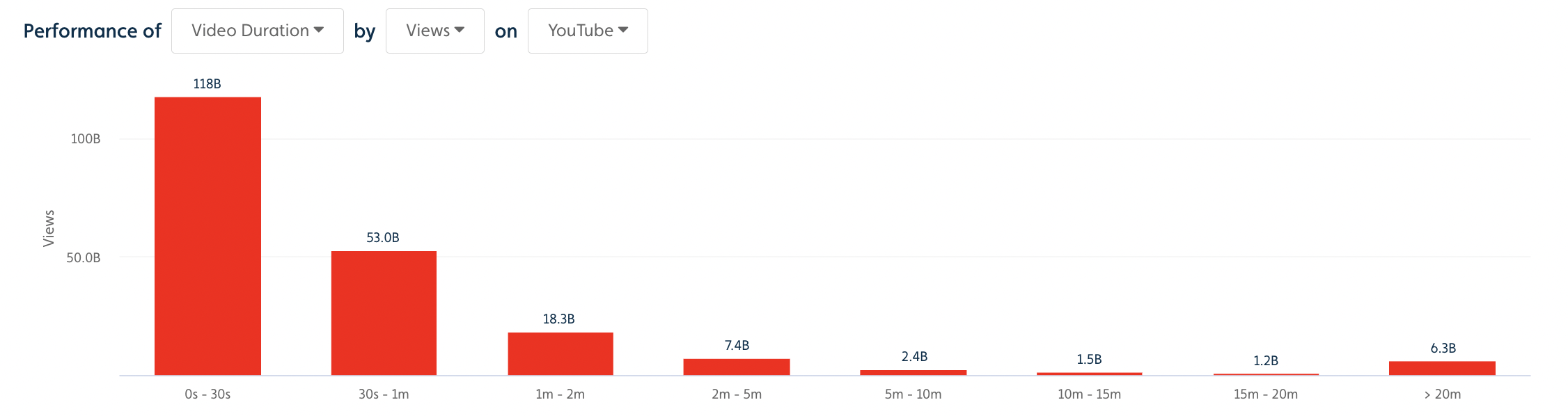
(via Tubular Labs)
The skewed results for brand content in particular helps inform why so many brands are more willing to spend on creator partnerships. Shorts from U.S. creators well outperform brand content, with an average of nearly 96K views per video this year for creator videos that are 1-60 seconds long, versus 66K for brands.
Notably, however, the gap’s smaller for creator long videos vs. brands’; 14.7K on average vs. 7.6K, respectively. That’s not a large enough gape to warrant increased spend on Longs with creators the same way it does for Shorts.
But it’s a completely different story for media companies, who present a greater opportunity for partnership on those longer-format videos (and the ones more likely to be watched on TV devices). Through October 2025, U.S. media companies are averaging 52.6K views per videos running 20 minutes or longer, and those videos account for 15% of views.
On a wider scale, those figures showcase how media companies — inherently better resourced with video footage and production capabilities most times — have a greater ability to use Longs to generate audience and extended watch-time. There’s also established history of brand integrations that allow for repeated incorporation (via naming rights, logos, etc.) and behaviorally, the narrative-based viewing encourages more media consumption time.
Partnerships aren’t the only answer, though. Despite the data showing odds are stacked against widespread success for longer brand content views, these videos are also regularly produced for a target audience, and not mass consumption.
Some brands also still find ways to generate views on Longs, though, and could provide a roadmap for how others follow suit.
In 2025, 20 different NVIDIA YouTube videos have run for over 20 minutes, generating 4.5 million views per upload (buoyed by this March CEO keynote), and leans into corporate presentations to regularly inform and excite the market.
Renaissance Periodization is more consumer-facing, but uses longer-form videos and celebrity discussions in ways that educate viewers but also allow it to behave more like a media company. The brand nets 664K per video on long uploads, and has 91 million views on its 137 uploads of videos running 20 or more minutes so far this year.
Various kids and family brands also follow a similar script, and in many cases pioneered aspects of behaving like a media company. While companies like LEGO, Nintendo of America and Hot Wheels all primarily sell physical products, they’re also prolific content creators with that intellectual property in ways that encourages tune-in to narrative-based shows (instead of pure ads).
Of course, every brand can’t just create best-selling toys and games from scratch. But the approaches show how any brand can use part of its sales proposition and key traits to entertain consumers and keep them coming back to watch more. Red Bull has long embraced similar ideas around its social video presence, and is regularly one of YouTube’s top brands by views — with much of that coming from longer-format viewing, too.
As YouTube viewing behaviors continue to adjust and consolidate around shorter formats, understanding the underlying gaps becomes essential for brands trying to make the most of social video spend. There’s no one way for every brand to approach YouTube. But the data presents some shortcuts for those willing to invest in and cultivate a vibrant long (or short) video audience.