TikTok Isn’t Stealing Users, It’s Promoting Cross-Platform Behavior
I’m a cranky old thirty-something. I look around and see how social media has pulled society to the polar ends of every spectrum regardless of topic. I “log on” and can’t help but feel like it’s empowered hateful rhetoric thanks to the perceived security of online separation. It leads me to one simple conclusion: social media was a mistake.
But I am also a realist. The social media revolution has come and gone. This is the era we live in for better and for worse. Social media will continue to shape consumer behavior and entire sub-economies. So, as a media analyst, I can’t help but also be fascinated with what that behavior can tell us about today’s audience.
Here’s what I’ve learned recently—TikTok is not a silo, it’s a starting point. When looking at all U.S. adult consumers, Greenlight Analytics finds significant overlap with Instagram, Facebook, YouTube and even LinkedIn. Focusing on specific age cohorts such as Gen Z and Millennials then reveals the nuances of what we often shorthand as the “TikTok-native” audience.
Raw Scale and Generational Specificity
TikTok users are not monolithic, even as parents may assume that’s the only activity their kids engage with all day every day. In reality, TikTok users stay active on other major platforms, indicating broad, cross-platform engagement.
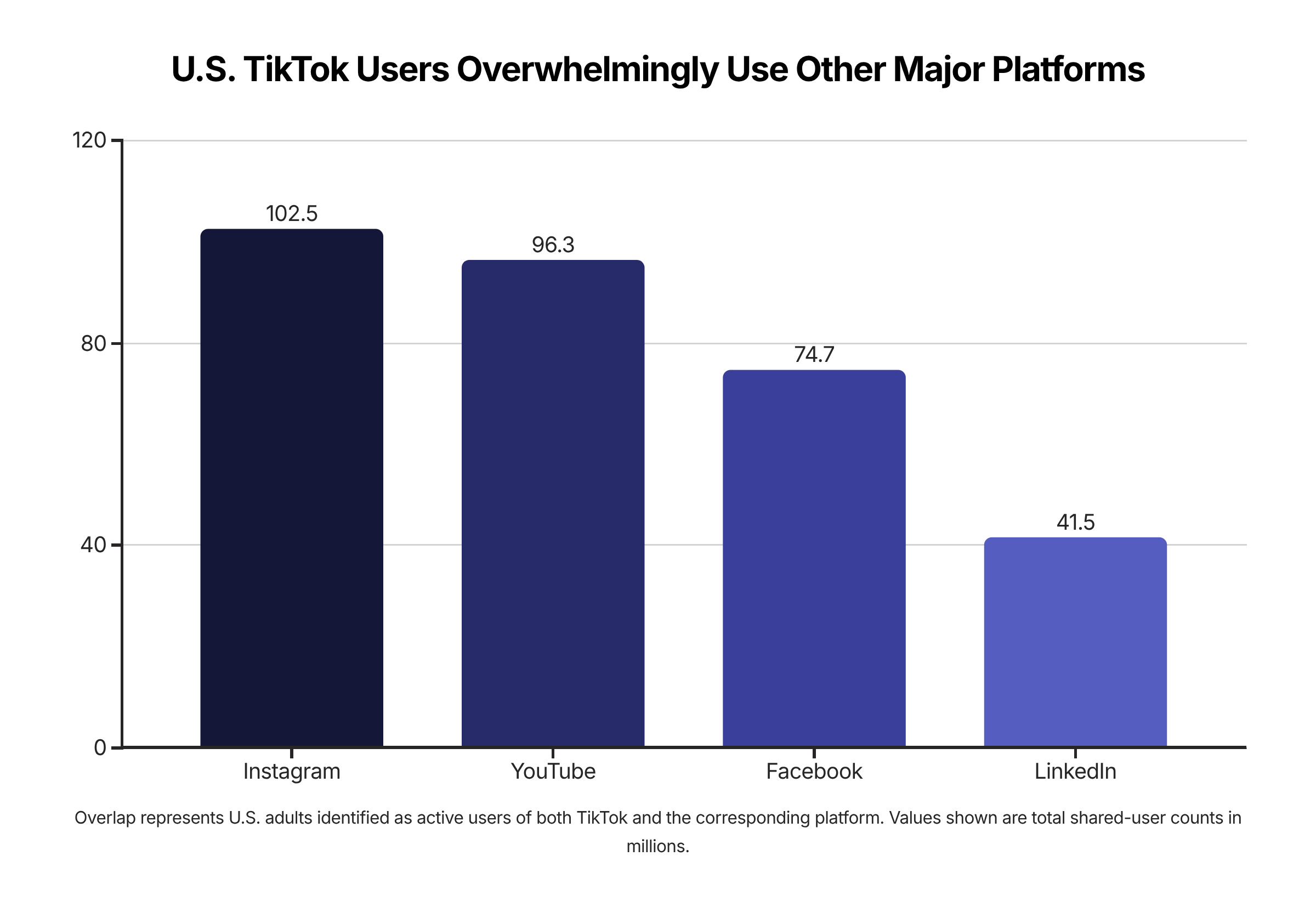
TikTok and Instagram share 102.5 million U.S. adult users, ahead of TikTok–YouTube (96.3 million), TikTok–Facebook (74.7 million) and TikTok–LinkedIn (41.5 million), according to Greenlight Analytics. That's a massive overlap across the board. But the generational patterns within those overlaps vary in instructive ways.
Gen Z TikTok users are nearly a one-to-one match with Gen Z social media users overall when it comes to Instagram, Facebook, LinkedIn and YouTube. TikTok isn’t drawing them away; it's sharing engagement on relatively equal footing. Their mix of social media platform usage is nearly identical to Gen Z as a whole and is not a distinct subgroup operating differently.
Millennials see mild deviations, with this generation’s TikTok users slightly less likely to use Facebook but slightly more likely to be on YouTube and LinkedIn. Given the age differences, that makes sense; college students aren’t normally as focused on professional networking sites.
So if general TikTok users overwhelmingly also use other major social media platforms, and Gen Z and Millennials specifically share similar traits, what does that mean? Essentially, TikTok users are the mainstream social media audience. The notion that “TikTok kids” operate as a segmented, isolated cohort is inherently false.
Marketers need to realize that TikTok, which typically serves as the earliest discovery funnel, isn’t displacing users from other platforms. The same people are already engaging across all of them. YouTube and Instagram represent the strongest companion platforms to TikTok, with roughly 100 million overlapping U.S. users apiece. They match TikTok’s discovery methods with creator-driven personality and visuals and are often the immediate next social stops on the user journey that deepen connections and associations. Facebook, despite skewing older, still plays a distribution role thanks to its group and sharing functions. TikTok’s entertainment focus doesn’t directly map to LinkedIn’s career-oriented use case, but with more than 40 million shared users, the two aren’t quite as opposing as oil and water. Understanding these pathways can boost the ability to convert awareness into actionable behavior. (After all, we’re all trying to get people to buy something, right?)
Social media may be toxic, but that doesn’t mean we can stop learning from it.