TVision Study: What We Watch When We Watch YouTube On TV
What are people watching on YouTube when they watch it on TV is a question that has been plaguing the television industry since it was revealed that people spend more time watching YouTube on their TVs than Netflix.
I was recently granted access to data from TVision that measured what their panelists were watching on YouTube.
The results were surprising in the context that they varied significantly from YouTube’s mobile viewing numbers, which leans heavily towards Shorts.
That, and they seemed to refute the urban myth that YouTube’s strong numbers were attributable to Millennials and Zoomers streaming three hours of Rogan and other podcasts each day in order to preserve battery life on their phones.
So here’s what we did find:
Big Creators Get Co-Viewing, Niche Creators Get Attention
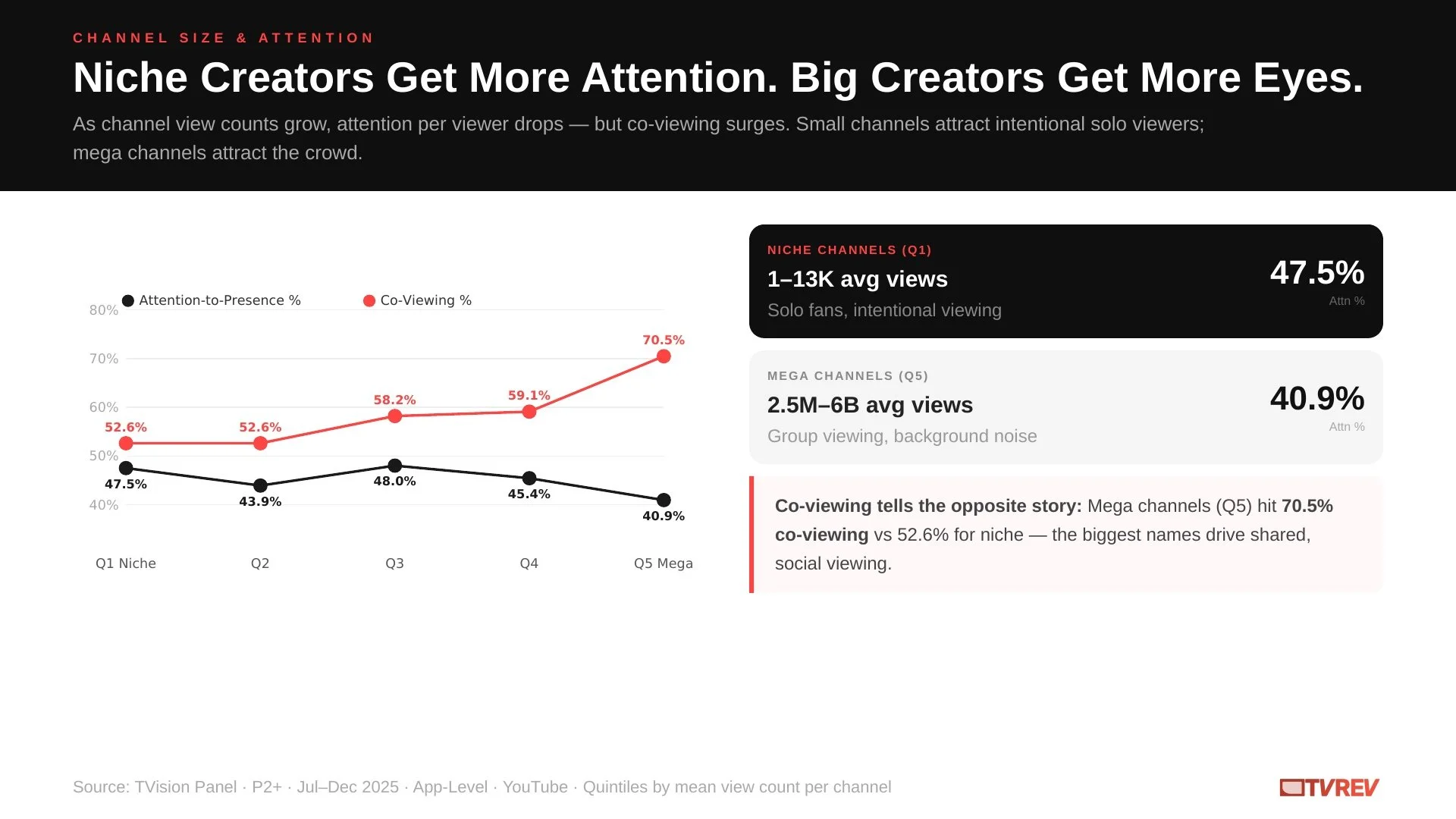
TVision’s data looked at several different metrics: how much time was spent with each video, how much of the viewers’ attention it received and whether it was viewed solo or in a group.*
What they found was that big-name creators, the MrBeasts of the world, got more viewing time overall and more co-viewing time than smaller creators. The smaller creators though made up for that with attention—viewers were far more engaged than they were with the bigger names.
At some level this makes a lot of sense.
Bigger creators are bigger because they appeal to a broad audience. Much of their output is perfectly suitable for kids. It’s somewhat formulaic and so becomes the YouTube equivalent of background noise. Families can be watching episodes of Roblox while playing on their phones. Niche creators, however, are likely solo viewing by more passionate fans who actively seek out their content.
So while they don’t get big numbers they get dedicated ones.
Studio Content Drives More Attention Than Creator Content
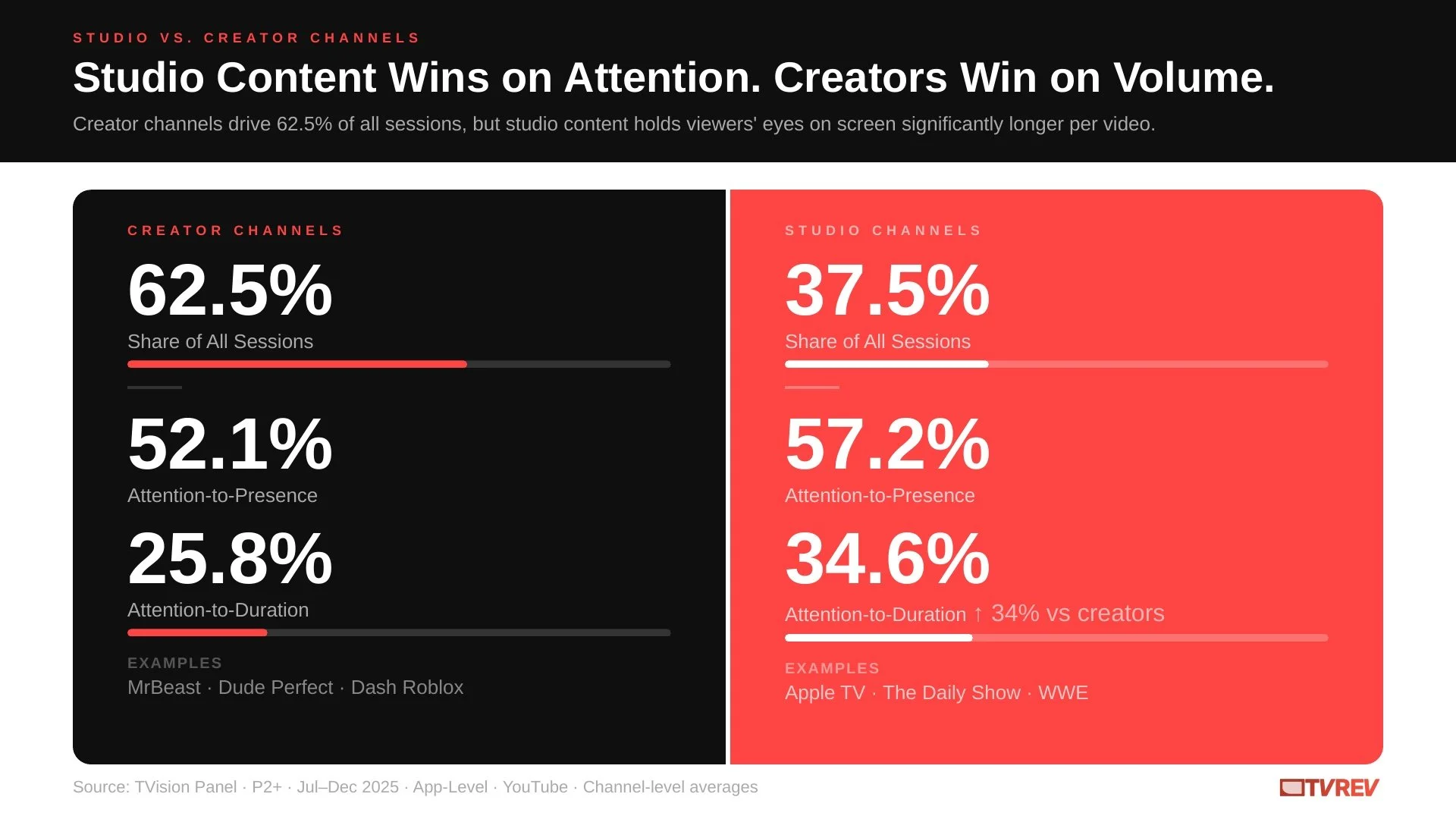
Studio content, as in Hollywood studios, is also quite popular, dispelling the myth that YouTube is almost entirely creator-driven.
Studio content ranges from clips of late night TV hosts to movie trailers to full-on series. It spans a wide range of categories too, from sports shoulder content to talk shows to comedies and dramas.
Creator channels account for more sessions: 62.5%.
But Studio Channels have better attention metrics:
Studio Attention to Presence: 57.2%
Creator Attention to Presence: 52.1%
Studio Attention to Duration: 34.6%
Creator Attention to Duration: 25.8%
This is again not all that surprising: studio content is popular and viewers who seek it out on YouTube (versus watching it on traditional TV) are going to be fans. It’s not what the stereotype of YouTube viewing is, but it does constitute a substantial and broadly popular piece of it.
Mid-Form and Long-Form, Not Shorts
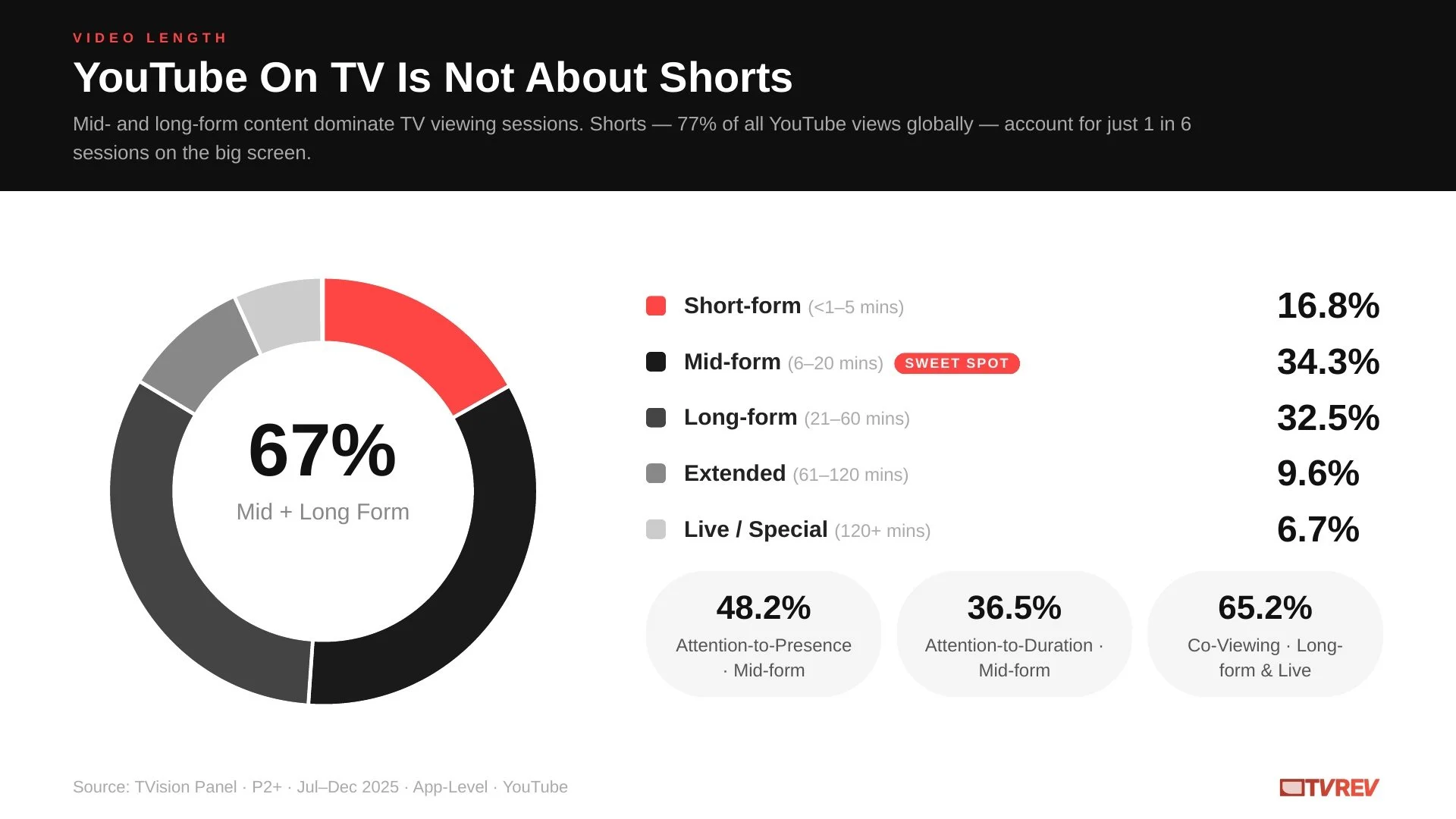
Tubular Labs reports that 77% of YouTube views on any platform are of videos that are under one minute in length, meaning they are primarily Shorts.
Which, makes the mid-form and long-form numbers from TVision even more notable:
Short-form accounts for just 16.8% of sessions, while mid-form and long-form together account for 66.8%. Mid-form (6–20 minutes) represented 34.3% of views, while long-form, 21–60 minutes represented 32.5%.
This makes several things clear:
Most of what is being watched on TV looks a lot like “TV” in terms of the length of the show.
Viewers see Shorts as something to be watched on mobile.
The number of mid-length shows was somewhat surprising, though there are several possible reasons for their popularity:
Part of this may be supply, rather than demand. YouTube's economics pushed creators toward making videos of 8 minutes or longer so they could benefit from mid-roll advertising revenue. So one explanation may just be that a lot of what got made falls into that range.
The long-form content was also interesting in that it proves that people are looking to YouTube for the same type of content they get on traditional TV. While some of that could be creator content or podcasts, the data from TVision indicated it was spread across a wide range of programming, everything from NFL-related content to BBC Earth, all of which are also found on traditional TV.
Other Key Takeaways
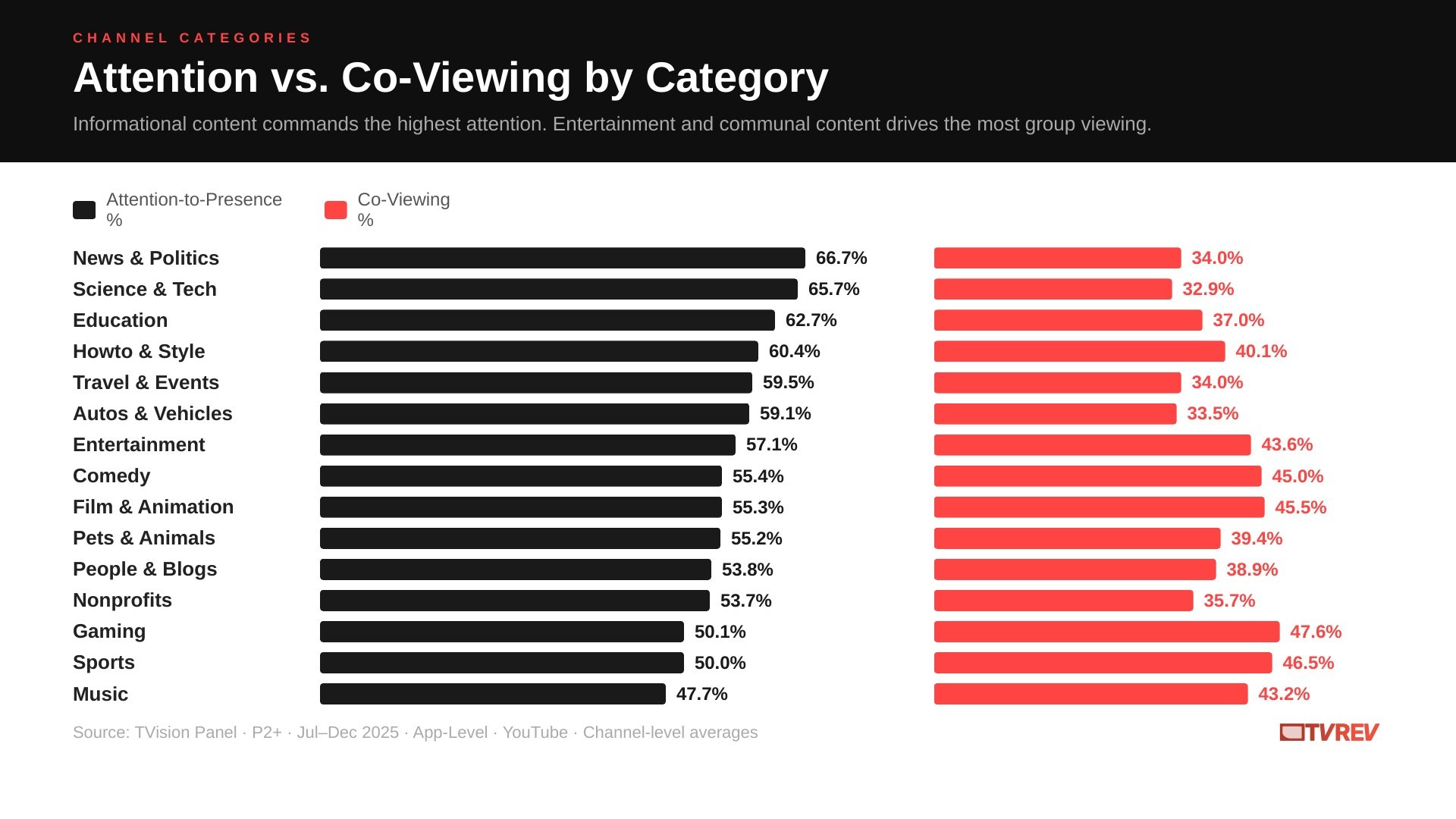
Entertainment was the most watched category, which was not much of a surprise: it’s a broad category, encompassing both fiction and non-fiction shows, which explains its broad appeal. What was notable was that the category commanded a high degree of attention: 57.1% attention-to-presence.
Of all the categories, Entertainment seems to span both the creator and studio worlds, encompassing everything from Netflix’s YouTube channel to creator series like Frozen vs. Fast vs. Fancy Food Taste Test.
News and Politics was a surprise category in that it commanded the highest attention score at 66.7% attention-to-presence and 52.9% attention-to-duration. It also had one of the lower co-viewing scores at 34.0%.
News on YouTube, which TVision’s data indicated ranged from FOX News to The Bulwark, does not appear to be a replacement for local broadcast TV news, but rather, a mix of cable news and more niche sources, hence the high attention/low co-viewing scores.
Music, Gaming and Sports were all notable too, mostly because they behaved the way you might expect them to behave on a TV screen.
Music was the third-largest category by sessions, but had the lowest attention-to-presence score. Which makes sense. A lot of music on YouTube is something you put on while you are doing something else and a good way not to drain the battery on your laptop or smartphone. Even on linear and CTV it is not a high viewing engagement category.
Gaming had the highest co-viewing score of any category. That also tracks. Gaming videos, especially Roblox and other family-friendly titles, are easy group viewing. They don’t require everyone in the room to be locked in every second, but they are easy for everyone to follow.
Sports proved similar. It had the second-highest co-viewing score, and the examples TVision provided included both a Chiefs-Chargers livestream and Timberwolves-Knicks full-game highlights. Meaning it is not people watching random trick-shot videos, but rather the same type of viewing that brings people together for long periods of time on traditional TV as well.
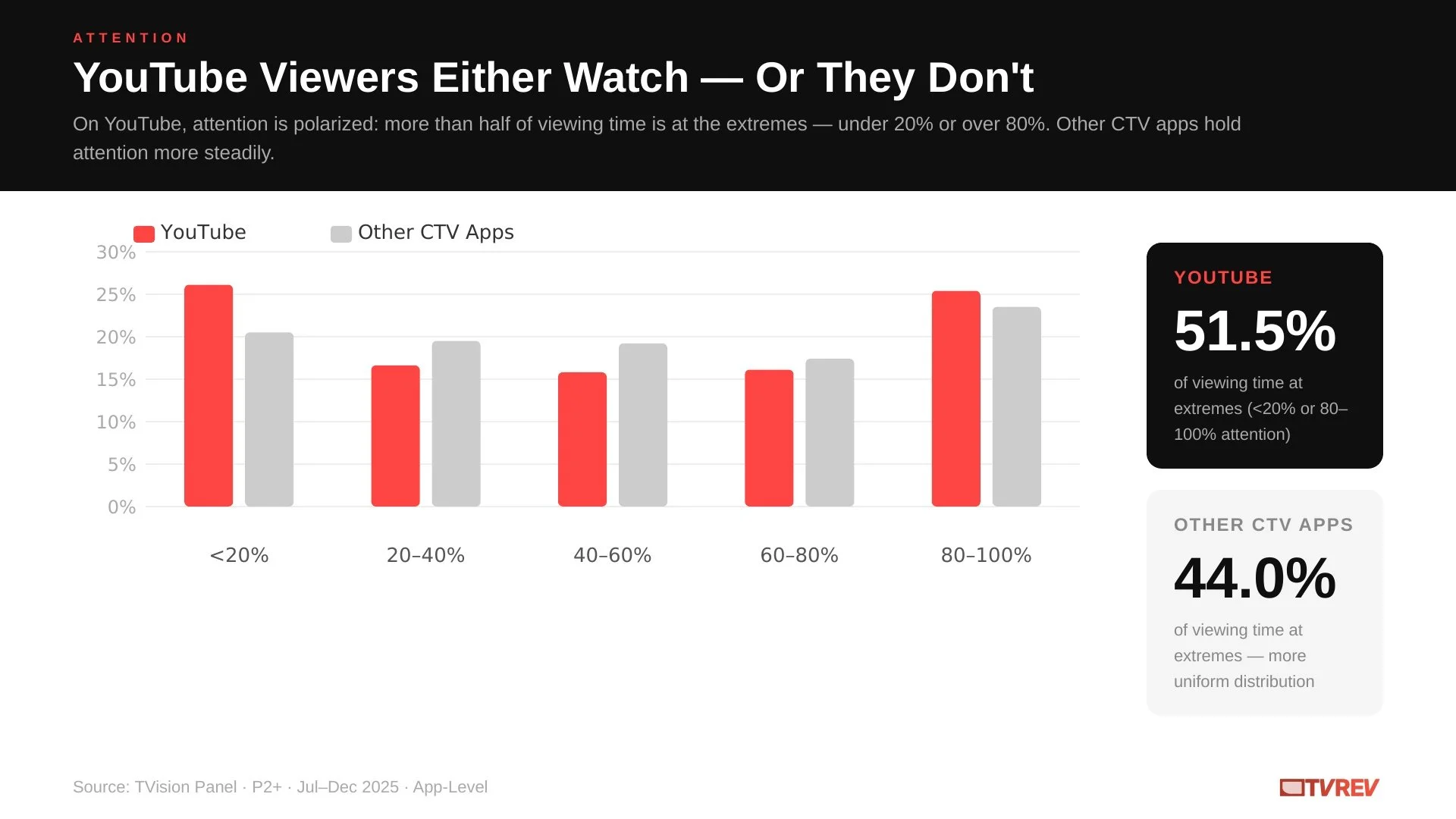
Attention was an interesting marker, in that YouTube viewers were more likely than traditional CTV viewers to be at one end of the attention spectrum or the other.
26.1% of YouTube viewing time fell into the lowest-attention bucket versus 20.5% for traditional CTV, a difference of 5.6 percentage points. At the other end, 25.4% of YouTube viewing time fell into the highest-attention bucket versus 23.5% for traditional CTV, a difference of 1.9 percentage points.
Meaning YouTube viewers were either barely watching or watching with intent. That goes a long way toward explaining why YouTube is so hard to classify. Sometimes it is background noise. Sometimes it is lean-in viewing. In a way that differentiates it from traditional TV.
So Is YouTube TV?
Looking at the results of the study, the answer to the question of whether YouTube is TV or digital video is clearly “Yes.”
Meaning that it is both.
Unlike traditional TV, YouTube is impossible to classify. .
There is much on the platform that is indistinguishable from either “TV” or “CTV”. Though “identical” may be an even better word because it is the same content—TV series and live events like NFL games.
There is also a lot of episodic content that people watch the same way they watch TV shows. Plus a lot of shows that people watch in groups.
Which may be the surest sign of all that consumers view YouTube (or at least parts of YouTube) as TV: if there is one core difference to how people watch TV versus other video media it is that they watch it in groups. It is that shared experiences, of people watching video together, that makes something “TV.”
And yet… not all of YouTube is TV.
As noted, 77% of YouTube views worldwide came from Shorts. Which, because they are Shorts, does not mean that 77% of viewing time was spent on Shorts, but it does confirm that Shorts make up a sizable percentage of YouTube viewing, and that viewing largely happens on mobile phones in an experience that is very unlike TV.
Which is not as contradictory as it sounds.
Netflix is introducing vertical video teasers and promos for its shows that will live on the Netflix mobile app. It may, at some point, roll out microdramas or other short-form series on its mobile app.
And it is unlikely that we will consider that “TV.”
So the real solution is not to get hung up on labels. To accept that YouTube is its own beast and can contain content that behaves a lot like TV: longer form, co-viewed, while at the same time containing lots of mobile-first short form.
That’s not a cop-out, it’s reality, and it is likely how all our video media sources will end up.
Because people want options and they will spend their time with providers who give it to them.
Regardless of what bucket some analyst thinks they fall in.
*Attention-to-presence measures how much of the time viewers were actually looking at the screen while they were present in the room. Attention-to-duration measures how much of the full video playback time viewers were actually looking at the screen, whether or not they were in the room the entire time.