Tube Trends: YouTube Audiences Still Love Comedy As Other Formats Flee
Comedies, once a hallmark of the theatrical experience, have declined significantly in recent years.
Coupled with a decentralized national culture in the U.S., an increasingly fraught political environment and TV’s own diminished investment in laughs, it’s led to an overarching narrative around comedy’s demise. Judd Apatow and others have pushed back on this idea, of course. And they’re right to.
To their point, comedy just needs another “hit.” But that next hit may just be about Hollywood — and particularly, TV — just embracing comedy’s format change.
Data from Tubular Labs shows how comedy is still alive and well on YouTube and other social video platforms.
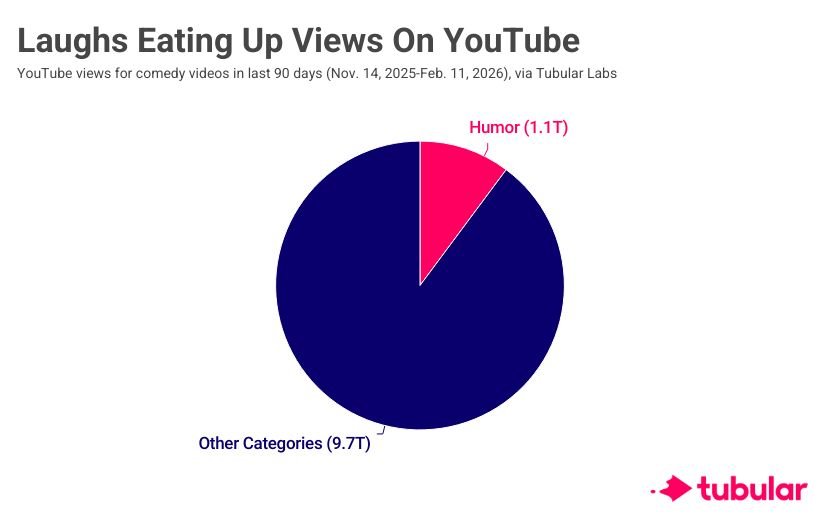
(via Tubular Labs)
Over the last 90 days, comedy videos accounted for 1.1 trillion (10.2%) of YouTube views. That’s more than all videos about movies and TV, more than video games, parenting videos, sports videos or food & drink videos.
It’s the predominant category on the platform, really, and without uploading significantly more videos than any of its competition. Humor videos were earning an average of more than 418K views in the last 90 days, while topics like sports (202K per), news & politics (154K) and video games (224K) are all much lower.
The evidence would seem to be there that humor is very much in demand. So what’s the problem?
Part of it could be the nature of the comedy on YouTube (and other social platforms).
YouTube’s expansion to TVs has helped fuel a longer shelf life for various types of content, yet comedy doesn’t appear to be one of them yet.
Looking at the same 90-day window, Tubular data shows that on average, nearly all of views for “humor” videos on YouTube are happening within 30 days of being uploaded. Other video categories don’t have overwhelmingly shorter tails on content, but humor is still among the shortest.
That’s fine for Shorts and “internet humor” and memes (which have always had a notoriously short shelf life), but it’s less acceptable if you’re using it to justify investing millions of dollars on a show or movie production.
Even established comedy brands have had to adapt to this dynamic.
Saturday Night Live, while a top-50 media creator on YouTube, is achieving that in part by embracing the short-tail nature of digital comedy.
The comedy institution has been uploading every skit for years, now shortly after they air live. And they’ve even gone back and uploaded plenty of older content too, so as not to miss younger audiences simply looking to turn something on and laugh.
Last fall, it was even mentioned that the success of SNL digital short “Lazy Sunday” was a key catalyst for getting more eyeballs on YouTube in the site’s earlier days pre-Google acquisition.
But the tables have turned since then, to a point. With even late-night brands having to counteract the effects of YouTube on comedy by tailoring shows specifically for snippet-based viewing.
The fact that these shows are tailoring comedy to what’s happening on YouTube comes out of necessity. But it also makes it even harder for Hollywood comedies (again, TV or movies) to do anything truly groundbreaking without involving digital elements. And the second digital’s involved, there’s a timer on the content.
Perhaps the solution is making Hollywood’s comedy content more tailored to who’s watching YouTube’s comedy: Gen Z. Otherwise, there will be a point where Hollywood’s comedy is simply part of YouTube’s (much larger) hold on comedy overall.