Traditional media has been all over social video for years, and in many ways, TV networks have embraced platforms like YouTube as both a promotional signal as well as a way to connect with audiences that don’t watch cable/satellite.
There’s an ease in that process, to an extent. Many of these networks have been in the video content business as long as there’s been a video content business. Utilizing video already appearing on traditional TV in another place like YouTube is a natural fit that requires very little “new” production, outside of perhaps edits and possible capture for vertical video.
The same is not true for print media, however.
Say what you will about last decade’s “pivot to video,” but there was value in print media adopting video as part of its larger audience acquisition strategy. They just didn’t need to abandon writing in the process.
To their credit, numerous print media publishers did stick with it. And the results have made for successful YouTube channels that build upon what they’re doing with the written word and expand it to include more visuals and a conversational tone, plus vertical video at times when it make sense.
For print media that is not necessarily using video to its full potential yet, though, here are the repeatable things that the best U.S. newspaper and magazine pages are doing well on YouTube.
Behind-the-Scenes Framing
For print media, a behind-the-scenes framing immediately signals to audiences that the content they’re about to watch is additive to the written article(s) and not simply restating what they may have already read.
Among the top U.S. print media videos on YouTube by views since October 1, multiple uploads are longer-form (10-to-15 minutes) pieces that specifically frame the content as something that feels additive and exclusive.
Architectural Digest’s Julianne Moore profile is the most-viewed of any of these videos with an “inside” look that garners 6.4 million views. Business Insider similarly goes into specific details of the country’s only internet sea cable marker to the tune of 5.5 million views — in a way that simply writing about it wouldn’t be able to sufficiently capture.
Other pieces from Architectural Digest (this time, profiling 76ers star Jaylen Brown), Bon Appetit, Rolling Stone, The Wall Street Journal and more show a format that works over and over: Telling audiences you’re about to peel back the curtain on both the journalism process and the subject, and then delivering a unique experience to that end.
Using First-Person Quotes To Draw Viewers In
The New York Post is a prime example of how to use a good pull quote to acquire an audience on YouTube. So far in Q4, some of the paper’s most-seen uploads — including details of a Florida plane crash and a trans creator’s arrest in Egypt — lead with key quotes that tease out a several-minute video.
Allure, AL.com and Forbes all take similar approaches on some of their most popular videos, leading to their most-viewed content as well. But where the New York Post excels beyond others is the sheer number of uploads.
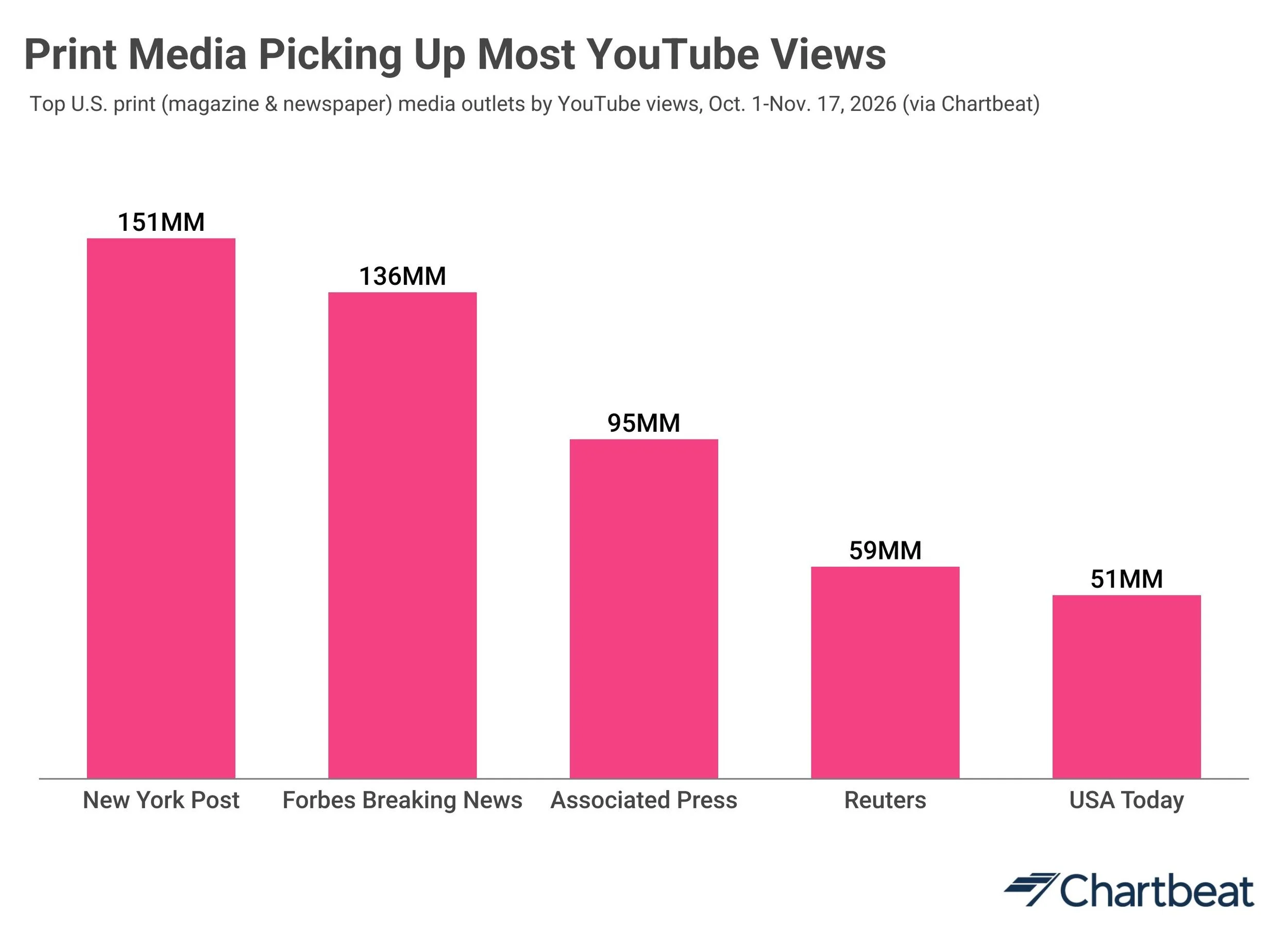
Since October 1, the paper has uploaded over 2.4K videos to YouTube, which is more than even some TV networks like CNN and ESPN, as well as AP, CBS News and Fox Sports.
These are not production value plays as much as a volume one. Most uploads are narration over a quick video or series of photos. Audiences quickly get the news they’re looking for and move on to the next story.
A breakdown of the top U.S. newspaper & magazine media companies by YouTube views is below.
Shorts-As-Promos
With magazines primarily relying on in-depth journalism and long-form written content for print sales and pageviews, most don’t have the ability to produce hundreds of video productions every month. But their social video footprint still works well, because they’re using Shorts on these platforms to promote their written content (or occasionally, video series, where applicable).
Print media’s most-seen Shorts since October 1 are primarily from magazines. GQ, Allure, ELLE, and Esquire all utilize celebrity-focused Shorts to draw initial interest. But the ultimate goal is to spur off-platform actions.
Even with just 39 vertical video uploads, Allure manages to be No. 5 among all traditional print media publications by Shorts views (17.6 million) in the timeframe. ELLE and Newsweek are also among the top 10.
While every publication has their own unique identity, these are still basic scripts that media can follow and find similar success that helps grow their audience.