Tube Trends: How A&E Uses YouTube To Appeal To Cordcutters
Cable television has been under siege for years as streaming has eaten into its once-reliable stable of viewers. But more agile networks have been figuring out how to remain relevant by following audience trends to appeal to both cordcutters and cord-nevers.
A&E may be one of the best examples of this — despite what can be seen as uphill challenges for a channel without a ton of new and live programming available.
Those challenges have paved the way for a novel approach, though.
A&E’s YouTube strategy is unique among cable networks. Effectively, the channel utilizes YouTube as a way to appeal to cordcutters/cord-nevers and keep them in the content ecosystem — even if they wind up not subscribing via cable or satellite.
According to Tubular Labs’ December 2025 audience ratings, A&E was the No. 3 overall creator by U.S. YouTube watch-time, at over 1.2 billion minutes. That figure was up 68% month-over-month, and has more than doubled since Dec. 2024.
Though the network was already embracing a strategy like this on YouTube, the late 2025 surge shows how it had more room to grow via long content (something that comes from the top given its greater focus on/overhaul of digital last year).
While many networks are already using YouTube as a way to push promos via Shorts and potentially drive tune-in off-platform to another service, A&E is leaning into the way people are already watching its videos: For long stretches and on their TVs.
Of A&E’s 231 YouTube uploads in December, nearly 75% were full show episodes! That’s multiple days’ worth of (largely evergreen) programming, uploaded for free.
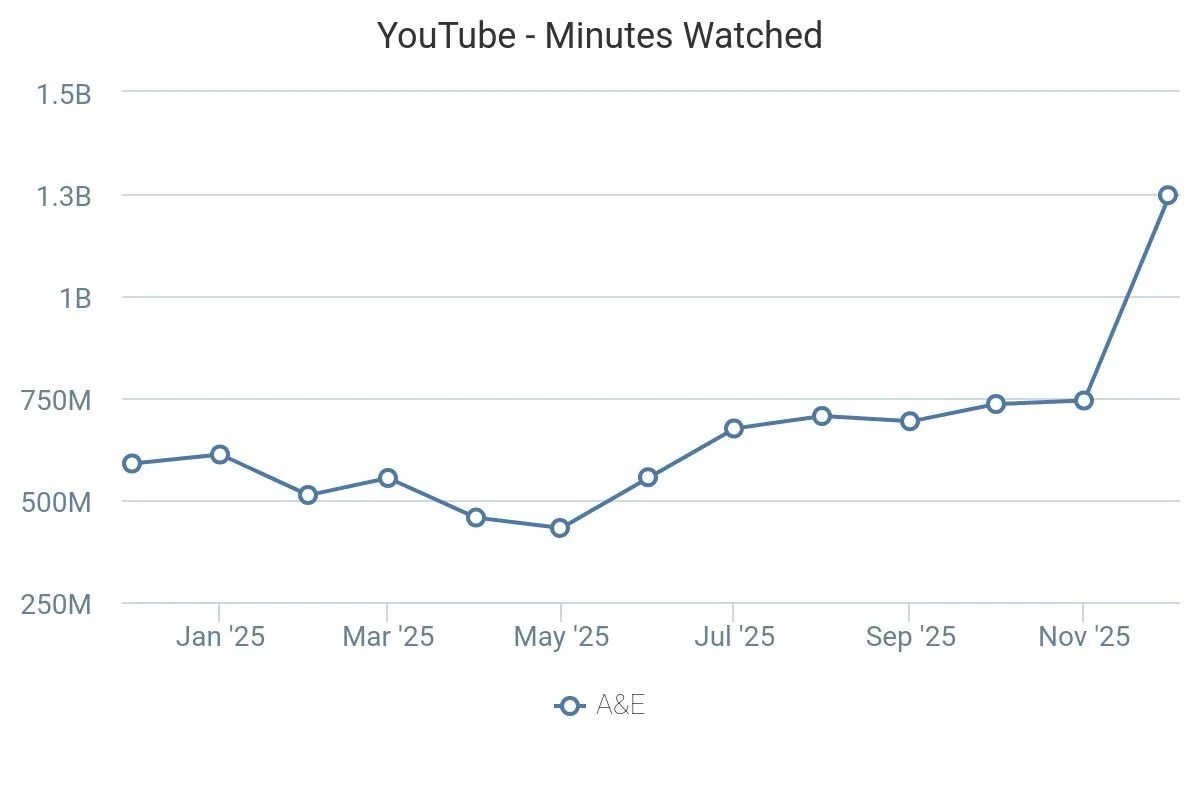
A&E Network - Monthly U.S. Minutes Watched On YouTube (Via Tubular Labs)
The network hosts several-hour marathons of various shows as well, including two different four-hour videos of Hoarders episodes edited together.
Even if this not an approach for every network — for instance, news and sports would struggle more here and need more volume to grow — A&E’s content style is perfect for it. And it provides a roadmap for how other cable channels like theirs can similarly thread the needle with audiences that aren’t watching via MVPD.
Networks like Comedy Central, TLC and a variety of Discovery-adjacent channels can likely go the same route. Some already have, to lesser extents. But the larger demands of driving audiences into streaming and/or cable ecosystems may prevent them from fully diving into a YouTube-first strategy.
The path is there, though, should they choose it. A&E’s success should be enough proof.
Leaning more heavily on YouTube allows these cable networks to embrace viewer preferences in real-time, while still monetizing content with (targeted) ads during these longer uploads. All while entering into discovery-based ecosystems and search results they would have limited access to otherwise gated behind streaming paywalls or true cable subscriptions.
Chances are we were going to end up here at some point. The savviest cable brands will take the leap with their audience, before they’re completely forced to chase them.