‘Project Hail Mary’s’ Second Act: Why Amazon May Win Even Bigger at Home

The roughly $200 million-budgeted Project Hail Mary just opened to a rousing $80.6 million domestically and more than $140 million worldwide. Ryan Gosling’s sci-fi crowd-pleaser is now well on its way to a $500 million-plus box office run. Amazon MGM can officially uncork the champagne and bust out the pigs in a blanket (I have no idea what pairs well with champagne).
Yet Project Hail Mary is not just a box office hit. It’s poised to drive value across its entire life cycle. Red One, Amazon’s previous biggest movie ever, finished its theatrical run with $186 million before becoming 2024’s 10th most-watched movie on streaming in just one month, per Nielsen. Project Hail Mary is similarly positioned.
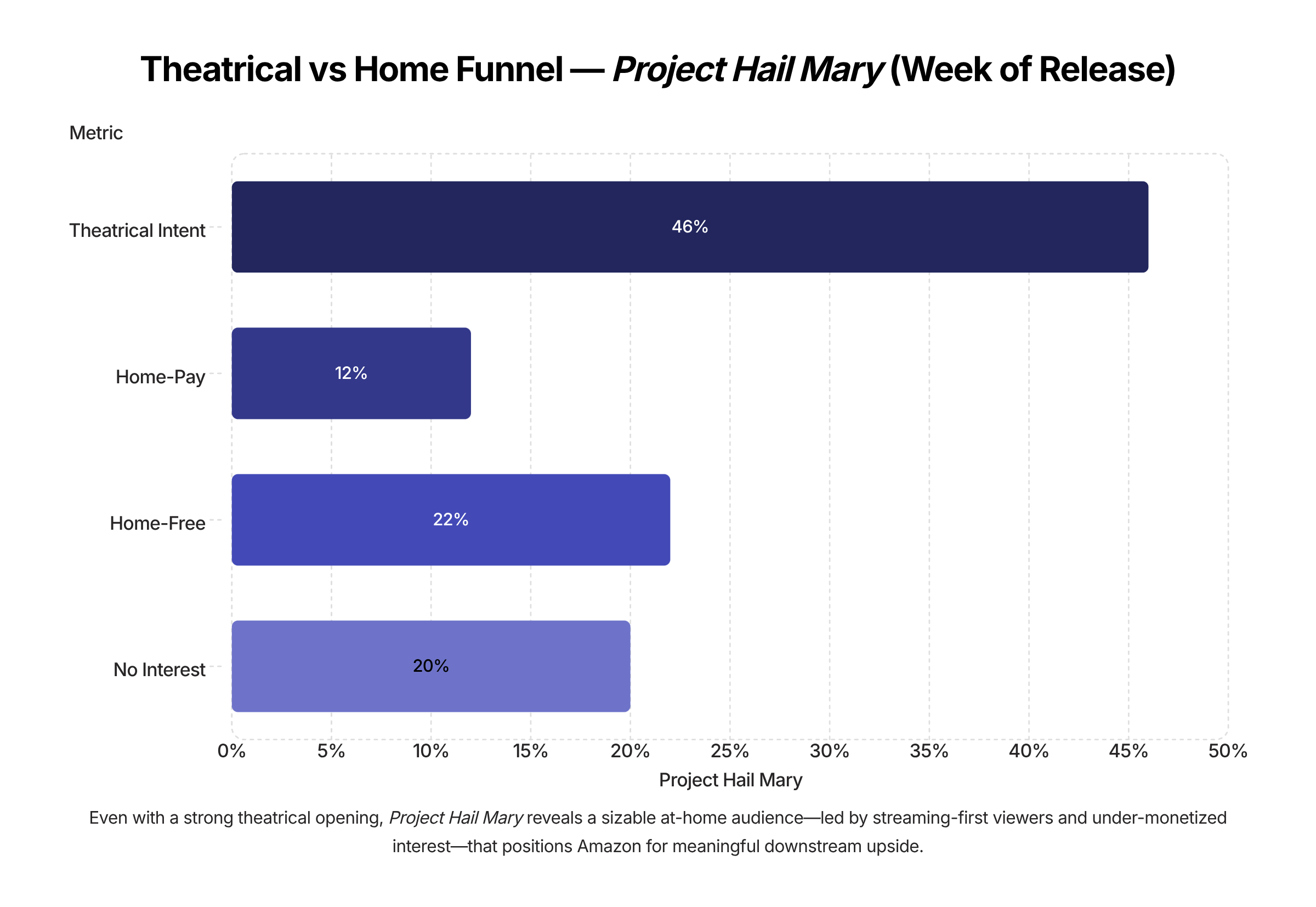
In the week of its release, 46% of viewers preferred to see the film in theaters, while 34% said they would wait to watch it at home, according to Greenlight Analytics. Theatrical held a healthy lead, while the home window promised potential when the film was made available at home. That’s the dream.
Of those home viewers, 12% were willing to pay (either via a VOD transaction or a new streaming subscription), while 22% preferred to wait until it arrived on a streamer they already subscribed to. The deferred demand is further highlighted by home viewers producing the biggest drop-off of any demo between Interest and Willingness to Pay, per Greenlight. The desire is there; it’s just a matter of convenient windowing. Different consumers are activated at different times based on their viewing preferences.
Amazon Prime is uniquely built for this audience, as its users are 36% more likely than the average U.S. adult to be streaming-exclusive viewers. While some may view this as theatrical leakage, Amazon should see it as a built-in conversion funnel. Hungry for engagement, the popular blockbuster is tracking like a streaming entree.
Prime, which is roughly 50/50 male and female among U.S. adults, will also deliver female audiences to Project Hail Mary. Theatrical sci-fi skews heavily male, and there was a gap among women between Interest (43%) and Theatrical Intent (39%) for the film. The VOD and streaming windows become a second chance to monetize those viewers, as well as others who were interested but didn’t make it to theaters. That’s how you expand beyond the core sci-fi demo.
The film notched a rock-solid 58% Willingness to Pay score upon release. (Granted, Red One finished at 65%). The on-demand window represents immediate additional revenue and potential subscriber growth, while the Prime Video window supports retention and engagement via new audiences. It’s a strong example of the long tail of value that hit theatrical films can create. For Amazon, it’s all upside from here.