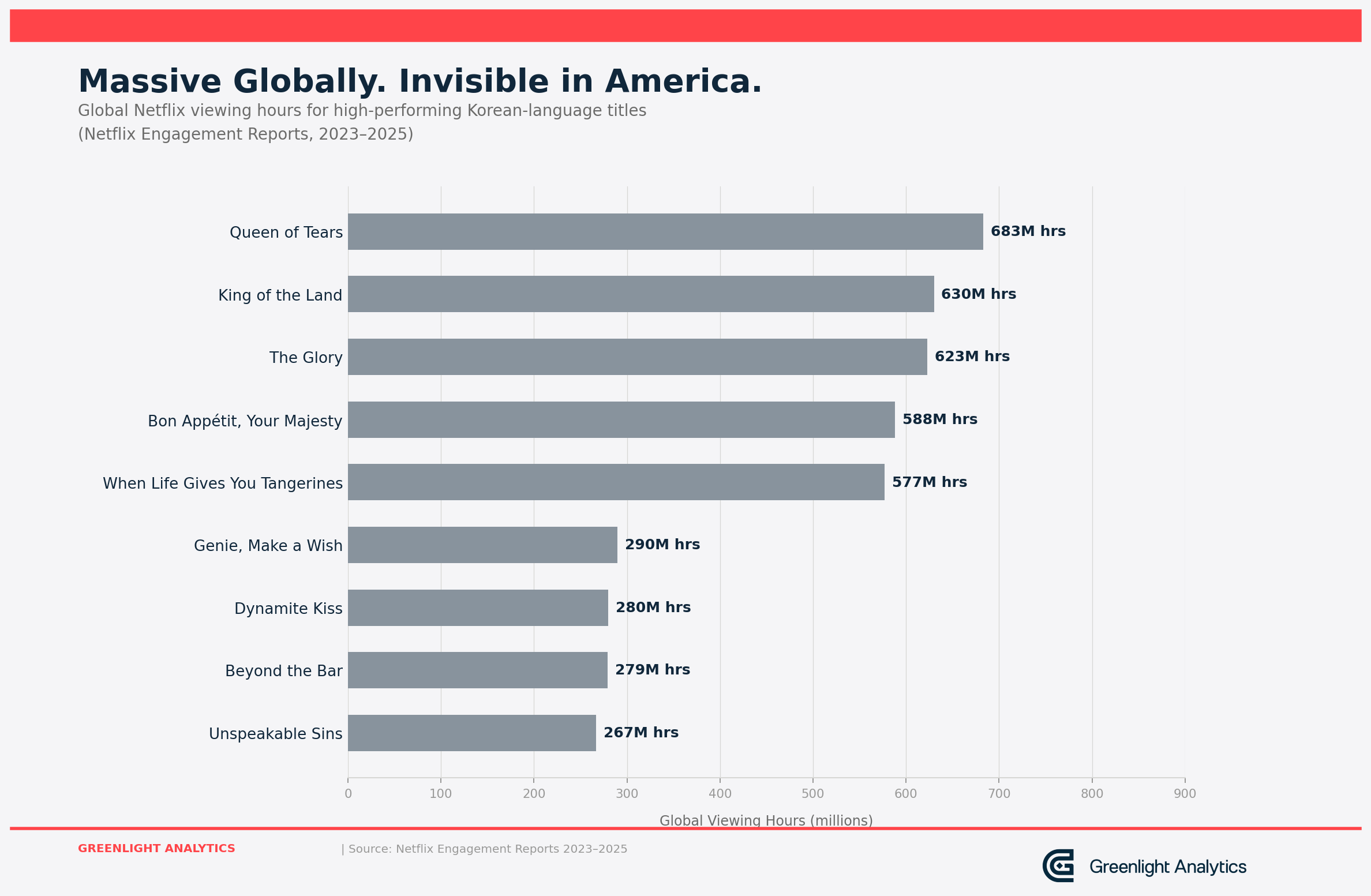
Netflix’s bi-annual engagement reports and Nielsen’s weekly streaming Top 10 rankings aren’t exactly apples-to-apples. The former provides global viewership data for 99% of the market-leading streamer’s library across all viewing destinations (TVs, laptops, mobile devices). The latter only captures various top 10 most-watched titles on streaming via TV sets in the U.S. No mobile viewing included. But when comparing the two, we can more or less reveal the titles that generate impressive to massive global viewership on Netflix yet remain practically invisible to American audiences.
The UCAN market boasts the highest average revenue per user (followed by EMEA), making it the most important for Netflix and other premium global streamers. But what constitutes a hit for the market-leader depends on where you’re measuring. Tracking the data trends illuminates domestic and international content divergences.
International Hits
Looking at Netflix’s Engagement reports from 2023-2025, we can see several titles generating 500M-700M viewing hours in a given reporting period. The overlap with Nielsen’s weekly US charts for non-English content is nearly nonexistent.
Queen of Tears (683M global viewership hours) was Netflix’s 14th most-watched season of TV in H1 2024. It never appeared in a single Nielsen Top 10 list. The Korean series drew only 29.2M “views” (total viewership hours divided by running time), an average of just 23.4 hours per viewer, which reflects the show’s 16-episodes. That’s relatively small from a unique Netflix subscriber viewership standpoint, but shows impressive stickiness and completion among those that did watch.
King of the Land (630M hours), The Glory (623M), Bon Appetit, Your Majesty (588M), and When Life Gives you Tangerines (577M) follow suit. These series are in the same-ish relative vicinity as The Night Agent Agent S1 (812M) Bridgerton S3 (734M), Ginny & Georgia S2 (665M), and Adolescence (555M), most of which dominated the domestic pop culture conversation and Nielsen Top 10s. Adolescence had 144.8M “views”, an average of 3.8 hours per viewer across the show’s four episodes. That’s an underlying nod to the sampling culture that US-driven social virality creates.
Hours-to-views reflect penetration vs. breadth, and they speak to unique sub-culture viewing patterns. K-dramas have become one of Netflix’s most popular content exports (boasting smaller but more committed fanbases across longer-runtimes), yet the American audience is largely uninterested as it clusters around top-end breakouts with episodic structures. Spanish language content shows a similar, but slightly less popular trajectory. Non-English hits have more concentrated viewership outside the U.S.
And the gap is widening.
Squid Game Exception
Squid Game made more than a dozen Nielsen lists, with several single-week totals surpassing 50M hours. Its organic pandemic breakout led to viral marketing, Hollywood-style press cycles for subsequent series, a US reality spinoff, and massive social media conversation. No other non-English series has come anywhere close to replicating this success.
Nearly every other high-performing Korean Netflix original—ranging from 250M-683M global viewership hours—failed to make the US Nielsen charts. The gap between Squid Game and its Korean language contemporaries on Nielsen are enormous. Yet South Korea is still enjoying global content growth overall.
In H1 2023, there were less than five Korean language titles that generated at least 250M+ global viewership hours on Netflix, by my count. By H2 2025, that number had risen to more than eight. Genie, Make a Wish (290M), Dynamite Kiss (280M), Beyond the Bar (279M), Unspeakable Sins (267M). None of these charted in the US despite growing global footprints.
We know Netflix continues to invest in South Korean content, and we know the world’s appetite for said content is increasing. But the streamer’s highest-yield customers continue to largely ignore it.
Global Content Trends
A Netflix hit means different things in different regions. Every country prefers to watch local language programming. But the U.S. audience experience strictly revolves around English-language originals, occasional British prestige drama, and the hyper rare non-English breakthrough. Hollywood is the strongest exporter of content worldwide. But international viewers are showing an increased interest in Korean-language romance and drama, Spanish-language crime and thrillers, and genre content from all over. Even if American audiences are slower to broaden their horizons, local language investment remains a crucial bet on both the present and the future.