Tube Trends: What U.S. Media Can Learn From India On YouTube
While the economy around YouTube, and the website itself, may have originated in the United States, there’s significant investment from other countries’ media ecosystems.
One of those is India, where media and entertainment pages have actually surpassed those in the U.S. in recent years — and become more efficient in doing so, as data from Tubular Labs, powered by Chartbeat, shows.
Part of the reason for Indian media’s surge comes from the rapid increase in internet usage within the country. From 2014 to 2026, total internet users in India quadrupled from 250 million to over 1 billion, and social app and video usage have followed suit.
Indian media has risen to that increased demand. After years of either trailing the U.S. (in aggregate) or existing at relative parity by views, the data below shows just how far ahead media & entertainment creators in India have jumped their U.S. counterparts.
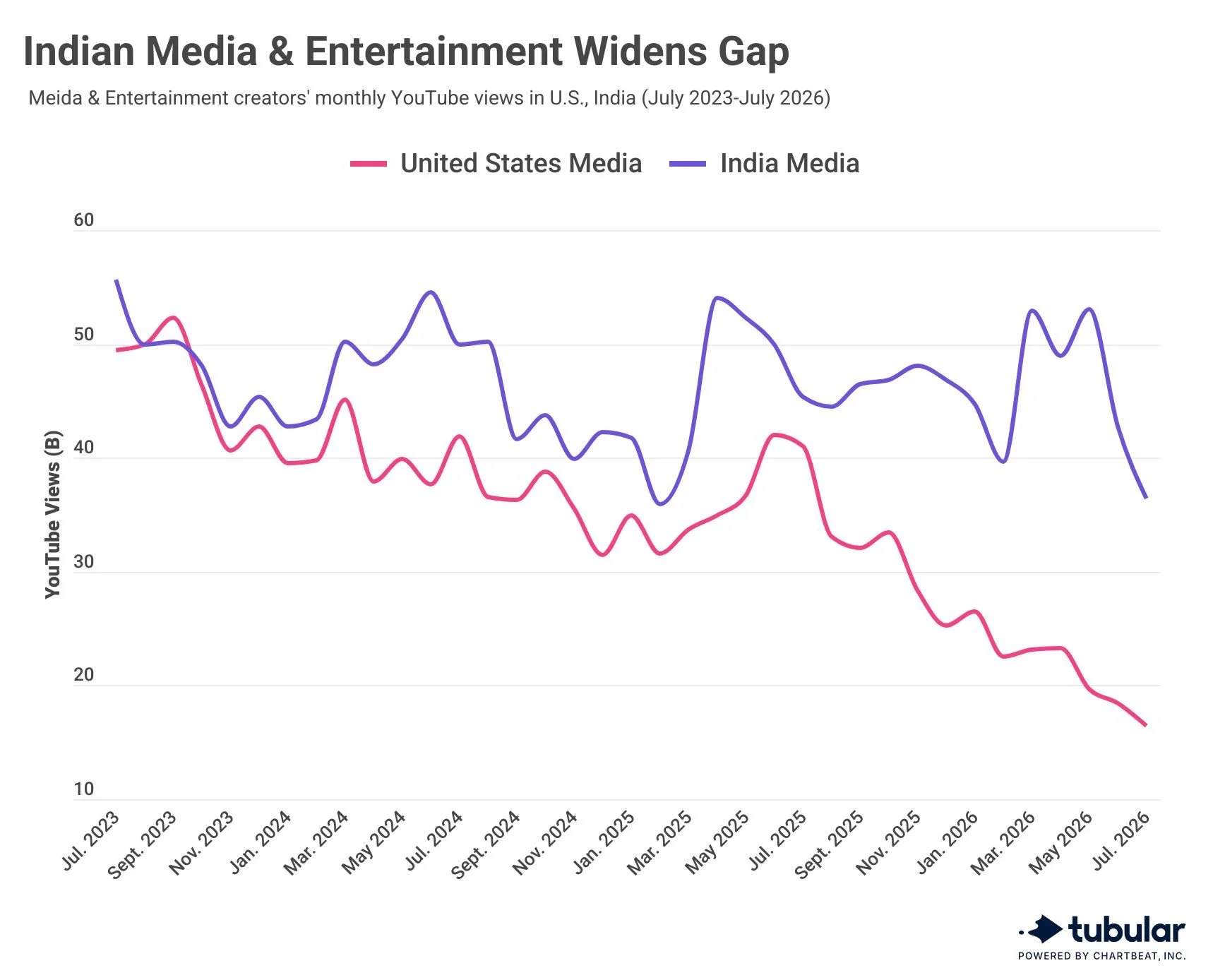
(via Tubular Labs, powered by Chartbeat)
U.S. media & entertainment pages on YouTube were beating Indian pages as recently as September 2023 (52.3 billion views to 50.2 billion), and the two were within relative shouting distance of one another every month from July 2023 through March 2024.
The gap starts widening significantly from there, with a few exceptions.
And while both increased the number of monthly uploads since 2023, by about 30%, Indian media & entertainment creators are now getting not only more views, but more views per video as well.
In 2026, Indian media & entertainment creators have 2.1x the number of views as their U.S. counterparts, despite also uploading 32% more videos running 20 minutes or longer. So what’s the takeaway for the U.S.?
Even if not competing directly with Indian media creators — in aggregate or individually — the country’s overall results seem to have fallen behind those in India. And while it’s a different market, they’re still finding success.
Don’t Be Scared Of Long Videos
Shorts are dominant globally. And even in India, they account for 48.3% of views from media & entertainment creators. Yet, they’re not the end-all, be-all. And those Shorts regularly drive audiences to longer videos housed on the platform as well. So there’s a direct pipeline between the creators’ highly successful Shorts (including 0-30 second videos that average nearly 100K views per upload in 2026) and the longer videos that net 52K views per.
Not every long video view is a short video view conversion. However, the long videos represent the importance of giving audiences something to stick around for.
In a market like India, where a significant portion of the audience may not have paid TV at all, it’s crucial to respond to that with content that is housed somewhere that’s free.
For Indian media, some of the potential loss from lacking paid subscriptions is then made up by ad revenues derived from these longer videos.
U.S. media doesn’t have the same problem right now, per se. Yet, as some younger audiences prefer social video to traditional TV, and the cost of paid streaming subscriptions grows exorbitantly, there could be a shift that makes longer content (full episodes, live streams, movies, etc.) more palatable.
Lean Into Music
Music is a large global category on YouTube, though some countries emphasize it more than others.
In India in 2026, nearly 4% of media & entertainment YouTube views were music-related, but on just 21K uploads. Music content from these creators generated over 621K views per video, 2-3x more than other top categories. Many of the year’s 20 most-seen videos from India are music videos.
For U.S. media & entertainment creators, music-related videos aren’t that far behind in terms of share of total views (3.7%). Yet, they’re averaging under 200K views per upload (as are nearly all of the top video categories beyond food & drink).
Some of that comes from an emphasis on Shorts there — since audiences aren’t necessarily watching music videos on YouTube for a small snippet. But it also comes from a different environment around “music videos” in the U.S.
Those behaviors don’t shift overnight, though by simply emphasizing music (music videos, songs from movies/TV, live performances), it’s a start to learning some lessons around how to better attract audiences and monetize their content on YouTube.
The other major takeaway is finding a new way to approach Shorts, across all categories.
Media’s advantage, especially in the U.S., is having a large cache of well-produced video material at their disposal. But if it’s always being chopped up into smaller doses (with no next step), then it’s losing its value. And the advantage it may have over creator/influencer content, which is many times built for shorter sessions.