The Streaming Audience Is Getting Narrower, Not Bigger
When in doubt, blame Wall Street. It’s a very effective wide-ranging philosophy right up there with “Hakuna Matata.” And in the case of Hollywood, it’s directly applicable.
Legacy media was left wallowing in envy at the juicy stock multiples and long leash Wall Street afforded to Netflix throughout the 2010s. So it launched a handful of streaming services to chase the same generous treatment. Yet the SVOD bubble popped across 2022-2023 when Wall Street pulled a 180 on the streaming model. Ever since, there’s been an audience contraction.
Streaming-exclusive viewing — audiences that can only be reached on digital — is now concentrating around older, female, and less diverse audiences. The most valuable customers are leaking to other entertainment options.
This doesn’t necessarily mean the total streaming audience is declining. U.S. TV screen streaming was up 19% year-over-year in 2025, per Nielsen, while Netflix’s global viewership was up nearly 2% (though engagement per viewer is down). But the composition of that audience is shifting. Growth is now distributed among a more narrow band of viewers.
Who’s Gaining: Older, Female, More Middle Class
You need to understand demographic changes over time to effectively program and advertise to an audience. Doing so without it is like trying to pitch a no-hitter while downing three beers after every inning. It’s going to get progressively harder.
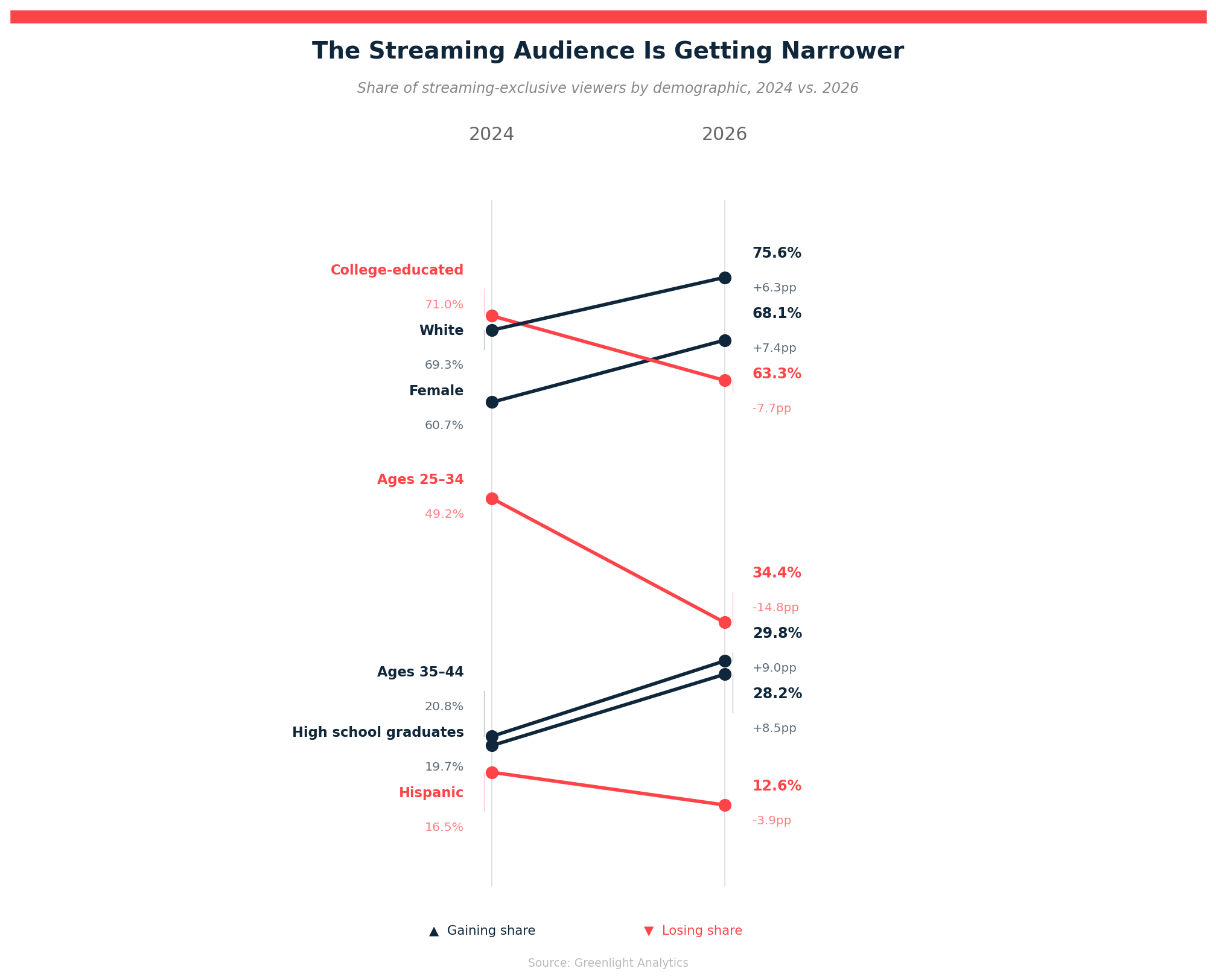
From 2024 to 2026, Greenlight Analytics saw its modeled share of female streaming exclusive viewers (ages 18+) jump from 61% to 68%. One would think that would be driven by an influx of younger users. But in reality, the 25-34 cohort dropped sharply (49% → 34%) in that time, while 35-44 and 45-54 are on the rise. The primary streaming audience is aging up, with young adults engaging less.
In that two year span, viewers with an annual household income of less than $50,000 grew to the largest segment (35%), per Greenlight. Median incomes held relatively steady, while there was a slight drop off in household incomes of $250,000-plus.
The most core streamers are rapidly becoming more habitual, less premium, older and more female. A trickier landscape to navigate for advertisers.
Who’s Losing: Younger, More Diverse, Higher-Engagement Viewers
Younger consumers have historically shaped and driven cultural momentum. That’s what makes their broadening media horizons so compelling. As we just covered, they are dropping out of the streaming-exclusive category.
From 2024-2026, Greenlight’s modeled share of streaming-exclusive white audiences has taken a noticeable jump (69% → 76%). The shares for Hispanic and Black viewers have declined in that timeframe, painting the streaming-only world as a less diverse consumer ecosystem.
The share for college-educated viewers has fallen (71% → 63%), while high school graduates have risen (20% → 28%).
What It All Means for Hollywood
We are quietly witnessing an industry-wide behavioral shift that is only just now being recognized. Consumers leaving the streaming-exclusive pool are more likely to attend theaters, more active on social media, and more likely to pay for content via VOD. Those that remain are more passive, valuing convenience and stable retention over cultural urgency. Streaming isn’t suddenly bleeding viewers, but it’s losing high-value customers.
This is good for movie theaters. Younger, diverse viewers are the most active ticket buyers. Their big screen appetites reinforce the medium’s once-wobbling reputation as the pop culture launching pad. But it also explains streaming’s creative race to middle-of-the-road programming (or “gourmet cheeseburgers”) in recent years. It aligns with the demographic developments. Broader content strategies, safer retention.
If the streaming-exclusive audience is becoming far more predictable and concentrated, can the industry reverse the trend? Does it even want to? Streaming executives may prefer the stability of this narrower audience. But the answers may very well come down to what Wall Street values most in Hollywood over the next five years.