The New Commissioner
The television industry spent the last decade redesigning itself for streaming. The next redesign may not be about another platform shift. It may be about commissioning itself.
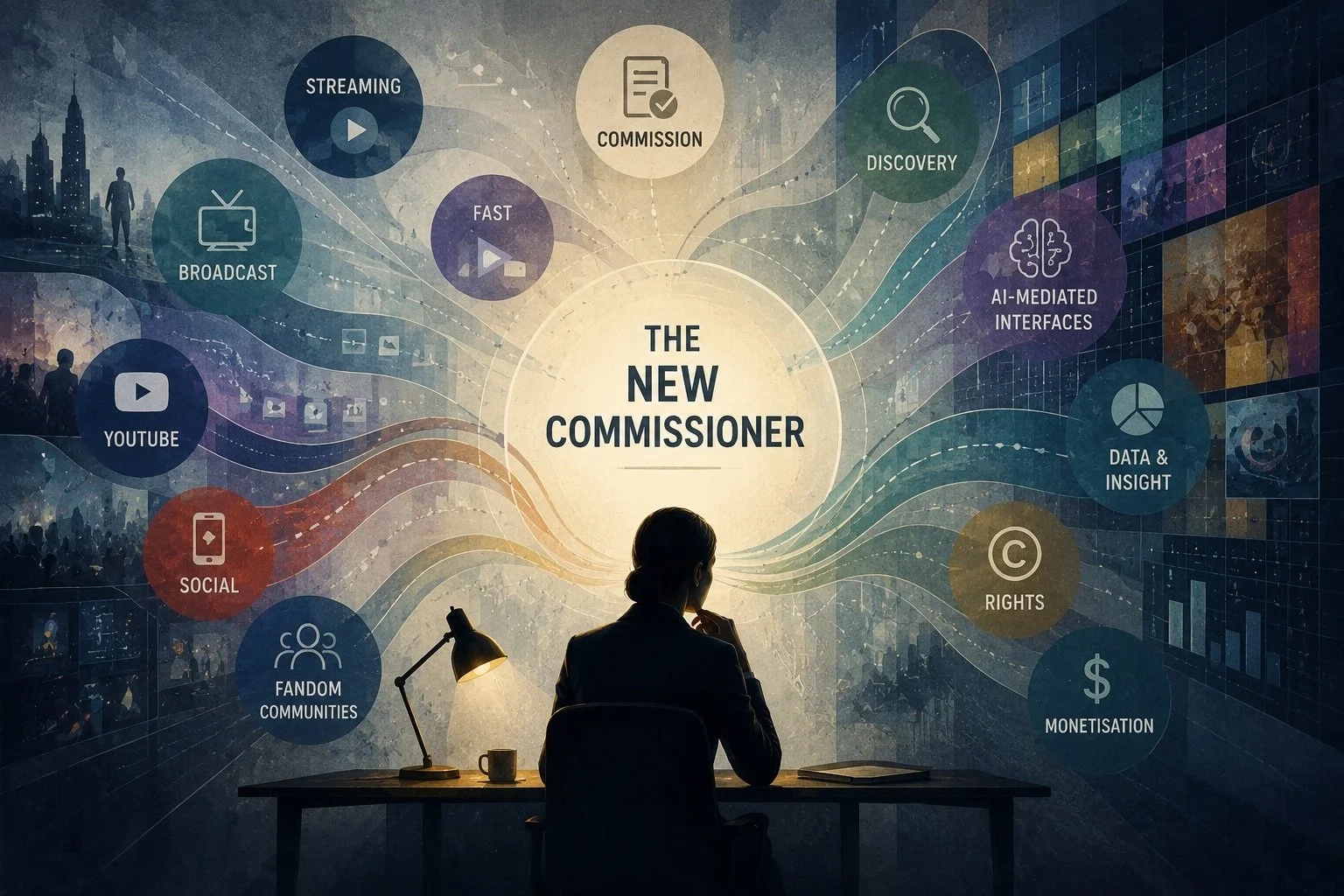
The traditional commissioner helped decide what got made, who it was for, and where it might perform. That role is not disappearing. But it is no longer sufficient for a world in which IP moves across broadcast, streaming, FAST, YouTube, social platforms, fandom environments, TV operating systems and, increasingly, AI-mediated interfaces.
The question is no longer simply whether a programme works in one place. It is whether the IP can travel, persist, and accumulate value across television environments.
In earlier columns, I argued that formats are becoming operating systems for IP: structures that allow stories, talent, audiences and commercial opportunities to flow across platforms. I then argued that Liquid Content creates real value when those flows compound, rather than merely extracting revenue once at the point of monetisation.
The question now is who inside the organisation is shaping that value.
For much of television history, the answer was easier. Content moved through a relatively orderly chain: commission, produce, schedule, distribute, monetise, archive. Separate functions could govern separate stages because the value was formed sequentially.
That world has not disappeared. But it is no longer the only logic that matters.
Liquid Content behaves differently. A clip may shape demand before the primary viewing event. A social moment may build memory long after it. A YouTube presence may not rival premium video in direct yield, but it can create demand and audience familiarity. A FAST channel may not transform the P&L alone, but it can prove recurrence.
The most valuable effects of IP may increasingly occur before, after, or entirely outside the primary viewing event.
That is not simply an expanded commissioning brief. It is a different institutional function.
The emerging commissioner is increasingly concerned with audience persistence, value accumulation and downstream leverage. Success, in this model, is not only whether people watch. It is whether the IP becomes more valuable because it has been watched, clipped, discussed, searched for, extended, licensed, sponsored, recommended or remembered.
This matters because not all value is direct. Trusted News, for example, may not need to sit behind a paywall to propel the earning power of a broadcaster. Its role may lie in trust, frequency, public relevance, brand authority, advertiser confidence and habitual return. Evaluating it solely by direct monetisation is to misunderstand how that value compounds.
Entertainment works the same way. A social extension may not monetise meaningfully in isolation, but it can build format memory. A talent-led clip may increase sponsor confidence. A FAST channel may prove that a catalogue still has recurring audience behaviour. None of these effects is incidental if the IP has been designed intentionally from the outset.
The commissioner’s question, therefore, changes.
Not only will people watch this? But: will it travel? Will it persist? What should remain scarce? What should create a habit? What should build sponsor value? What should return data or negotiating leverage to the rights owner?
This is where AI becomes strategically important, but not because it is another platform to commission for.
AI changes the discovery itself. The shift from browsing to intent - from scrolling through rails to asking directly for what you want to watch - is not simply a user experience evolution. It changes how IP is surfaced, interpreted, remembered and ultimately valued before consumption even begins.
That matters for commissioning because content increasingly needs to be understood not only by audiences, but by the systems mediating audience intent and access.
This does not mean every programme should be engineered for algorithms. That would be a grim future and a creative mistake. It means that in the AI-mediated world, the industry can no longer treat discovery, rights, monetisation and format design as afterthoughts once the creative work is complete.
The current AI debate is often framed defensively: how do broadcasters and IP owners protect content from scraping? That question is necessary. But it is not enough. The larger opportunity is to design rights models, licensing structures and formats that are ready for AI-mediated discovery and consumption without surrendering the value of the underlying IP.
This is where the old operating model starts to creak: too many decisions that determine future value are still treated as downstream considerations.
That is why the New Commissioner is not simply a better content buyer. Nor is it a creative executive with stronger digital instincts. It is a core institutional function that connects creative intent, discovery logic, rights architecture, monetisation design and audience persistence from the beginning.
They may increasingly determine whether a programme remains a one-off viewing event, simply an advertising inventory, or evolves into an IP system designed to compound value over time.