Why The Oscars Wanted YouTube
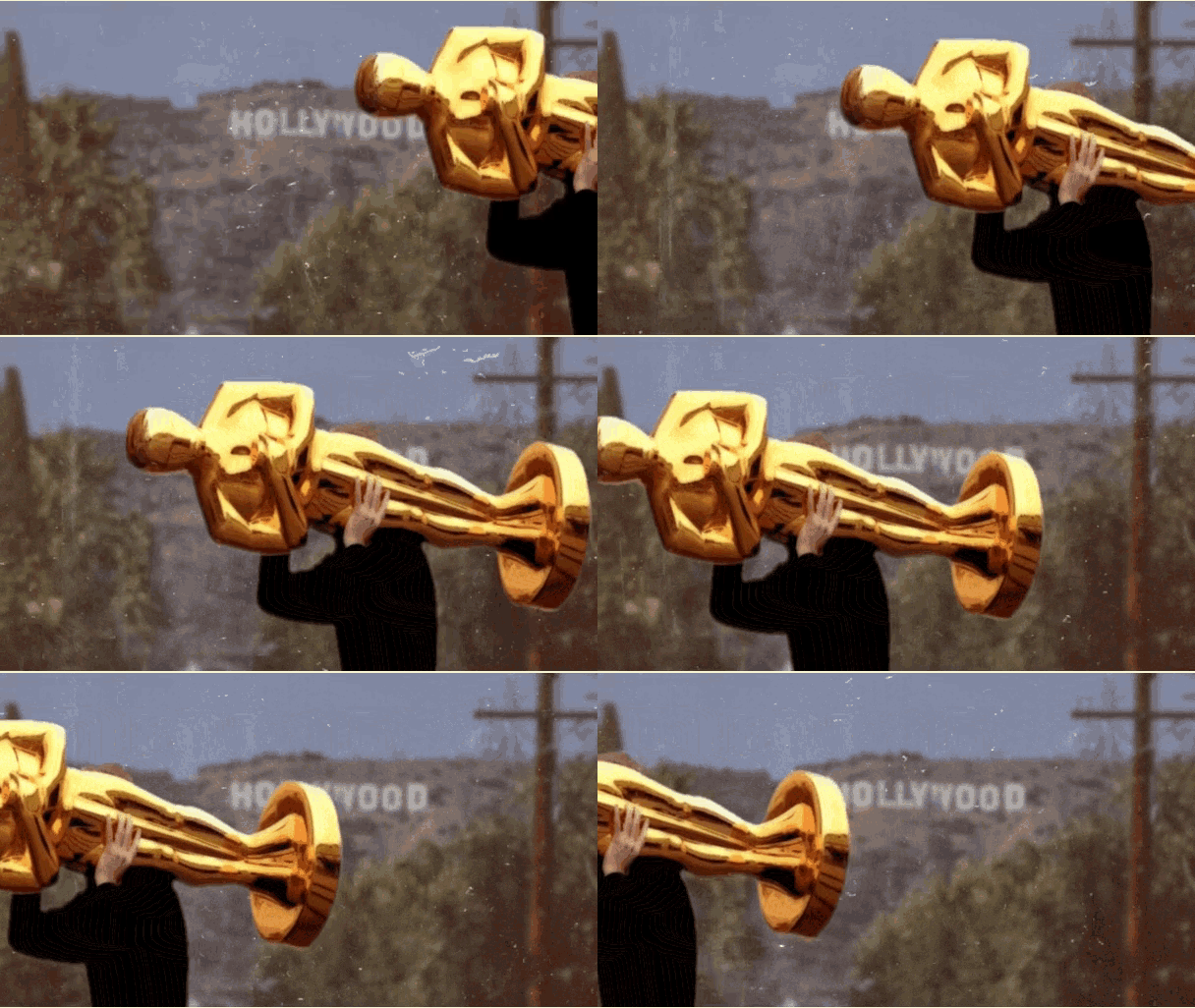
News dropped yesterday that Academy of Motion Pictures Arts and Sciences would be moving its annual awards ceremony, colloquially known as “the Oscars” to YouTube in 2029.
The question though is not what’s in it for YouTube—the prestige alone is worth it, let alone the ability to convince people that they are really just the evolution of TV.
The real question is what is in it for the Academy and fortunately that one is not very difficult to answer.
You see, unlike ABC, the previous rights holder, YouTube is a global business and increasingly, so is Hollywood.
As I wrote last week in the Week In Review, the movie business is not in a good place. Attendance is down, but more than that, relevance is down. People no longer look to movies to provide cultural moments.
At the same time, Hollywood has been finding success in the untapped audiences of the Global South.
Movies that translate easily to other cultures—superhero movies, for example—do gangbusters overseas, which is why you see so many of them.
At the same time, Hollywood’s iron grip on the global entertainment ecosystem is steadily loosening.
That is driven by a number of factors—the aforementioned global market, the desire to hear stories from many cultures and, above all, the lessening of the “production gap.”
Advances in AI, along with more accessible pricing for cameras and other hardware, means that filmmakers in other markets now have access to the sort of production quality that was once more or less exclusive to Hollywood. Which means that YouTube’s global reach and global audience will be even more critical for the movie industry.
The final driver for the Academy is the access to YouTube’s talent pool.
Movie audiences skew young—teens, 20s and 30s are the sweet spot—and who better to appeal to that young audience than their favorite influencers. Which is why it’s notable that the deal included shoulder content as well: it’s easy enough to see all those red carpet clips winding up on YouTube Shorts.
And while it was a big deal when YouTube got rights to the NFL, the spin on that was centered around YouTube TV, their popular vMVPD.
This time, YouTube TV is part of the deal again, but the focus is on YouTube proper.
That’s because the industry is starting to accept that YouTube is TV. People can debate whether it’s “TV-like” “TV adjacent” or “TV 2.0” (my favorite), but it’s got a lot of video that’s watched on a big screen.
Yes, it has some work to do—I’ve seen enough jokes in the past 24 hours about how they’re going to cut away to commercials for weight loss plans mid-Best Actor announcement—but that would seem to be an easy fix, especially on a live show, and it’s something YouTube has dealt with before, during NFL games.
So congrats to Fede Goldenberg and the YouTube team on the win. As for the rest of you, you’ve got three years before this actually goes down, but mark my words, this deal is going down as a turning point.
One more thing: if there’s anyone who is happy about this deal, it’s likely Netflix’s Ted Sarandos.
Why?
Because in order for the Warner merger to go through, Netflix is going to need to convince regulators that the market they are in includes digital giants like Google, Amazon and Apple, which would mean they are nowhere near the market-dominating near-monopoly their enemies will try and make them out to be.
A deal where Google’s YouTube is competing with Disney for rights to the Oscars is a most excellent proof point for that argument.
Especially now that Oracle, Silver Lake and MGX have officially inked the deal to take over TikTok’s U.S. operations.
For Sarandos, the timing couldn't be better. With Larry Ellison’s Oracle taking a big chunk of TikTok—while Ellison is simultaneously backing the Skydance/Paramount offer to buy Warner—it’s easy to argue that the lines between 'Big Tech' and 'Big Media' are even blurrier.
That in turn allows Netflix to paint itself not as a market dominator, but as the only thing standing in the way of a total Tech takeover.