Tube Trends: Why 2-To-5 Minute Videos Are Media’s Sweet Spot
In some respects, media companies have their work cut out for them on social video platforms like YouTube.
Audience views are overwhelmingly watching more creator videos across all platforms —Chartbeat video intelligence data shows that at least 85% of global views in 2026 are for creators. And Shorts, a format that can lower the barrier for entry, are watched more than longer videos.
Brands are also willing to spend on platforms like YouTube, making their content (or sponsored content) more likely to appear in a given users’ algorithms.
And yet, most media has an advantage that they can utilize: A large cache of highly-produced video content. For traditional news, in particular, those are not made for sub-60-second formats or 20-minute views. But they are perfect for 2-to-5 minute watches.
Chartbeat’s new benchmark report dives into how South Korean media has (as a group) emphasized these produced 2-to-5 minute videos to drive views. But the findings are instructive for media in any country as well.
The 2-to-5 Minute Advantage
On YouTube, 2-to-5 minute videos make up the largest portion (23%) of media uploads by duration, but only 15% of views. The discrepancy shows a clear understanding from media on its strengths (especially segments from traditional broadcast media), but a lack of viewership and engagement across some geographies.
As mentioned above, one country that has leaned into this video duration is South Korea, and the results have been impressive.
Through the first half of 2026, over 21% South Korean media & entertainment views have been driven by 2-to-5 minute video. That was significantly higher than the U.S. share despite similar shares of uploads, and South Korean media also more than doubled views per video.
The advantage of these videos is two-fold, especially for traditional news companies: Broadcasts are already broken up into segments of these lengths, making for little/no editing and creating resource savings. And the 2-to-5 minute duration provides monetization opportunities that don’t really work for Shorts (given their length).
For South Korea, in particular, these publishers also made this video duration a core part of their upload strategy. So audiences understood that they could find 2-to-5 minute segments on those pages. MBCNews, YTN, and SBS all uploaded over 10K videos of that length, and were not flooding their channels with other video durations as well.
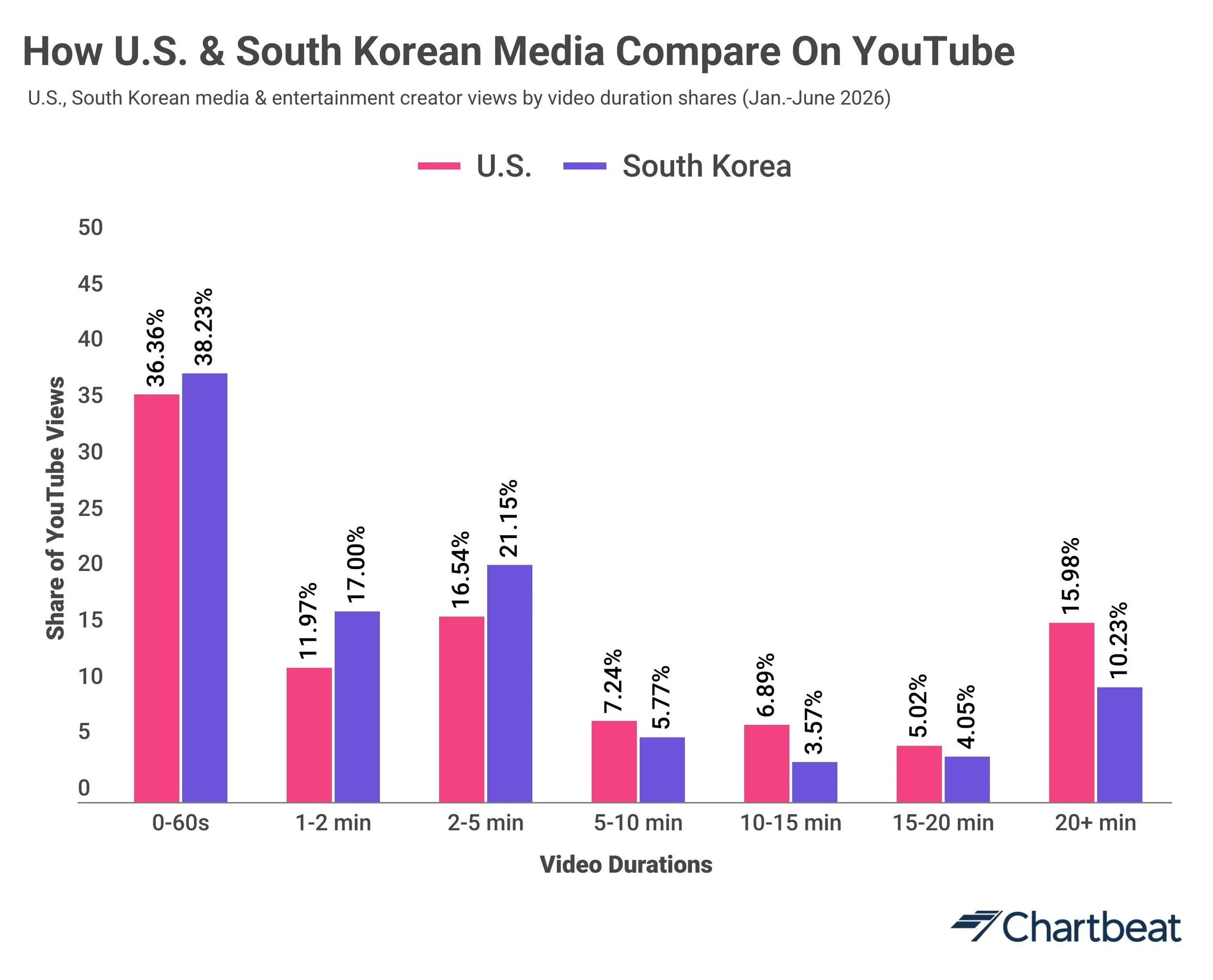
(data via Chartbeat)
The U.S. Opportunity
In the chart above, you can see the differing approaches for the two countries’ media companies.
In aggregate, South Korean media has more views from videos under two minutes long (45.23%), but also more views of videos 2-to-5 minutes in duration (21.15%, which is its wheelhouse). And those 2-to-5 minute videos are getting 2.3x more views than the U.S. videos of the same length.
Meanwhile, U.S. media does generate a significantly larger share of views on videos 20 minutes or longer. But South Korea has slightly more views per video there, too.
Some of these per-video discrepancies come from a volume difference. U.S. media has uploaded five times the number of videos, and with that increase can also come a larger number of videos that don’t land. But that’s also where the U.S. can find better efficiencies.
Over 29% of U.S. media uploads are on videos under one minute long, despite that video length not being its natural forte. While not a universal truth, many domestic publishers — especially those endemic to TV — can take this as a hint that they’re not necessarily getting views from those Shorts worth the effort; from a views or resources perspective. And they’re not able to monetize them as well.
U.S. media creators are excelling with 20-minute videos, but a good portion of that comes from hours-long simulcasts of traditional newscasts on TV. Where they’d potentially fare better when it comes to maximizing video content and generating loyal and repeat viewership could be the 2-to-5 minute duration that allows audiences to better customize their viewing for the screen and available time.
By investing more heavily in these 2-to-5 minute videos, they could also pull back on both Shorts and the 5-to-20 minute videos that are not generating as many views or as much engagement. There’s a time and place for them, of course. But the benefits of them at scale simply aren’t there when compared to the 2-to-5 minute alternatives.