The MCU’s Urgency Curve — And What It Signals For ‘Avengers: Doomsday’
The Marvel Cinematic Universe became the most consistently successful franchise in film history by creating a sense of urgency around each and every chapter. For more than a decade, audiences rushed to theaters with the speed of Quicksilver to devour the latest installment lest they be left behind in the cultural conversation.
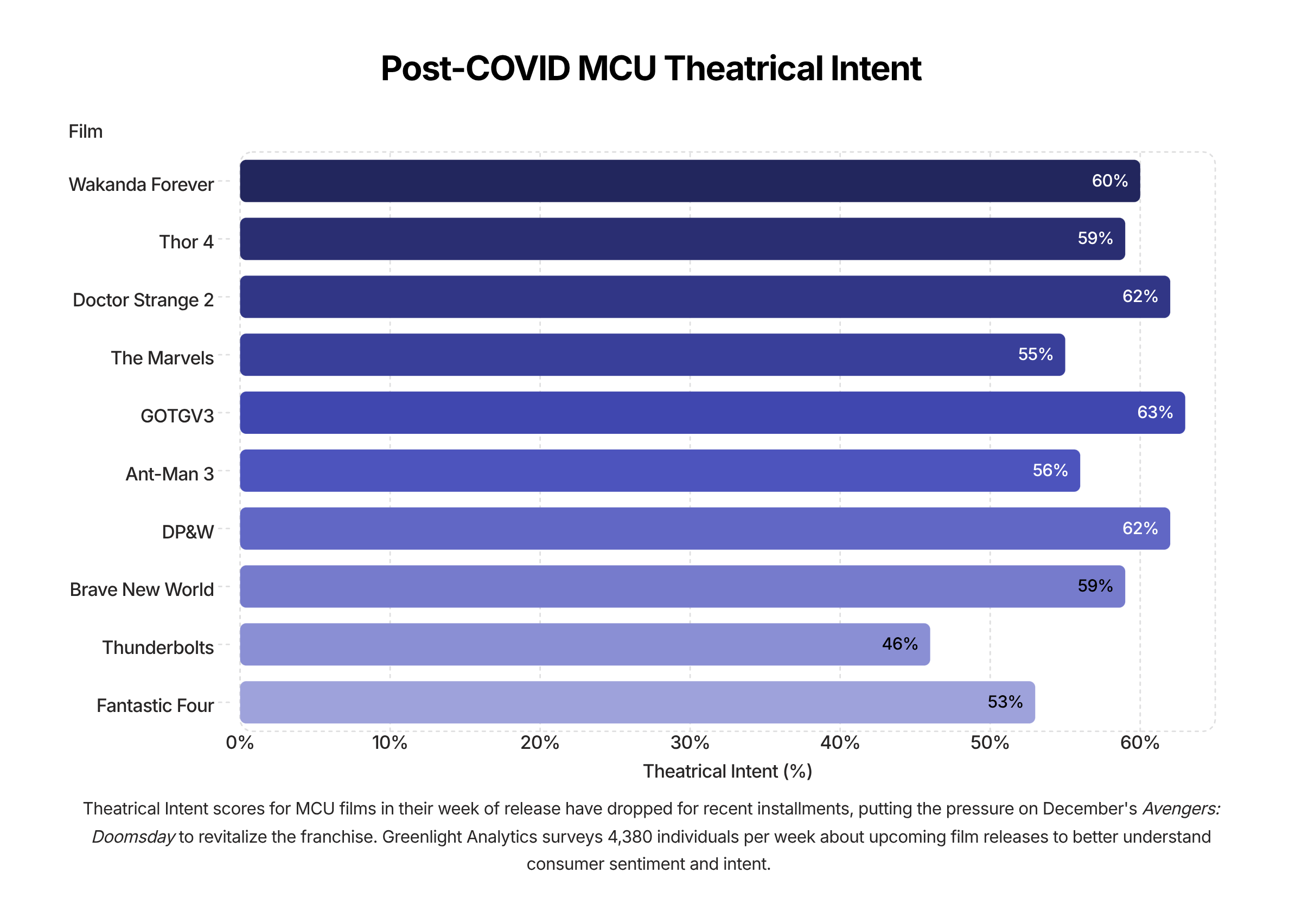
While 2019’s Avengers: Endgame marked a natural off-ramp for some fans, Theatrical Intent scores for select event releases in its wake suggested the franchise was still as financially potent as ever. Guardians of the Galaxy Vol. 3 (63%), Doctor Strange in the Multiverse of Madness (62%), and Deadpool & Wolverine (62%) all tracked like must-see blockbusters through their releases, with the subsequent box office to prove it. But more recent titles — Captain America: Brave New World (59%), Thunderbolts (46%), and The Fantastic Four: First Steps (53%) — have not elicited the same excitement, according to Greenlight Analytics. The data suggests the MCU isn’t lacking in Awareness or Interest. It’s losing urgency.
The big question is what this means for December’s Avengers: Doomsday.
Avengers: Doomsday
A whopping nine months before release, Avengers: Doomsday looks like a winner on paper. Awareness (45%), Interest (57%), Theatrical Intent (50%), and Willingness to Pay (61%) are all strong, especially this far out. Awareness will rise dramatically as we get closer to its December 18 release. But the early signal is already clear: Theatrical Intent is in line with several recent MCU releases despite minimal marketing. The return of Robert Downey Jr. will do that, I suppose.
Even in the streaming era, Theatrical Intent remains the strongest indicator of opening weekend prospects. Post-COVID MCU hits tend to cluster around the 60% zone. If a title lands within that vicinity, studios can typically expect a strong debut, impressive premium large format ticket sales, and a high domestic box office floor. It helps that 50% of those interested in Avengers: Doomsday prefer to see it in theaters, compared with 29% who would rather watch it at home. Even within that split, opportunity exists.
Of that 29% of home viewers, 10% are willing to pay for it (either via a VOD transaction or by signing up for a streamer they don’t currently subscribe to), while 19% prefer to wait until it arrives on a streamer they already pay for (in this case, Disney+). The theatrical audience will drive opening weekend and months of box office legs. But a not insignificant streaming cohort is already poised to support downstream engagement. Remember, studios tend to keep roughly 80% of PVOD revenue. And Disney+ could use a jolt after Percy Jackson Season 2 didn’t quite match Season 1’s viewership and the fantastic Wonder Man didn’t elicit the audience it deserved. (Disney’s share of U.S. streaming is relatively flat over the last two years, per Nielsen).
Disney’s famous flywheel has always positioned film as its engine. But “content” is no longer just a product catalyst. Now more than ever, blockbuster films must serve as the raw material for the broader Disney ecosystem. The company’s parks division generates about 60% of company profit and its streaming prognosis largely drove its share price during the pandemic, highlighting how crucial cross-platform success has become.
Though the MCU oversaturated the market and lost some of its novelty, it hasn’t completely lost its audience. Not every entry will automatically generate blockbuster-level enthusiasm based on the Marvel brand alone. But that’s why Doomsday is so integral to the franchise’s future success. The film must not only work financially, but revitalize the entire franchise’s theatrical urgency so that more theme park attractions, streaming subscriptions, clothes and toys, and games can be sold.
Ironically, Doomsday has the potential to be a rebirth.