NBC Brings Local Voices To National Baseball — And Changes The Game
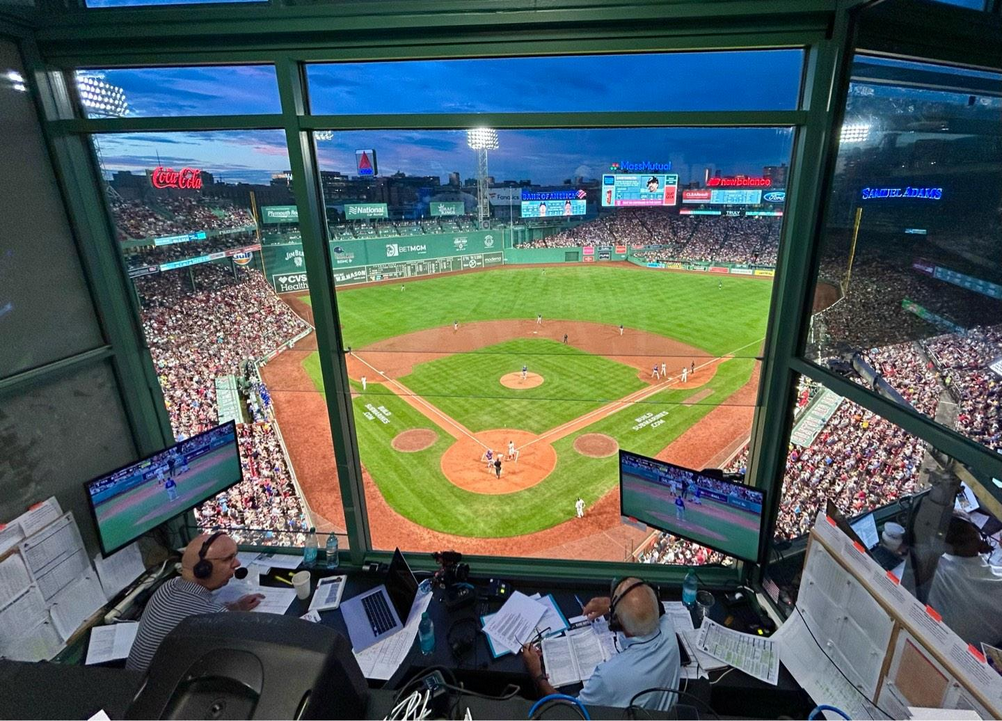
photo credit: A View From My Seat
NBC Sports’ plan to use a rotating cast of local analysts on its Sunday night Major League Baseball broadcasts has been widely framed as a novel production twist. That undersells it.
What NBC is really doing is taking a meaningful swing at the core idea of what a national sports broadcast should look like — and, in the process, signaling where sports television may be headed next.
Turning The National Booth Into A Local One
At a basic level, the format is straightforward. Jason Benetti will handle play-by-play, while analysts rotate week to week, often with direct ties to the teams on the field. In many cases, those voices will come from local TV or radio booths — the same people who follow those clubs every day.
On paper, it’s an intuitive fix to a long-running issue. National baseball broadcasts have struggled for years with a familiar complaint: they can feel distant. The production is polished, the storytelling is competent, but the insight can drift toward the generic — especially compared to the specificity fans hear from their local announcers over a 162-game season.
NBC’s answer is simple: bring that local knowledge into the broadcast instead of trying to approximate it.
From Streaming Experimentation To Prime-Time Stage
This isn’t entirely new. NBC tested a version of this model during its Peacock-era “MLB Sunday Leadoff” games in 2022 and 2023, frequently incorporating team-specific analysts and reporters. At the time, it felt like a low-risk experiment — a way to differentiate a streaming package.
What’s changed is the stage. By bringing that approach to a flagship national window, NBC is no longer experimenting at the margins. It’s making the concept central to how it presents the sport.
Extracting What Still Works From Local Broadcasts
There’s also a broader industry context. Regional sports networks — the traditional home of local announcers — are under sustained pressure. Cable and satellite distribution has shrunk due to cord-cutting, advertising revenue is declining, and consolidation has left some networks financially fragile. As a result, the long-term structure of the RSN model is increasingly uncertain.
NBC doesn’t need to solve those problems. It can simply extract what still works: the announcers. Instead of building a traditional national booth and asking it to cover the entire league evenly, NBC is importing expertise from people who already have it. The result is a broadcast that aims to feel more informed without sacrificing scale.
For decades, national broadcasts were positioned as the top of the hierarchy — more authoritative, more polished. Local broadcasts offered depth, but within a narrower lane. NBC is beginning to collapse that distinction.
The Voice That Holds It Together
This approach only works if there’s a steady presence tying it together — which helps explain NBC’s decision to build around Benetti.
He’s not just a national voice. He currently serves as the television play-by-play announcer for the Detroit Tigers, following a previous run in the same role with the Chicago White Sox and prior dues-paying with teams in the minors. That background gives him a deep understanding of the rhythms and storytelling arcs that define a full baseball season.
At the same time, Benetti has built a national profile through college football, basketball and MLB assignments with Fox Sports. That dual perspective — local immersion paired with national experience — is exactly what this format requires.
Here, the play-by-play role is less about narration and more about orchestration. With analysts changing weekly, the broadcast needs someone who can establish tone quickly and adapt in real time. Benetti’s flexibility makes him a natural fit for a booth that won’t look the same from one week to the next.
But a booth that changes week to week isn’t just an opportunity — it’s also a calculated risk.
Consistency has long been a strength of national broadcasts. Familiar voices create stability and allow chemistry to develop over time.
A rotating booth disrupts that. Some combinations will click. Others may feel uneven. Over the course of a season, the experience could vary more than viewers are used to. NBC is betting that variability is acceptable — so long as the payoff is greater specificity and insight.
Blurring The Line Between “Local” And “National”
If this approach gains traction, it doesn’t just reshape national telecasts — it likely reframes local ones, too.
Historically, local broadcasts derived value from exclusivity. If you wanted that level of team-specific knowledge, you had to watch your regional network. NBC is testing a world where that expertise is more portable.
If national windows can feature credible, team-embedded voices, the line between local and national softens. That creates both opportunity and pressure. It elevates local broadcasters, giving the best of them a broader platform. But it also shifts the focus away from distribution and toward talent. If the announcer is the most differentiated asset, the long-term leverage of the RSN model becomes less clear.
The likely outcome is evolution, not disappearance. Local broadcasts may lean harder into what still sets them apart: daily access, deeper storytelling, and a more defined point of view built over time.
A Blueprint For Other Sports?
The logic here doesn’t stop with baseball. The National Basketball Association and National Hockey League operate with similarly strong local ecosystems, and their national broadcasts often face the same critique — polished, but occasionally lacking texture. In both leagues, national viewers often notice the difference between generic commentary and insights that reflect a deep understanding of a team’s daily rhythm.
A rotating analyst model could address that without requiring a full overhaul. Even college sports could adopt a version of this approach, blending national distribution with regionally informed perspectives and earnestly biased announcers. At minimum, NBC is expanding the playbook.
This shift also reflects how fans consume sports today. Team-specific coverage is everywhere — podcasts, newsletters, digital outlets, and social media feeds offering constant, granular insight. Much of it goes deeper than traditional national broadcasts. In that environment, the conventional model can feel a step removed. NBC isn’t trying to out-polish that dynamic. It’s trying to meet it — bringing the level of detail fans already expect into a broader national window.
National Coverage, Now With Local Depth
It’s easy to see NBC’s rotating analyst plan as a clever production tweak, but it feel much more than that.
NBC is betting that fans don’t just want a professional broadcast — they want one that feels rooted in the teams it covers. By prioritizing insight over uniformity, and specificity over rigid consistency, the network is redefining what “national” coverage can mean.
If the gamble pays off, it could do more than just change the sound of Sunday night baseball. It could signal a shift across sports television, proving that national broadcasts don’t need to sacrifice depth for scale — and that the best way to connect with audiences may be to bring the local booth to the national stage.
Local News To Peruse
Judge Grants Restraining Order To Pause Nexstar-Tegna Merger - Ted Johnson [Deadline]
Nexstar Tells Judge Aspects Of Tegna Merger “Cannot Be Reversed” - Ted Johnson [Deadline]
US Senators Probe FCC Chief Over Fast-Tracked Nexstar-Tegna Deal - Kelcee Griffis [Bloomberg]
Carr Blares The Horn - Jon Passantino [Status]
Lawmakers: FCC Should Mandate NextGen TV Switch To Spur Consumer Interest - Matthew Keys [TheDesk.net]
ATSC 3.0 Update: Dueling Surveys & Contact Your Congressperson! - Lon Seidman [Lon.TV]
Comcast Pulls Scripps-owned Channels From Xfinity TV - Matthew Keys [TheDesk.net]
Can Regional Sports Networks Survive, Or Even Thrive? Depends On Whom You Ask - Evan Drellich [The Athletic]
Fox, Sinclair Tell FCC That Sports Should Stay on Broadcast TV - Kelcee Griffis [Bloomberg]
Hearst Exec: Yes, Newspapers Are Still A Good Investment - Brier Dudley [The Seattle Times]