What ‘Hoppers’ And ‘The Bride’ Tell Us About At-Home Demand
There are no moral victories in sports, but there is plenty of nuance when it comes to value. For example, my New York Yankees have not won a World Series since all-world slugger Aaron Judge made his rookie debut in 2016. Yet the three-time MVP is consistently among the top-selling jerseys every season, while the team routinely ranks in the top three in tickets sold, average national TV ratings, and average local audience. The House That Ruth Built is, uhh, judged on rings. But there’s no debate that Judge has helped the franchise’s fortunes without one.
A similar philosophy has long been present in the film industry. Every executive hopes that every theatrical release becomes a blockbuster. But for years, even box office disappointments held out hope of marching toward profitability thanks to the at-home market. Opening weekend is but a snapshot of the monetization tale. Films can and do find success beyond the multiplex.
Pre-release audience signals can help project film performance in at-home windows, providing early strategic prescriptions for studios. Let’s take this weekend’s Pixar original Hoppers and Warner Bros.’ Frankenstein genre mashup The Bride as examples. The former is gearing up for a healthy opening weekend while the latter is less certain.
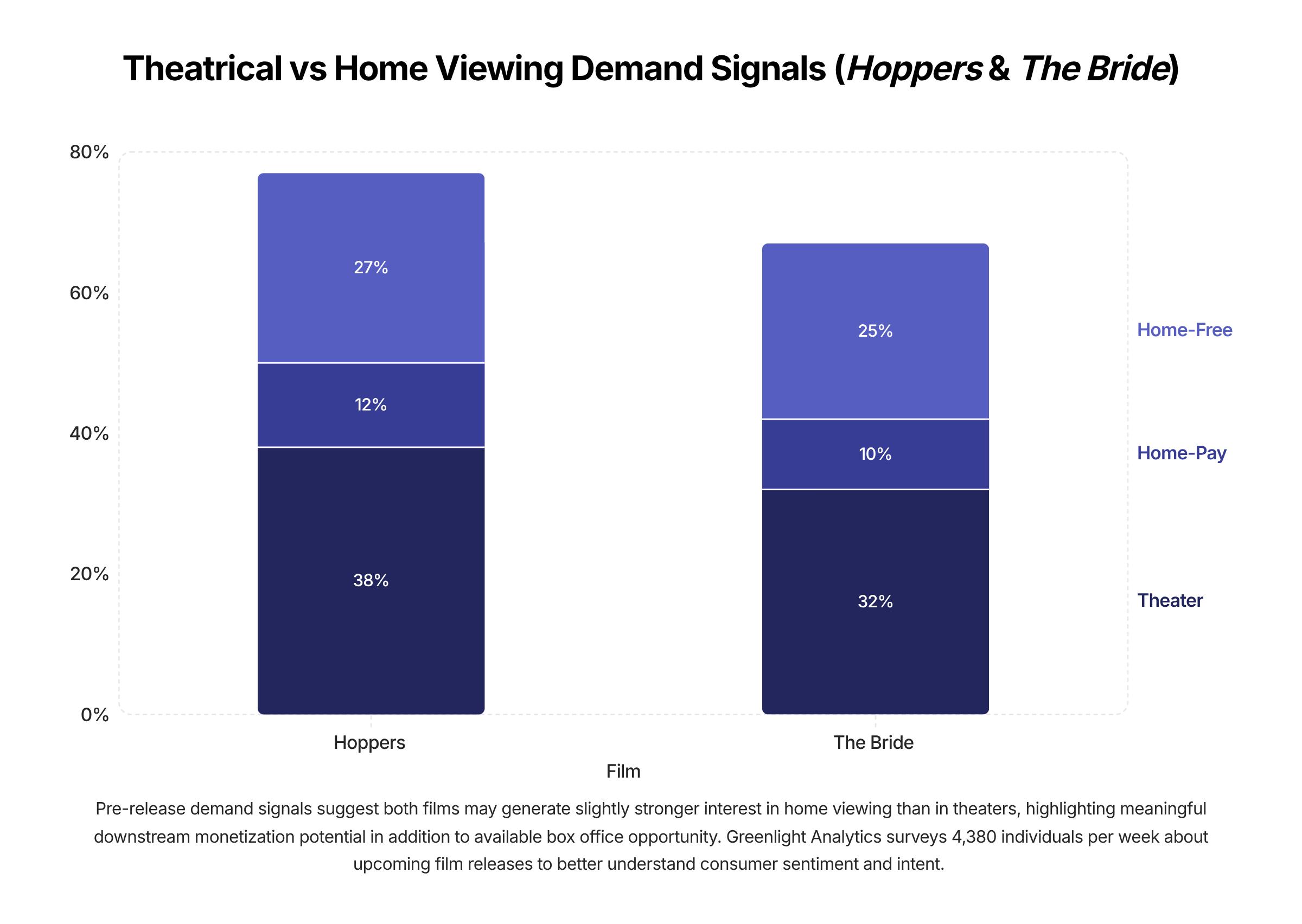
Theatrical Intent—those expressing a desire to see a film in theaters—for Hoppers (38%) and The Bride (32%) is slightly behind Home Intent, or those expressing a desire to watch a film at home (39% and 35%), according to Greenlight Analytics. This doesn’t automatically equate to box office weakness (Hoppers is eyeing a strong debut around $40 million). It simply means that there is a wider available audience beyond theaters. To paraphrase Arrested Development, there’s always money in subsequent windows.
Around 12% of Hoppers home viewers expressed a willingness to pay for the film via VOD or a new streaming subscription, versus 27% of home viewers who prefer to watch for “free” through an existing streaming subscription. Similarly, 10% of The Bride’s home viewers are willing to pay to see it, compared with 25% of home viewers content to wait until it hits HBO Max.
The Home-Pay cohort obviously represents more immediately monetizable interest, even if they lack the urgency required to head to theaters. The additive Home-Free audience, meanwhile, will contribute to streaming viewership and retention. Pay-1 window licensing fees are often determined by box office revenue, which makes forward-looking insights all the more valuable.
Since the theatrical and home audiences for Hoppers are relatively equal, Disney can emphasize its theatrical exclusivity to further eventize the title and stress urgency in its marketing. After that, the Mouse House can pivot to a broader post-theatrical push to soak up VOD revenue and streaming minutes. If The Bride disappoints in its debut, Warner Bros. can begin treating its theatrical rollout as a marketing campaign for its at-home availability. The hope is that positive word-of-mouth can be promoted for meaningful downstream engagement. Maybe the studio will even make it available on VOD quicker than usual.
Box office, like World Series championships, is still the ultimate goal. But studios increasingly need to evaluate film financials across the full window lifecycle, and remain nimble enough to pivot to the most advantageous opportunity when audience data sends a clear message. Movies such as Hoppers and The Bride demonstrate how we can identify a title’s theatrical leakage risk and at-home upside before the first reel is ever shown.