How Carr’s Deregulatory Push Masks A More Perilous Power Grab
@BrendanCarrFCC / X (fka Twitter)
If you want to understand where FCC Chairman Brendan Carr is steering the future of American broadcasting, the current Jimmy Kimmel Live! imbroglio offers some telling clues.
Carr’s politically orchestrated campaign against ABC/Disney and Kimmel — carried out with the help of a pair of conveniently pliable, pending-deal–compromised affiliate station groups — may look like mere culture-war theater. But it signals a deeper strategy. The Chairman is not just attempting to dismantle structural rules through his previously announced deregulatory blueprint — he is now openly testing whether the FCC can police content. What looks to many like performative grandstanding is really a direct message to broadcasters: your programming choices now factor into regulatory calculations.
Deregulation As Cornerstone
In his 2023 contribution to the conservative-leaning Heritage Foundation’s ominous Project 2025 government reform opus, Carr outlined a sweeping deregulation agenda: eliminate ownership caps, scale back public interest mandates, and put broadcasters on the same, less-restrictive regulatory footing as cable and streaming platforms. His argument was straightforward: in an era of unlimited competition, why should broadcasters face outdated legacy rules?
The implications are striking. Scrapping ownership limits would accelerate consolidation, concentrating power in the hands of the largest station groups. Weakening “New Deal–era” public-interest obligations would erode requirements for children’s programming and local news. Promoting “technology neutrality” could unravel must-carry and retransmission consent protections, leaving broadcasters with less leverage in a market already strained by cord-cutting and streaming competition.
But the Kimmel spectacle shows that Carr’s FCC agenda is no longer just about deregulation, but also something more potentially perilous — content oversight.
“Public Interest” As Cudgel
The Chairman has suggested stations airing “biased” programming could face license challenges. He praised Nexstar and Sinclair for preempting Kimmel on their ABC affiliates, and has similarly threatened FCC investigations into The View, Saturday Night Live, and even PBS and NPR. He has also reopened long-dismissed complaints about supposed “partisan” election coverage. His primary instrument is the FCC’s historically broad and vaguely defined “public-interest” mandate — a power that can, if misapplied, undermine editorial independence.
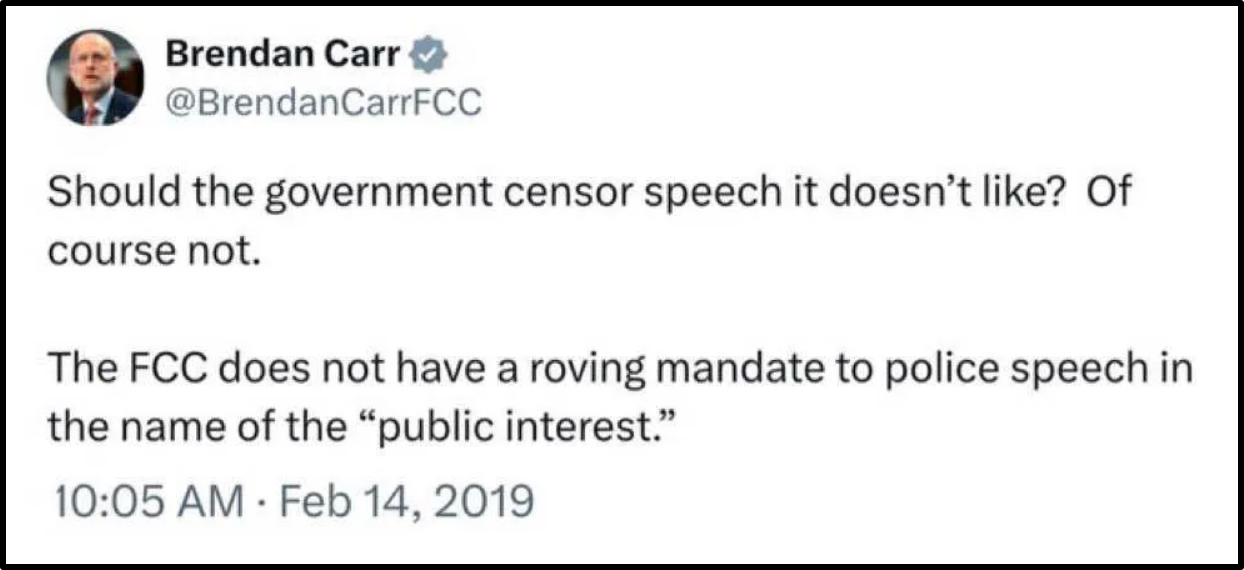
For decades, the FCC has avoided using licensing power to police political speech, precisely because of First Amendment concerns. Despite knowing better when he was a mere commissioner, now-chairman Carr instead frames his current logic as defending free expression — while simultaneously threatening broadcasters for decisions they have made or might make.
Paradoxically, he argues that broadcasters should be treated like digital platforms, yet selectively applies rules unique to broadcasters to exert content leverage. Digital platforms face no comparable license risk; local TV does.
The stakes are profound; the potential effects, perverse. Market-driven consolidation already threatens the diversity of local voices. Add FCC scrutiny over programming, and stations may avoid controversy altogether — potentially softening investigative reporting, coverage of marginalized communities, or satirical content critical of power to prevent becoming the next FCC target.
Double Trouble
The combination of deregulation and selective enforcement is a double squeeze: owners gain scale and power, while local stations and their newsrooms grow risk-averse. The “empowerment” of local broadcasters Carr touts increasingly looks like pressure to conform.
Carr’s defenders argue he is modernizing the FCC for a competitive digital era. But modernization should not mean stripping away obligations that sustain civic life — nor should it turn the FCC into a content watchdog. When license renewal hinges on whether programming meets the chairman’s personal definition of “serving the public interest,” broadcasters aren’t liberated — they’re intimidated.
The future of local television will not be decided in social media spats or late-night comedy dust-ups. It will be decided by how ownership rules, public-interest standards, and content oversight are rewritten and enforced. If Carr’s vision prevails, local TV risks becoming both homogenized and politicized — consolidated into a few large conglomerates, and pressured to avoid programming that might displease those in power.
That may deliver short-term profits and partisan wins, but for communities it means fewer independent voices, weaker accountability, and a diminished public square.
Carr calls it free-speech protection. In reality, it looks more like government-sanctioned censorship — paired with deregulation that hollows out the very journalism the “public interest” is supposed to protect.
Local News To Peruse
Which ABC Stations Are Not Airing Jimmy Kimmel’s Return? See List. - Saman Shafiq [USA Today]
How Long Will Sinclair And Nexstar’s Jimmy Kimmel Blackouts Last? - Todd Spangler [Variety]
Jimmy Kimmel Impasse Follows Years Of Growing Tensions Between Local TV Stations And Broadcast Networks - Dade Hayes [Deadline]
Even As Jimmy Kimmel Returns To The Airwaves, TV Networks Remain More Vulnerable To Political Pressure Than Ever Before - Sage Meredith Goodwin & Oscar Winberg [The Conversation]
The Obscure FCC Rule Driving The Kimmel Argument - Aaron Mak [Politico]
NFL Commissioner Roger Goodell Says League Could Renegotiate Media Deals As Soon As 2026 - Alex Sherman [CNBC]
Sports Broadcasting Act May Be Too Archaic To Save College Sports - Michael McCann [Sportico]
Price: FCC Must Mandate A 2028 NextGen TV Transition - Hank Price [TVNewsCheck]