The Chief Data Officer Is Dead, Long Live The Chief AI Officer
There I was sitting in a circle with a group of talented mid-life executives, baring our souls. Passing the (figurative) talking stick. Sharing stresses, frustrations, alienation.
Don’t be jealous: they were all Chief Data Officers (CDOs).
One hates to stereotype. But one does anyway: these folks were all quants, wearing the uniform of the elite of the species: midlife men with silvering temples sporting blue blazers; and wearing brass buttons, and their Computer Science PhDs, on their sleeves. The midlife women--more CS PhDs--raised the mood somewhat with patterned silk and pearls. But no stroke of style could brighten their haunted air: this lot were up against it, and it showed in anhedonic frowns and muttered confessions.
Paraphrasing the sharing:
“My company possesses enormous amounts of data and they’re paying me to clean and organize it. But they have no idea what to do with it.”
“My company is piloting 36 separate product and metrics concepts with data and AI, but none of them are catching fire or making a business impact.”
“My company has an AI application that’s being used widely, but no one can figure out how to measure the ROI, so it might get killed.”
“Executives on the business side have no idea what to do with my team. They only give us nuanced statistical projects and don’t see us as strategic.”
This was back in October 2025--in other words, a lifetime ago. Since that time, the collective corporate attention has turned its back on that dinosaur of the “Big Data” era, the CDO, and has instead embraced thriving warm-blooded mammals known as Chief AI Officers.
The Chief AI Officer has bred and bred and bred
And like the primordial muskrats of the Cretaceous, The Chief AI Officer has bred and bred and bred: one IBM survey found that 76% of organizations had a CAIO in 2026, up from just 26% a year earlier--a leap from novelty to near-default in twelve months.
THE LOGIC OF THE OLD ROLE
The rationale for naming so many CAIOs makes sense: AI now reaches across every function. It’s moving faster than any technology in history. And every Board of every company is expecting immediate adoption and immediate results. It makes sense, then, to anoint a leader to have accountability for both adoption and results.
Yet we are setting up these CAIOs to be as dejected as our CDOs, if likely much busier. The role of CAIO, and CDO, require rethinking.
Today these roles are enablers.
The CDO is responsible for setting up an architecture and quality control system that make data available to all: accurate; privacy-compliant; via carefully vetted tools. In effect, safe to drink.
The CAIO is responsible for equipping leaders and staff with AI governance, training, and tools.
We knew the CDO was a technical role. Same is true of the CAIO. A scan of five prominent CAIO resumes illustrates the point:
a PhD in artificial intelligence
a doctorate in data science with two decades in analytics
an MBA in computational engineering with a PhD in quantitative economics
a computer-science PhD
an engineer who rose through the ranks in commercial roles (the only one)
One pictures an army officer with binoculars, waiting for the innovation to flare up
The single resume with a commercial background tells us what we need to know about the relationship of these roles with innovation. For both roles--the CDO and the CAIO--innovation is kind of a side mission. First, be an enabler. If, along the way, one of the users cooks up a banger of an application…then, and only then, should the CAIO use their C-suite powers to ensure it scales. One pictures an army officer in a watchtower with binoculars, waiting for the innovation to flare up.
NOW WHAT?
All right smartass, you may be saying: what should we be doing instead?
First we should recognize that the role of the CAIO is merely repeating the problems of the CDO role. Rand did a robust study on the success and failure of AI projects (worth reading; granted a bit dated from 2024), and it sounds remarkably like my CDO sob-fest:
“Few business leaders have a background in data science; consequently, the objectives they set need to be translated by the technical staff..
“The business leadership does not make themselves available to discuss whether the choices made by the technical team align with their intent…
“For example, business leaders may say that they need an ML algorithm that tells them the price to set for a product—but what they actually need is the price that gives them the greatest profit margin... The data science team lacks this business context…. errors become obvious only after the data science team delivers a completed AI model.”
That critical gap between business and technical teams remains in CAIO World. With each round trip between business and technical groups, momentum and efficiency is lost; frustration mounts; teams lose confidence in each other.
If data is the new oil, AI is the new combustion engine.
Second, we should acknowledge that the mission of the CAIO is not much different than the CDO. If data is the new oil, AI is the new combustion engine. Both data and AI are required to deliver a strong AI use case. They should be treated as tightly coupled opportunities.
Third, AI has a circular impact on data. With AI models proliferating, they create more outlets for, and hence more demand for, data. More demand increases the value of data. More combustion engines means we need more fuel.
Fourth, that being true, good data--hard-to-find, even unique data--is probably the most valuable unrecognized asset on any company’s balance sheet. AI is software and as such it is capitalized and amortized: an asset. Data, by contrast, is off the books. That means we may be ignoring it. Perhaps this is a good thing, in the sense that companies are carrying useful extra assets--I am obsessive about the notion of latent data, the data thrown off by a business that drives growth. But ignoring data as an asset may be a serious blind spot. Being a critical asset, it deserves a steward, just as our human resources have a head of HR.
AI is software and as such is capitalized and amortized: an asset. Data, by contrast, is off the books.
The comparison is useful. The head of HR is not just responsible for keeping our people orderly and ready for action. They are responsible for growing them; cultivating them; pushing them to achieve their potential.
A NEW JOB DESCRIPTION
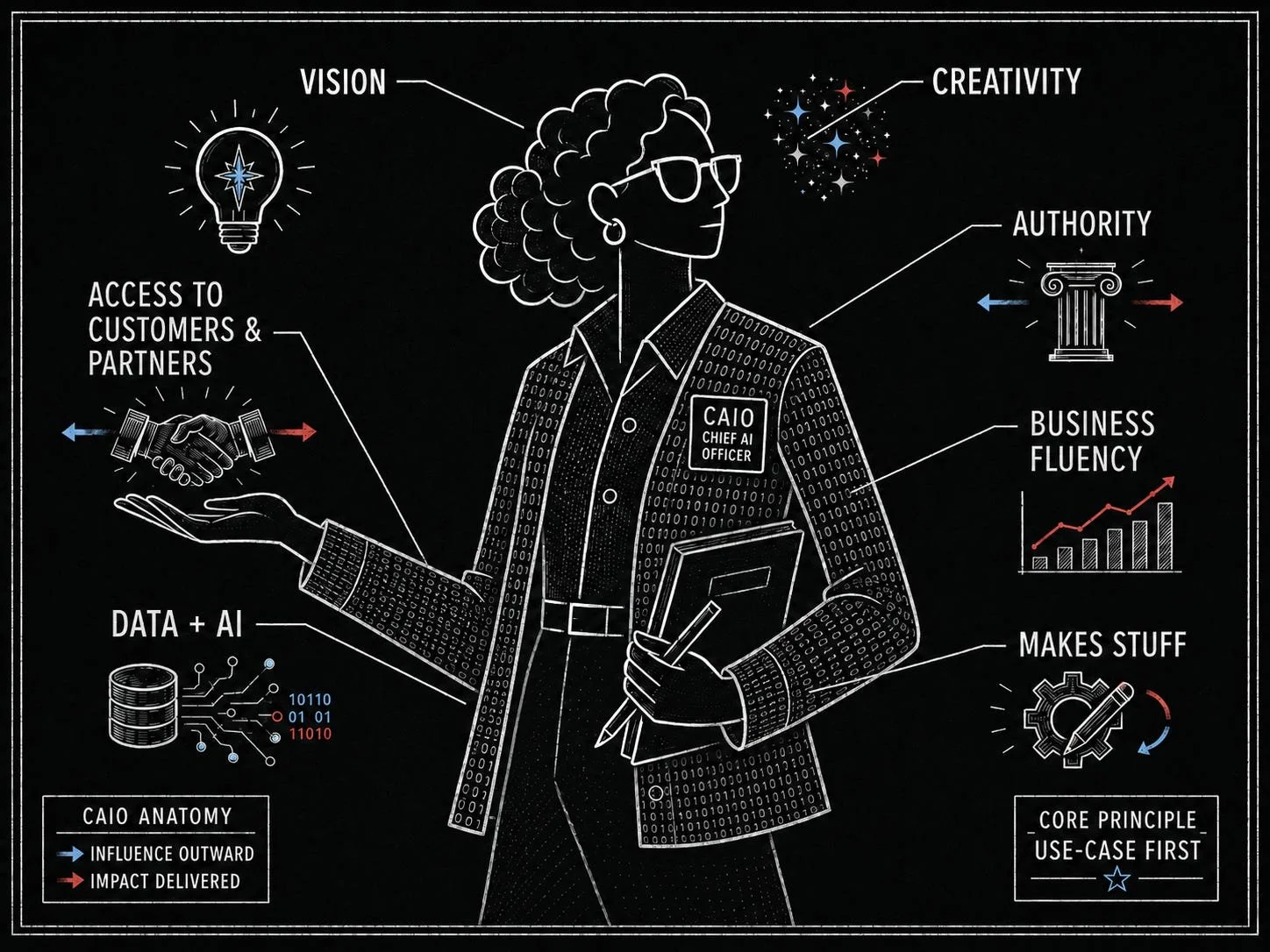
The same should be true of our CDO or CAIO. It is not enough for the CDO to make data accessible, tidy, and accurate; or for the CAIO to make AI tools and best practices available. The mission should be bigger and more bold. The role of CDO and CAIO should be generative. They should be responsible for making stuff.
The problem statement is embedded in the Rand study: Few business leaders have a background in data science; consequently, the objectives they set need to be translated by the technical staff… A whopper of a statement. If business leadership cannot speak data and AI, they can’t think that way. They won’t have the imagination to express customer needs in terms of data and AI products. If data and AI leadership are functional or technical experts, they have the inverse problem: they know the edges of the envelope: but they don’t know what to put inside.
They know the edges of the envelope. They just don’t know what to put inside.
The obvious answer is to bridge the gap. Make business leaders more data savvy. (A goal I wrote a book about.) Or make the data and AI leadership more business savvy. Or both.
So what is the ideal profile of the CDO or the CAIO? I believe they should possess several qualities they won’t get from a PhD:
Vision. An organization’s data has that org’s identity embedded in it. Like the history of a nation, it is the complete record of its deeds--its interactions with customers, suppliers, partners. It is unique to that company’s particular aggregation of expertise and assets; an expression of what that company does; and hence, who they are. The CDO/CAIO should know what this history and identity mean. They should have a personal passion and vision for where their little nation is going. They should be obliged to articulate this: not just as principles or a manifesto (as I heard Section’s Michael Dominic compellingly argue at Tech Week), but actually what it all adds up to.
Creativity. Data and AI are languages. CDOs/CAIOs should be poets. They should know the nuances of their craft, and every night they should lie dreaming about using it to solve problems.
Access to customers and partners. If we are padlocking our CDOs / CAIOs in the boiler room, or making them the equivalent of a waiter pushing a dim sum cart around the office (“AI tool?”), we are not using them properly. We need to fuel their imagination and output with continuous input; sparks for their creativity; new problems to solve.
Authority. With the above qualities and mandate, the CDO / CAIO should be a full partner with the CEO and Chief Product Officer in what the company makes, for whom, and why.
ISN’T THIS JUST A CHIEF PRODUCT OFFICER?
One could argue that the job description overlaps with and competes with the Chief Product Officer. A CPO’s core skill is to research customer needs and figure out how to meet them. And in many sectors now, the highest-value product features are data-and-AI features. So the CPO, just by building products, is already deciding which data gets used, for what, and to what end. If you staffed the CDO/CAIO role the way I am arguing--imaginative, business-fluent, use-case-first--you’d essentially be describing a product leader who happens to specialize in data. The risk of the overlap would be two top executives fighting over the same roadmap.
The questions the business hasn’t thought to ask yet
The counter-argument is that the CPO owns products--the discrete things the org ships; while the data leader owns the asset--the company’s data--and its use everywhere: inside products, yes, but also in pricing, operations, risk, strategy, and the questions the business hasn’t thought to ask yet. A CPO optimizes a roadmap; by contrast, this vision of the CDO/CAIO asks them to imagine ways to use an asset across the whole company, including places that never become a product per se. A CPO thinks in features and releases; this leader thinks in what the asset could become, across the entire enterprise and over a longer horizon.
THE BENEFITS
So what are the benefits to the company who embraces this approach?
Below I point to a few case studies, not so much precisely as examples of my proposed role of a new-era CDO or CAIO in action, but rather as the opportunities available to firms who embrace their data as a core asset--importantly when data as such was not their original business. By embracing and focusing on their data as an asset to be leveraged, these companies found robust growth.
By embracing data as an asset, these companies found robust growth.
I believe that virtually every organization in the world has these growth levers available to them--and that for many, the opportunities, like the data, remain unrecognized.
Visa & Mastercard. Visa and Mastercard’s global payment networks generate enormous datasets: between them, well over a billion transactions a day. Both companies have converted that data into “value-added services” for banks, merchants, fintechs, consultancies and governments: a services layer with metrics and software for fraud prevention and cardholder identity authentication, but also selling the consumer purchase insights to consultancies and for marketing services. For Visa, this business generated $10.9 billion in FY2025. Mastercard’s equivalent business generated $13.3 billion in 2025. Both are blasting away at double-digit growth.
Retail Media Networks. For those of us from adtech, retail media networks (or RMNs) are so much part of the woodwork that we forget they emerged as an alternative revenue stream from data these retailers were already producing: Amazon and Walmart, the most visible examples, have commerce businesses, which yield data about not only consumer purchases at the SKU-level, but also search. Starting around 2012, Amazon led the way to convert those assets into ad products that let brands target shoppers close to the point of purchase; then measure whether those ads translated into sales. Amazon’s ad business reached about $68.6 billion in 2025; Walmart’s global advertising business, started later, (now including VIZIO) grew 46% in FY 2026 to nearly $6.4 billion. Derivative businesses, at much higher margins. Retail media as a category is now estimated at roughly $170+ billion annually, with players joining in the feast ranging from United Airlines to Marriott to Chase to DoorDash--note they all have direct consumer relationships resulting in massive amounts of transaction data. It should also be noted that, like Visa and Mastercard, most RMNs do not go far to find clients: they are essentially selling more services and value back to their core partners (eg offering manufacturers the opportunity to promote their wares on the retailers ad platform).
Revelio Labs. Revelio Labs is a different kind of case. The post-Series-A startup had a core business in data. Workforce data to be specific: they gather and normalize job postings, employee reviews, layoff notices, and other labor-market signals--and sell it as workforce intelligence (think compensation and hiring data) to HR leaders, staffing firms, and Wall Street analysts trying to get a bead on company health. When in 2025 the Trump administration rattled the mission and leadership at the Bureau of Labor Statistics (creator of essential stats like Unemployemnt and Inflation), the company launched “Revelio Public Labor Statistics”: a free, monthly, labor-market data set designed to complement official government data with (what they position as) more timely and granular signal. This is less a study in new revenue from old data, as new marketing from same data: the public labor stats venture has built visibility and credibility for Revelio--and their core business.
These are all examples focused on data. What role does AI play? It processes data faster; it makes data more accessible to more users through natural language interfaces; it opens up its use to the non-expert (because agents handle the bothersome red tape); it converts dense workflow challenges into bite-sized manageable data solutions. AI accelerates the data innovation cycle.
THE SIZE OF THE PRIZE
So if we follow through on the above vision for the CDO/CAIO--what would this change be worth?
I’m seeing organizations treat data as means to help them save the world.
If we take Visa as an example: their valued-added-services (VAS) now comprise about 27% of the total business. We can flip those numbers around in a thought experiment--use the non-VAS revenue as a base, and look at the VAS revenue as growth on top of that base. Doing so would make data-driven VAS add about 38% new revenue to Visa’s core.
If you believe my premise that virtually every company has similar opportunities, you can apply that same ratio to the U.S,’s 2025 GDP… which implies that getting our data leadership roles right could be an $11 trillion opportunity. ($30 trillion 2025 U.S. GDPx .38 “latent data” growth.) Maybe that number is mad—yet the combined market caps of AI leaders Nvidia, Alphabet, Microsoft, Amazon, Broadcom, Meta, Micron, AMD, Oracle, and Palantir are $20 trillion. A perspective of where all that value might come from.
You might object and say that these types of opportunities are only available to massive, tech-savvy, transaction-rich players like Amazon and Chase and United Airlines. Maybe: but more and more in my consulting practice I’m seeing organizations even in the non-profit space, with budgets as low as 7 figures, now treat data as means to help them save the world--one meal or green space at a time.
The time since ChatGPT dropped in November 2022 has wreaked upheaval on every part of our commercial lives. Let’s add one more change: to the CDO /CAIO job description; a change that will not only make our silver-templed, blue-blazered friends in CDO roles more inspired, but one that can crack open growth up and down our economy, simply by seeing data for the asset it is; and matching it to the leadership it deserves.