The media world is currently obsessed with the "Company Superior Proposal" David Ellison’s Skydance-Paramount (PSKY) just threw at Warner Bros. Discovery (WBD). The trades are busy counting HBO subscribers and debating if David Zaslav’s "ticking fee" is a stroke of genius or a cry for help.
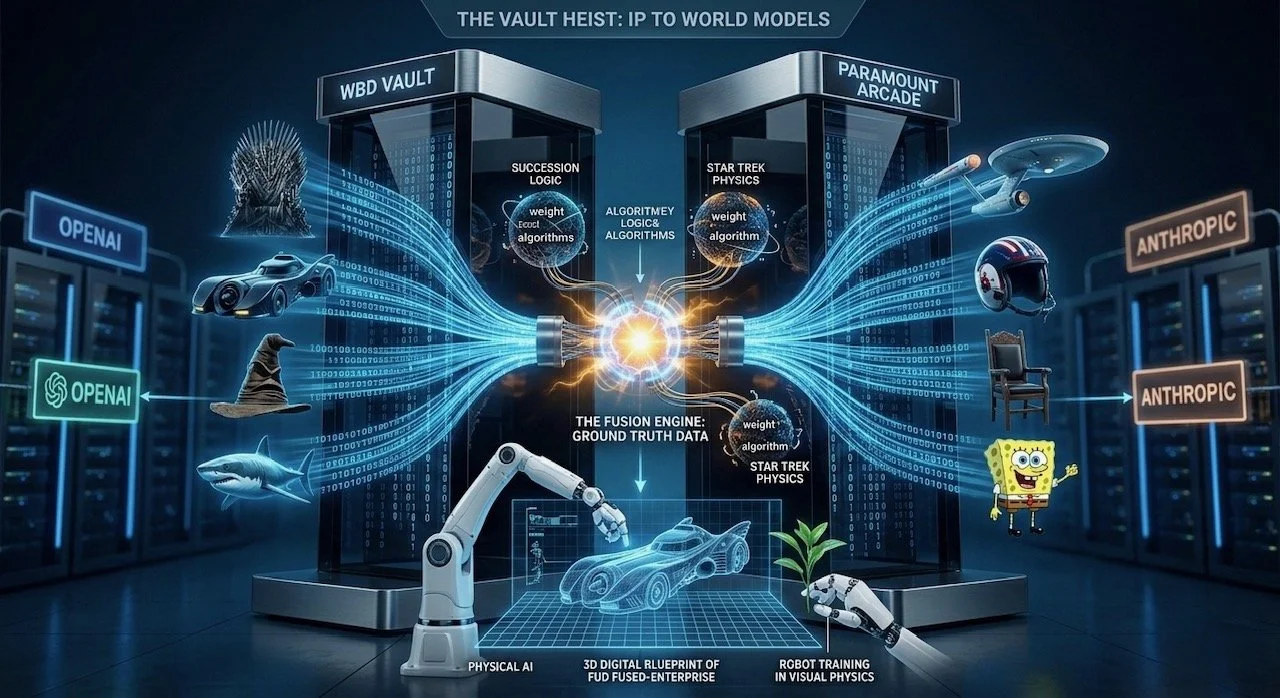
But while the analysts are fighting over linear TV's cooling corpse, they’re missing the actual punchline: This isn’t a media merger. It’s the formation of the world’s largest High-Fidelity Training Repository. In the age of Generative AI, the PSKY-WBD entity won't just be a content company—it will be the primary "Arms Dealer" for Silicon Valley. Here is why this combined IP library is the most valuable dataset on the planet.
1. The Death of "Internet Slop" and the Rise of "Ground Truth"
For the last two years, companies like OpenAI, Google, and Meta have been vacuuming up the internet to train their models. The problem? The internet is now a landfill of AI-generated "slop." When AI learns from AI, it enters a feedback loop called Model Collapse—it loses its grip on reality and starts hallucinating like it’s at a three-day rave.
To build an AI that actually understands how a human walks, talks, and betrays their own father, you need Ground Truth.
The "Succession" Weights: You don't feed an AI Twitter to teach it corporate strategy. You feed it every backstab and monologue in the HBO archive.
The "Star Trek" Physics: Paramount’s 60-year archive of sci-fi is a masterclass in rendering light, 3D environments, and spatial consistency that doesn't look like a 1990s screensaver.
2. The New Revenue Driver: Licensing to Our Hyperscaler Overlords
The business model has officially flipped. Forget the $15.99/month streaming subscription—that’s just to keep the lights on. The real money is in Non-Display Data Licensing.
The Disney-OpenAI billion-dollar deal of early 2026 set the floor. A combined PSKY-WBD has even more leverage. Sam Altman and the Anthropic crew are desperate for ethically sourced, copyright-cleared data to avoid being sued into the next century.
The Data-for-Equity Swap: Don't expect just cash. Expect the new PSKY-WBD entity to demand equity stakes in the models themselves. If OpenAI wants to train Sora on the Warner film vault, David Ellison doesn't just want a check, he wants a seat at the table where the future of intelligence is being built.
3. Physical AI: Why Robots Need Shark Week
This is the part that sounds like sci-fi but is the most lucrative: Physical AI. We are moving from AI that chats (LLMs) to AI that moves (Humanoid Robotics).
To fold your laundry or navigate a kitchen without killing the cat, a robot needs to understand gravity, torque, and object permanence. This is where the Discovery and Smithsonian libraries become a gold mine.
Visual Intelligence: Every frame of Shark Week or Planet Earth is a high-speed data point on fluid dynamics and natural physics.
The "Digital Twin" Vault: Between WBD and Paramount, they own the 3D blueprints for everything from the Batmobile to the bridge of the Enterprise. These are synthetic training environments where robots can learn to move in a simulated world before they ever step into your living room.
4. The Bottom Line: From Dinosaurs to Cyborgs
The PSKY-WBD merger is being framed as two legacy dinosaurs huddling together for warmth. That’s a mistake. If they can stop worrying about the slow death of cable and start acting like an elite data repository, they become the "Landlord of the Metaverse."
The "ticking fee" in the contract isn't just a legal clause, it’s a heartbeat. The clock is ticking on the old way of doing business. The winners of the next decade won't be the ones with the most subscribers—they’ll be the ones who own the blueprints of human culture and the physical world.
And if they fail? Well, at least we’ll get a really high-budget documentary about the collapse on Max. Or Paramount+. Or whatever they decide to call the new app. (My vote: Sky-Max Discovery+—because the logos aren't confusing enough yet).