Why Hollywood's 'Bro-Buster' Strategy Is Leaving Money on the Table
Barbie ($1.4 billion) broke out in a big way at the box office in part because it finally addressed half of the moviegoing audience that isn’t being served by today’s blockbusters (looking at you, Moonfall). Though men are the most consistent theatrical ticket buyers, tentpole titles in the 2020s shouldn’t be skewing male in theatrical interest by as much as 15 to 20 percentage points so consistently. Trying to make money while ignoring a huge audience segment is like trying to win a basketball game with just three players in your starting lineup.
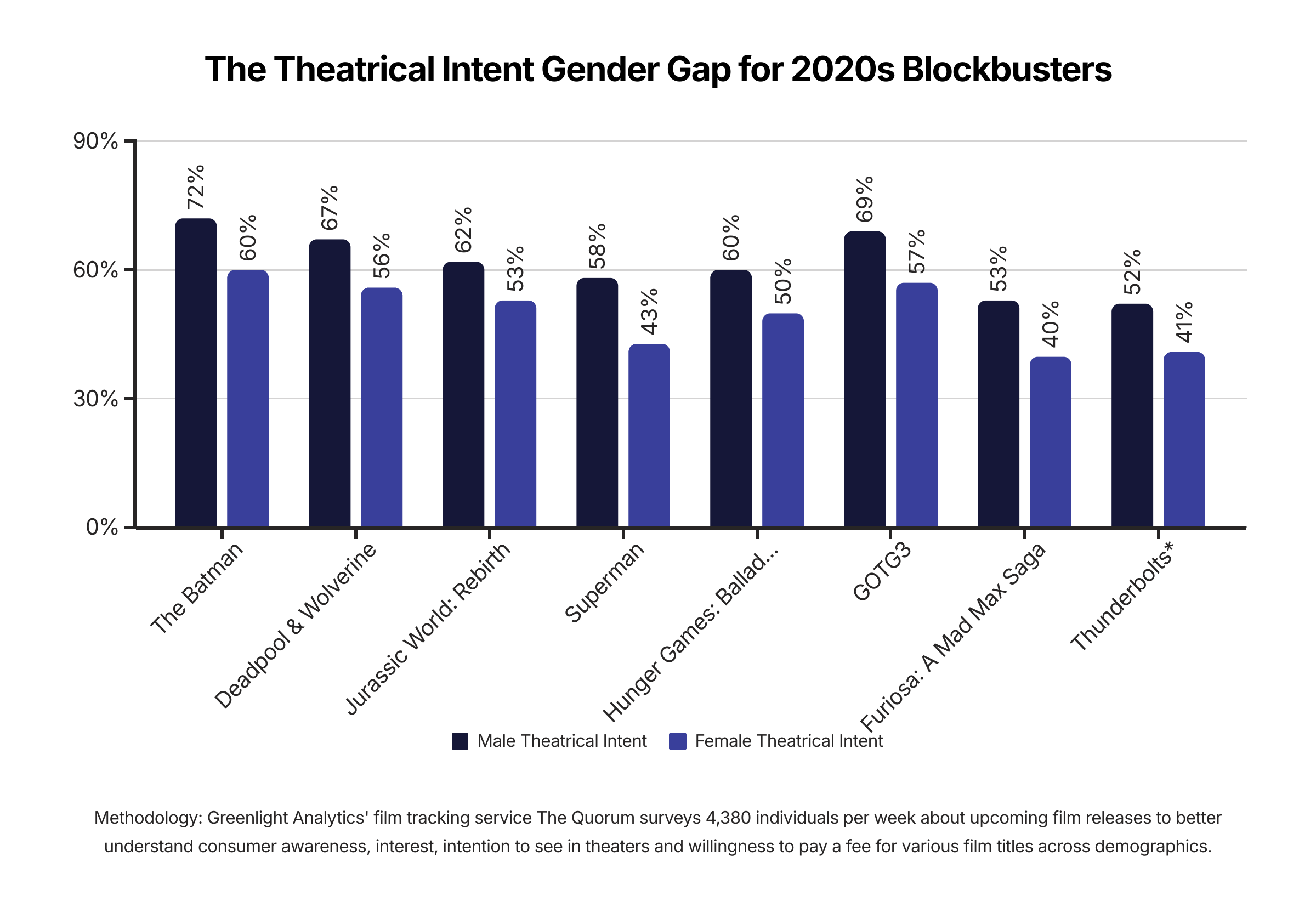
The gender gap among contemporary blockbusters is real. Six of the eight features in the below chart show a double-digit gap between male and female theatrical intent—or those planning to see a movie in theaters—in the week of their respective releases, according to Greenlight Analytics. Superman (15-point gap) and Furiosa: A Mad Max Saga (13 points) are the most extreme cases. But it should worry studios that even female-led tentpoles like Furiosa, The Hunger Games: Ballad of Songbirds & Snakes, and Thunderbolts* are struggling to balance demographic appeal.
Theatrical success, especially among nine-figure budgeted franchise films, hinges on broad demographic engagement. Marketing campaigns for superhero films, action tentpoles, and big franchise films are struggling to connect with women, especially those under 35. This can put a definitive ceiling on your film’s box office legs, especially if it isn’t benefiting from positive word-of-mouth.
Focusing too heavily on one audience segment versus eliciting genuine appeal from men/women, young/old is the difference between a chart-topping hit and an embarrassing flop. The Batman and Guardians of the Galaxy Vol. 3 may have skewed male overall, but they succeeded in large part because they generated higher theatrical intent among women than Superman or Thunderbolts* did in their debut weeks. It’s not a coincidence that James Gunn dropped the first Supergirl poster and said that a Wonder Woman movie is a priority right after Superman experienced such a pronounced gender gap.
None of this is to say that you can’t make money without female audiences. But if you’re hoping to launch the next era of successful superhero cinematic universes, or even just a highly profitable franchise film, you should aim to attract the entire audience, and not just one specific slice. That’s how a studio like Universal tends to draw more even appeal across many of its successful horror (The Black Phone: M-55%, W-46%), family (How to Train Your Dragon: M-46%, W-46%), and blockbuster movies (Fast X: M-51%, W-45%, Wicked: M-49%, W-60%).