Free The Airwaves: Why Local TV Should Be Streamable For Everyone
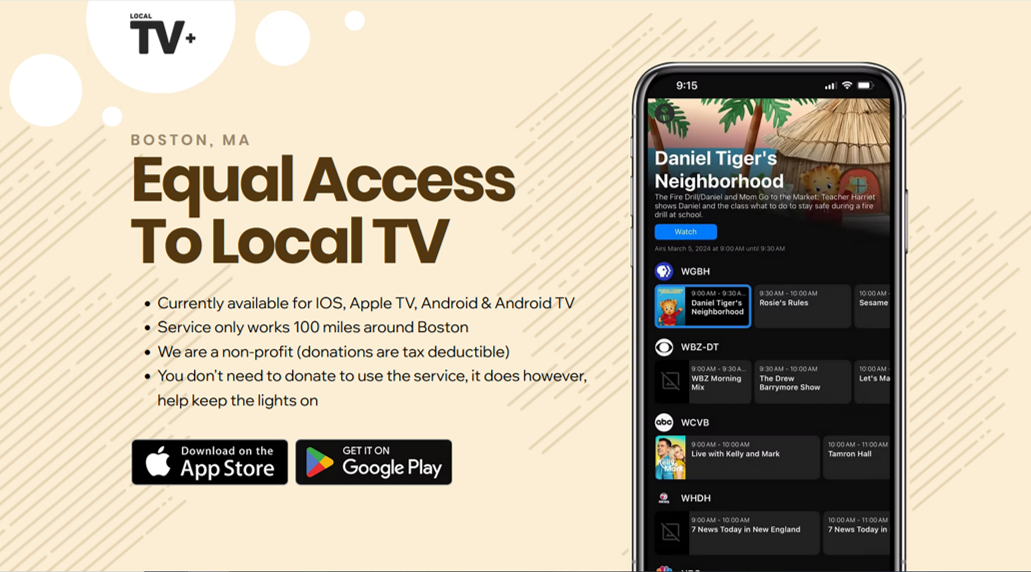
In the Boston area today, a growing number of viewers can open an app and watch local ABC, CBS, NBC, FOX, PBS, and independent broadcast TV stations live — without a cable subscription, without a streaming bundle, and without paying a monthly fee. The service, called LocalTV+, is operated by a Massachusetts nonprofit and works by capturing over-the-air broadcast signals and delivering them digitally to to phones, tablets, and connected TV devices within the local market.
At first glance, LocalTV+ looks like a clever workaround — a Locast-like resurrection for the cord-cutting era. But look closer and it represents something more important: a reminder that the long-standing promise of free broadcast television is increasingly at odds with how Americans actually watch TV — and with how the law treats modern distribution.
When “Free TV” Isn’t Really Free
LocalTV+ exists because the traditional ways of accessing broadcast television no longer work equally well for everyone. Antennas and the reception they provide can be fickle. Urban density, hilly terrain, building materials, and apartment restrictions routinely interfere with reception. For many viewers, especially renters and city dwellers, “just use an antenna” is less a solution than a shrug.
At the same time, broadcast television — nominally free — has become paradoxically harder to access without paying. Many major streaming platforms exclude local channels unless consumers subscribe to expensive live TV tiers. Cable and fiber providers periodically drop stations during carriage disputes, cutting viewers off from local news and sports overnight. The result is a quiet but growing class of consumers who are entitled, in theory, to free broadcast television — but practically locked out of it.
LocalTV+ attempts to bridge that gap. It does not does not materially alter or repackage the programming. It simply delivers local OTA broadcasts digitally to local viewers. The nonprofit model matters here: the service does not charge for access and positions itself as a modern translator — a digital extension of the antenna, not a substitute for cable.
That distinction is not new — but it is legally fraught.
We’ve Been Here Before - Sort Of
Over the past fifteen years, multiple attempts to modernize broadcast access have collided with U.S. copyright and retransmission law. Aereo, perhaps the most famous, tried to replicate individual antennas in the cloud, assigning each subscriber a tiny remote antenna. The Supreme Court ruled in 2014 that Aereo looked too much like a cable system and therefore required broadcaster permission. The service folded shortly thereafter.
Locast, launched several years later, took a different approach: a nonprofit service streaming local stations for free, supported by donations. Initially, it appeared to fit within a statutory exemption allowing nonprofits to retransmit broadcast signals. But a US District Court concluded that its funding practices and use of donations to finance rapid national expansion pushed it beyond the narrow nonprofit retransmission exemption. Locast shut down in 2021.
Other efforts, from the currently-mothballed LocalBTV, to the still-live Stanford University research experiment Puffer, have operated under tight legal and licensing constraints. The pattern is consistent: technology enables free, local, digital access to broadcast signals; the law resists once that access leaves the physical antenna and enters the realm of the internet.
The irony is hard to miss. Broadcast television exists because the federal government licenses public spectrum to private operators on the condition that the public benefits. Emergency alerts, local news, election coverage, and major cultural events are all justified on the premise that broadcast TV is universally accessible. Yet the moment that access becomes more equitable — more reliable across geography, housing type, or income level — it suddenly becomes suspect.
Disenfranchising Access
In practice, this creates a two‑tier system of access. If you live in the right spot, can mount the right antenna, and have the right sightlines, you receive broadcast TV freely and legally. If you live a mile away in a signal shadow, your “free” option disappears — unless you pay a cable company or streaming service for content that was never meant to be paywalled in the first place.
That isn’t merely inconvenient. It’s disenfranchising.
Local broadcast television still plays a unique civic role in American society. It remains the primary delivery mechanism for emergency information, local elections, and community news. Restricting access based on terrain, building design, or device choice undermines the public-interest rationale broadcasters themselves rely on to justify their privileged spectrum access.
The law’s current fixation on how a signal is delivered — antenna versus internet — misses the larger point. The content is the same. The viewer is the same. The public interest is the same. What has changed is the environment in which people live and consume media.
Broadcasters argue, with some justification, that unrestricted digital retransmission could undermine their business model — notably the lucrative retransmission consent fees that now rival or exceed traditional advertising revenue for many stations. But this concern is already overtaken by reality. Cord-cutting has hollowed out pay-TV bundles. Broadcasters themselves increasingly stream local news for free via proprietary apps. The notion that keeping full TV signals technologically inconvenient preserves economic stability is more nostalgic than persuasive.
Modernizing Access Without Killing Broadcast
A better solution would be clarity, not suppression. Consumers should have an explicit, protected right to access local broadcast signals digitally within their home markets, provided the service is noncommercial and geographically limited. Broadcasters should be able to enforce reasonable safeguards — but not veto modernization altogether.
LocalTV+ may or may not survive legal scrutiny. History suggests it faces an uphill battle. But its very existence (as well as the perpetual attempts of others) exposes the absurdity of treating 20th-century reception methods as sacrosanct while penalizing 21st-century ones.
If broadcast television is to be truly “free”, then it needs to be free in practice — not just in theory, not just for those lucky enough to live in the right ZIP code, and not just on the ‘proper’ side of an antenna’s line of sight. Free the airwaves, digitallya
Local News To Peruse
‘The Kelly Clarkson Show’ To End After 7 Seasons - Nellie Andreeva [Deadline]
Braves Will Have New Broadcast Plan; Could Gray Media Be New TV Partner? - Ken Sugiura [Atlanta Journal-Constitution]
Newsmax CEO Ruddy Gets His Cage Match With NAB, With Cruz Announcing 39% Cap Hearing - Ted Hearn [Policyband]
Station Groups Seek Routes Around An M&A Lull - Janet Stilson [TVNewsCheck]
N.F.L. Eyes New TV Deals Before The Old Ones Even Expire - Ken Belson/John Koblin [New York Times]
FCC Approves Transfer Of Five TV Station Licenses To Sinclair - Matthew Keys [TheDesk.net]
Should Broadcasters Produce News That Looks More Like YouTube? - Tom Sly [TVNewsCheck]