Ahead In Awareness, Behind In Urgency: ‘The Odyssey’ vs. ‘Oppenheimer’

Despite working in the entertainment industry for more than a decade, I still resemble your typical fanboy, especially when it comes to a certain filmmaker. To paraphrase Shakespeare, “If you give me a Christopher Nolan film, do I not buy a ticket?” The Odyssey is my most anticipated movie of 2026, so much so that I’ll be flying to another state to see it with my brother on opening weekend.
Forget A-list stars for a second. Nolan is the rare filmmaker who can sell tickets based on his name power alone. Oppenheimer was a three-hour, R-rated biographical drama that opened to $82.4 million on its way to more than $330 million domestic and nearly $976 million worldwide. But how much of that run was boosted by the organically driven Barbenheimer double-feature effect? And will The Odyssey be able to draw the same volume of infrequent older moviegoers?
Let’s jump into the tale of the tape and compare both films at similar five-month pre-release points to get a sense of how Nolan’s Greek epic is shaping up.
Quick Takeaways
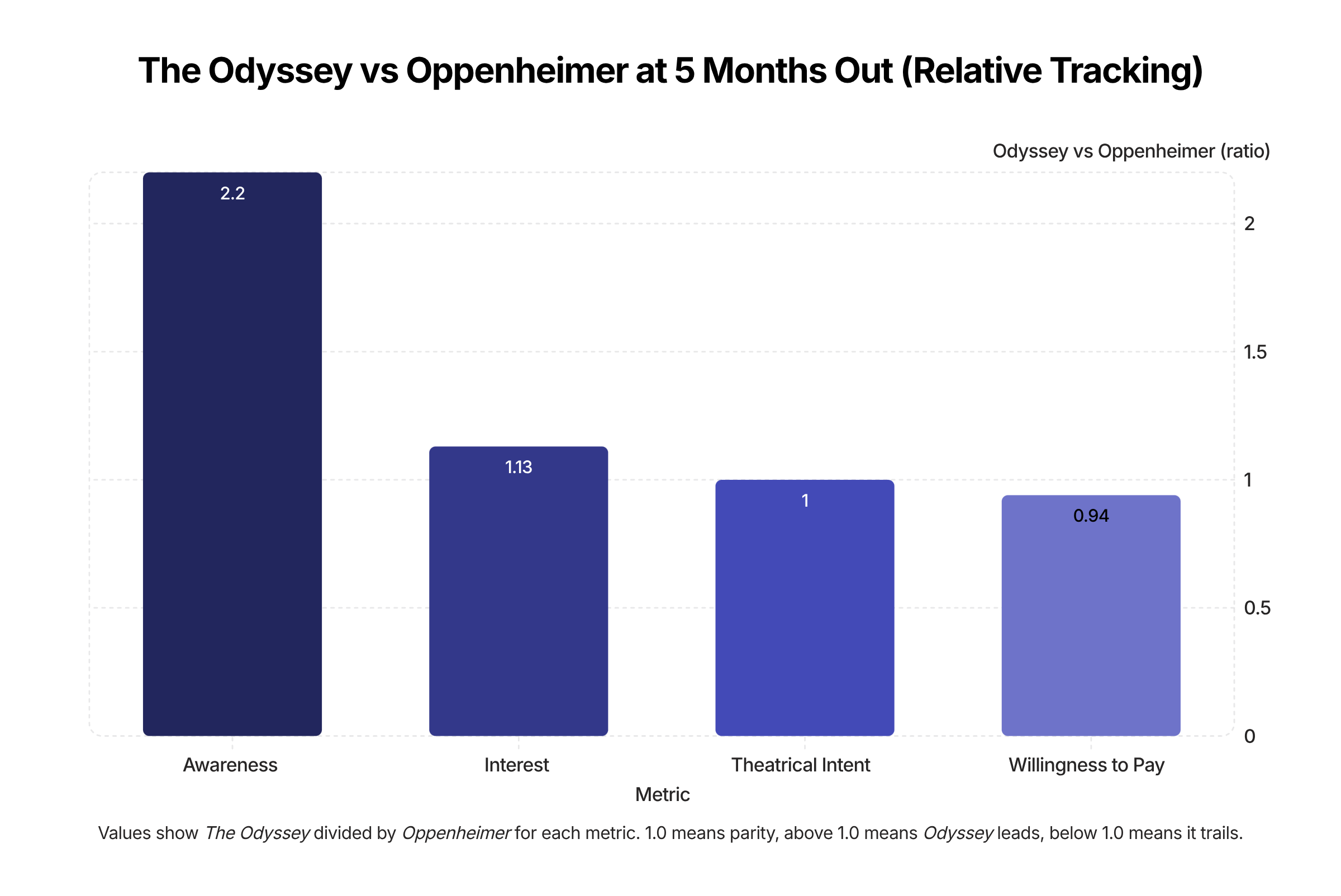
As of now, The Odyssey (44%) holds an enormous lead over Oppenheimer (20%) in Awareness at the same way-too-early pre-release point, according to Greenlight Analytics. The upcoming epic is also slightly ahead in Interest (53% vs. 47%) and Interest Among Aware audiences (77% vs. 70%). Pretty declarative, no? Well, hold your Troy-charging horses for just a moment.
Both films are even in Theatrical Intent (47%), while Oppenheimer leads in Willingness to Pay—via a theatrical ticket, VOD transaction, or streaming subscription (62% vs. 58%). (Generally speaking, gaps larger than 10 points between Theatrical Intent and Willingness to Pay can reflect a stronger desire for at-home viewing).
When looking at Interest Conversion (Theatrical Intent divided by Interest), Oppenheimer (1.0) is converting interest into ticket-buying intent more efficiently than The Odyssey (.89) at the same point in the campaign. This is an early and highly subject-to-change signal of familiarity versus urgency. The Odyssey is well known and intriguing, but it is not yet being viewed as must-see or must-pay at the same rate. (It may simply be a case of audiences needing to see more before deciding).
That dynamic shows up in the age split as well. Audiences 35+ are more aware of The Odyssey (55% vs. 21%) and hold slightly more general interest thus far (52% vs. 50%). It is one of the most famous stories in history, after all. Yet Oppenheimer appears more eventized at this stage. It leads in Theatrical Intent (50% vs. 45%) and WTP (63% vs. 55%) among that cohort. Those pesky older audiences may feel a more immediate connection to recent history than to ancient history. (Then again, older audiences are more consistent bingers than young folks, so viewership can be made up on the backside in home availability).
With five months to go, there is ample time for The Odyssey’s Theatrical Intent and WTP to close the gap or even surpass Oppenheimer. Sharper marketing, greater spectacle, the full force of the NBCU promotional machine—all of that can move the needle. (Who among us doesn’t want to see our favorite actors in a throwback swords-and-sandals world doing battle with mythical monsters, eh?) But if the movie were to open tomorrow, it would undoubtedly perform very well without quite matching the same highs.