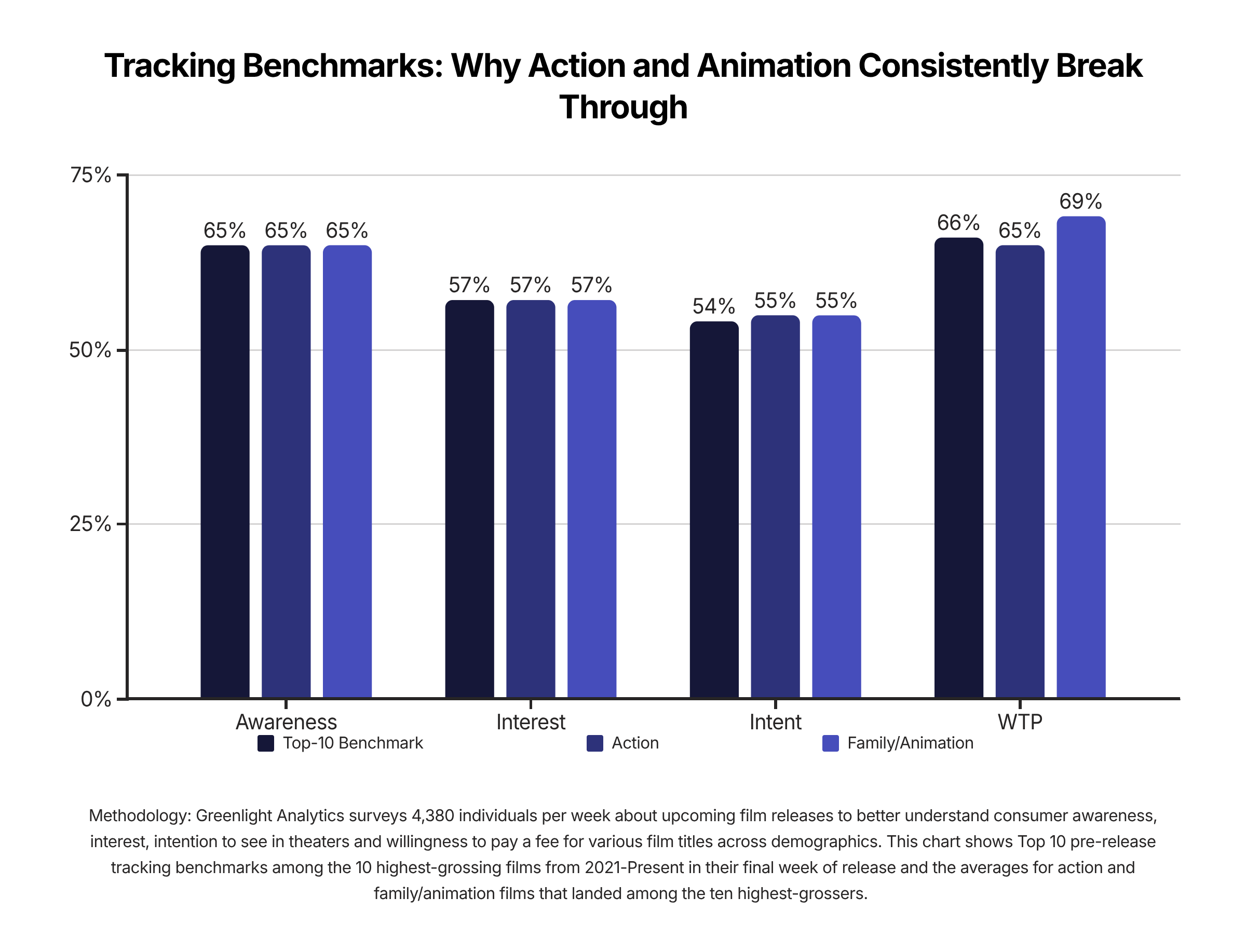
Uncertainty and volatility reign supreme in the entertainment industry today. Sure, that’s the nature of the Hollywood beast. Remember: no one knows anything. But we can all agree that the industry’s economic difficulties have somehow become worse in the post-pandemic world. (Hence all the talk about further consolidation). But as studios desperately search for reliable return on investments, the data shows that two genres consistently deliver: Action and Family/Animation.
Each works in different ways. Action creates urgency and works as both premium and lean back entertainment, while animation is essential for families and creates a pattern of repeatability. Together, they are keeping entertainment afloat.
Action
According to Greenlight Analytics pre-release tracking, films in the action and action-adjacent genre consistently reach top-10 grossing performance indicators in their final week: Awareness (~65%), Interest (~57%), Theatrical Intent (~55%), Willingness to Pay (~65%). This isn’t a major surprise; since 2011, action has never accounted for less than 20% of the U.S. box office, according to The Numbers. In 2024, it hit nearly 30%. But ticket sales are not the only source of strength for the genre.
Across both TV and film, action has proven to be a consistent engagement driver on streaming. Action-forward series such as The Mandalorian, Cobra Kai, The Boys, The Night Agent, Jack Ryan, Fallout, Reacher and more have all landed among the Top 10 most-streamed originals in a given year since 2020, per Nielsen. The same goes for action-oriented films such as Spenser Confidential, Red Notice, The Tomorrow War, The Gray Man, Avatar: The Way of Water and many others. Action accounted for 16.3% of Top 10 titles and 8.6% of Top 10 viewing minutes on streaming from 2020-2024.
Bottom line: Action is the only genre that is always urgent across both mediums.
Family/Animation
Though original/new-to-screen animation has struggled at the box office in recent years, known commodities have arguably never been hotter. Inside Out 2, Moana 2, Spider-Man: Across the Spider-Verse, Minions: The Rise of Gru, Kung Fu Panda 4—the list of box office smash hits goes on and on. Family/Animation consistently delivers the highest Willingness to Pay a Fee (WTP) scores among top films at ~69%, per Greenlight Analytics. Parents consistently pay more—and that trickles down beyond the theatrical.
On streaming, family friendly entertainment boasts immense rewatchability which makes it a very sticky churn reducer. Titles such as The Super Mario Bros. Movie, Leo and now KPop Demon Hunters stay firmly planted in Netflix’s Top 10 lists for weeks. Animation accounted for 25.4% of Top 10 titles and 10.9% of Top 10 viewing minutes on streaming from 2020-2024.
Animation offers both high upside in theaters and healthy retention on streaming.
Twin Engine Strategy
Action sits at the top of the funnel as it attracts audiences. Animation helps improve the lifetime value of a customer (particularly those with kids) once they’re engaged because it keeps you around. Action maximizes event-level urgency and leverages the growing interest in premium large format viewing experiences (hello, IMAX). Family friendly/animation IP can serve as the launching pad for multimedia franchises (Pokemon, Dragon Ball Z, SpongeBob, Toy Story, etc.). Action can be grafted onto drama, superhero, sci-fi, fantasy and other genres while animation has proven far more stable than prestige, streaming original sitcoms, or even horror.
Animation appears more frequently across the Top 10s, particularly in the film categories. Action commands fewer Top 10 slots overall but tends to produce massive one-off hits and high theatrical crossover. Both genres clearly overperform relative to their share of all genres. Greenlight’s prescription: studios that balance action’s broad appeal and malleability across mediums with family/animation’s monetization flexibility will maximize ROI across windows and platforms.