Tube Trends: Can YouTube Be Everything, Everywhere, All At Once?
At this year’s Upfront, YouTube was ready to boast: We’re TV now.
There’s increasing evidence to buy the concept from an audience standpoint.
Tubular Labs data shows that U.S. accounts generated 13.9 trillion views over the course of 2025; a 65% increase versus 2024.
Part of that climb comes from the fact that short-form video is helping create rapid growth in uploads. But still, total uploads climbed by “just” 15% year-over-year. So it’s not just a volume play. Audiences ARE watching more — especially in the U.S. where YouTube was pitching advertisers this week.
Where things get more interesting for YouTube in this conversation is around what they want to be for viewers. Because no matter what device they’re watching on or what sort of content they’re looking for, it seems like YouTube is angling to be an all-encompassing solution. But can they be everything?
Sports Hub
While the heavily rumored NFL deal that would’ve brought several live games to YouTube this season fell through, YouTube is still functioning as a central hub for sports content both in the U.S. and abroad.
As discussed in this space last week, that video genre’s ballooned significantly (Tubular points to a 51% year-over-year increase in views), partly on the backs of leagues like the NFL opting to invest more in the platform as a vehicle for attention even if those fans aren’t always watching live games.
Discovery
Not just limited to sports, YouTube has also been increasingly talking about discovery as a key message for brands, creators and publishers alike.
While social is the new search (h/t again to Tubular), it goes even deeper than that for YouTube as it partly reworks the platform’s function to be geared toward audience-fueled discovery actions. It’s not a TikTok “for you” page and it doesn’t need to be. YouTube — taking cues from parent company Google — is positioning itself as a gateway to what you’re looking for. AI is part of that. But YouTube videos become key pieces to the answers Google provides following AI prompts.
YouTube-As-Traditional Television
This is where the NFL deal could’ve lent a hand, as the league’s games are the ultimate lean-in viewing experience for audiences that excites advertisers more than any other program. iSpot data shows that the NFL delivered more ad impressions (3.55% last year) and fuels more linear ad spend ($1.52 billion) than anything else on TV.
Even without the games, though, YouTube’s TV viewership overtook mobile last year. And that’s while the platform is still generating plenty of mobile viewership.
On the strength of both long- and short-form content, though, YouTube is getting audiences to watch on TV. So whether they’re watching a live game, a marathon gaming session or a slew of beauty Shorts, audiences are treating the videos the same way they would traditional television. Even if lower quality in some cases (though not all), these video behaviors do demand greater attention from brands at some point, and that time may be now.
Podcast Replacement
Though Spotify has pivoted its video strategy away from YouTube toward Netflix, YouTube is still a home for most podcasts large and small not owned by Spotify. And in many ways, YouTube is the reason why podcasts have ceased being an “audio medium” and have become multimedia enterprises that almost NEED video.
Your author would argue that one of the highlights of podcasts is their portability and inherent prompts for lean-back audience behavior; something that is automatically reduced by adding video viewing (on TVs or not) to the experience.
However, the updated podcast format appears to be hear to stay. And video allows for these shows to be further monetized, which ultimately helps creators.
Data via Tubular Labs
The Official Home of Creators
Which brings us to the last of the major boxes YouTube is trying to check: Being THE place for creators to reach audiences and monetize their content and personalities.
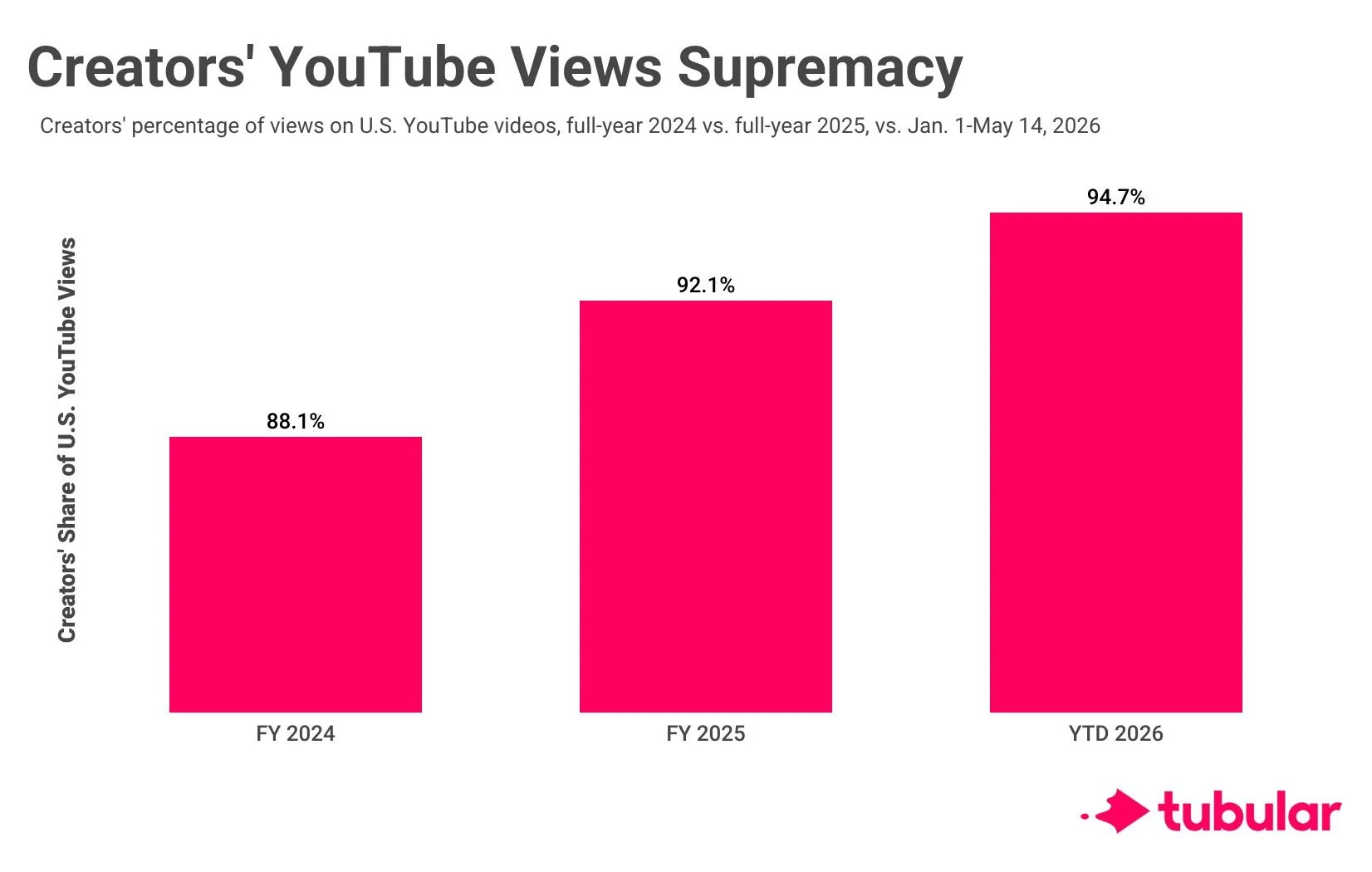
Year-to-date, Tubular data points to a stunning 95% (!!!) of views on U.S. content being generated by individual creators.
Comparatively, in 2025, it was 92% and in 2024, it was 88%.
Though all are high figures, the trend is still pointing up, even as total views and uploads also climb.
As a result, creators can’t ignore YouTube’s platform and are pushed to embrace it one way or another.
***
Despite a larger goal that could be unwieldy for most, YouTube is well situated to succeed in its efforts to be ALL of these things for audiences at the same time. And as it successfully woos brands, it only fuels the platform’s abilities to take over what we’ve long thought of as “TV” even more.