Local TV’s Future Depends On Who’s Left In The Newsroom
@carolineontv/Instagram
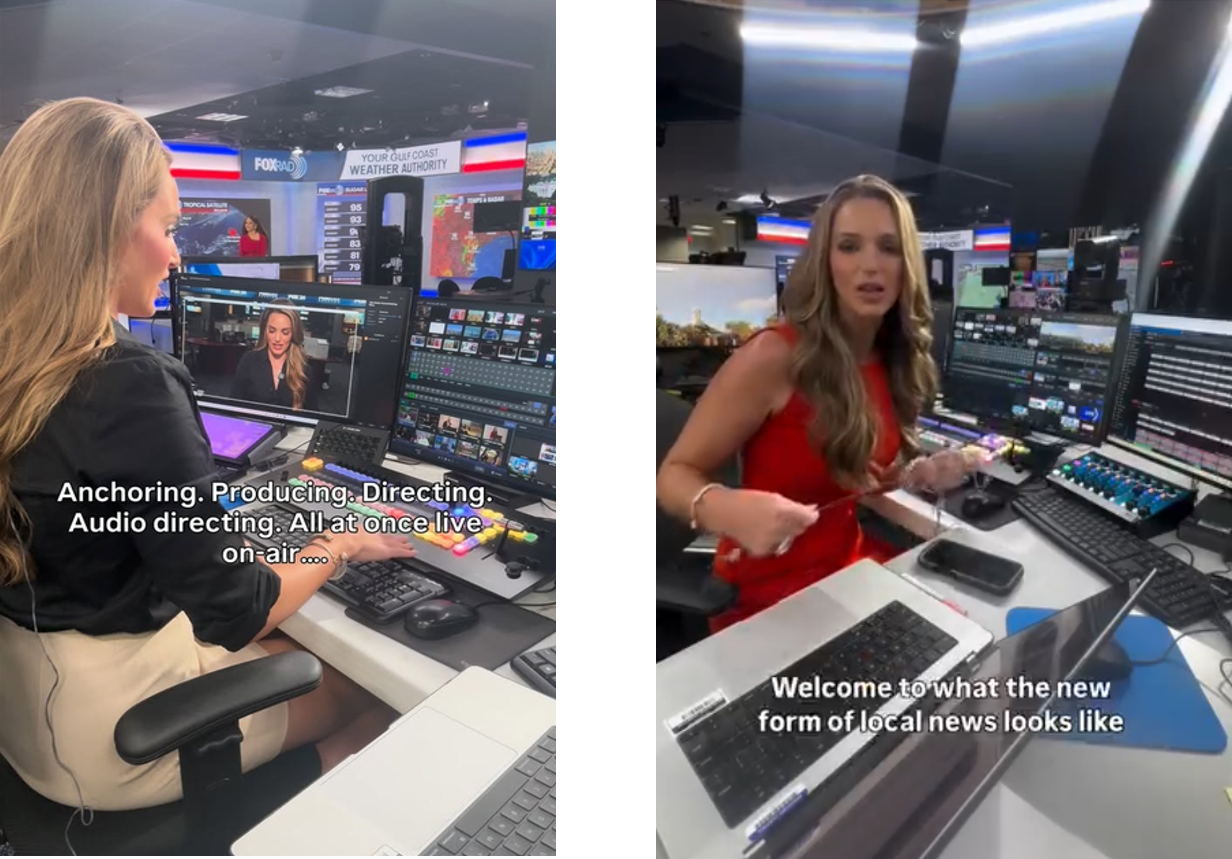
By now, many in the TV industry have probably seen the social videos of Houston anchor Caroline Collins learning to run a streaming newscast while also presenting it. At Fox-owned KRIV-TV, that means handling video switching, graphics and audio alongside her on-camera duties, as NewscastStudio recently reported. Her assessment after an early outing: “incredibly stressful.”
Other anchors know the challenge. Across town at ABC-owned KTRK-TV, Jonathan Bruce has described producing, directing and anchoring similar streams in Houston and, previously, at then-Gray-owned KKTV in Colorado Springs. He welcomed the creative freedom while acknowledging the workload concerns. A Fox 10 Phoenix job posting makes those combined duties an explicit hiring requirement: “independently produce, direct, and anchor” broadcasts.
At KRIV, the 10 p.m. newscast retains its traditional studio operation, but Collins says the setup she is learning will also be used for late-morning and early-afternoon linear programming. As these responsibilities extend across platforms and dayparts, the question becomes harder to avoid: how much work can one journalist take on before the journalism begins to suffer?
Combining Jobs Doesn’t Eliminate The Work
The appeal to station owners is obvious: more programming with fewer people. Technology can eliminate repetitive tasks and give journalists more control. It can also add responsibilities to an already demanding job.
Reporters have lived with that tradeoff for years. RTDNA’s latest staffing findings show nearly two-thirds of stations relying on multimedia journalists as their primary reporting model. Shooting, interviewing, writing, editing and posting all compete for the same working day. Combining those assignments does not create more time to do them well.
At the anchor desk, production controls compete for attention during interviews and breaking news. Experienced production staff catch errors and handle changes while the anchor concentrates on the story. When anchors absorb those duties, they have more to juggle precisely when a follow-up question, a factual correction or an unexpected development needs their attention. The result can be weaker journalism, a rougher broadcast — or both.
The Local TV Workforce Is Already Under Strain
The latest RTDNA/Newhouse survey puts full-time local TV news employment at 26,458 in 2025, down 2.2% following a 2.9% decline the year before. Stations producing original local news fell from 695 to 689. Digital staffing also declined.
A separate survey of 270 TV news professionals by local anchor and Substack writer Josh Helmuth found 63% were not at all or only slightly optimistic about the industry’s future. Consolidation and layoffs, low wages and shrinking resources dominated their concerns. One departing Kentucky anchor described employers as “more interested in output than impact.”
Helmuth’s self-selected sample is not necessarily representative of the entire industry, and neither survey directly measures objective journalism quality. But both raise real and acute questions about how much more output newsrooms can absorb. RTDNA identifies salary, work-life balance and burnout as leading reported reasons for departures. Helmuth’s respondents describe experienced colleagues leaving and worry about who will train their replacements. Heavier workloads risk driving out veterans just when thinner staffs most need their judgment and guidance.
For viewers, the consequences may appear gradually. A story gets less follow-up. An interview misses the revealing question. Coverage leans on readily available material because nobody has time to pursue what is harder to obtain. The newscast still airs (or streams), but its value can diminish long before its absence becomes the issue.
A Fuller Schedule, A Thinner Newsroom
Broadcasters need cheaper, more flexible ways to reach audiences, and Bruce’s experience shows the creative freedom these formats can offer. There is good reason to rethink traditional workflows. But success requires more than filling another hour.
KRIV’s examples do not indicate that its reporting has deteriorated or that this setup has eliminated jobs. They do reveal how much responsibility can rest with one journalist—and how much depends on that person’s attention and judgment.
Every new streaming channel, daytime hour or social feed creates another outlet for journalism and another demand on the newsroom supplying it. Without corresponding investment or fewer obligations elsewhere, the schedule expands while the same people are stretched further.
Owners should be able to show how their efficiencies preserve time to verify a claim, pursue a difficult story or prepare for an interview. Sustainable workloads belong in that calculation. If expansion depends on employees continually absorbing more duties, the apparent productivity gain may ultimately come at the expense of the newsroom’s capacity to report.
A fuller schedule means little if the newsroom has less time to find out what is happening in its community. The cameras may keep running — but the journalism still has to be worth watching.
Local News To Peruse:
Comcast’s Carr Calculation — Oliver Darcy [Status]
FCC Backs DISH Network In Must Carry Dispute With Georgia TV Station, Nixing Rosenworcel-Era Precedent - Ted Hearn [Policyband]
Can The FCC Rise Above It All? - Phil Kurz [TVTech]
Why Radio Can’t Ignore The Edison Research Data About 13-34’s And In-Car Listening - Garrett Searight [Barrett Media]
Format Counts: Religion Takes An 80-Station Lead Over Country - [Inside Radio]
The 2026-27 NHL Local Broadcast Accessibility Rankings - Manny Soloway [Awful Announcing]
Edward Czarnecki Uses Game Theory To Assess ATSC 3.0 Transition Policies - George Winslow [TVTech]