5 Takeaways and Brief Session Summaries from OpenAP’s Audience Summit.
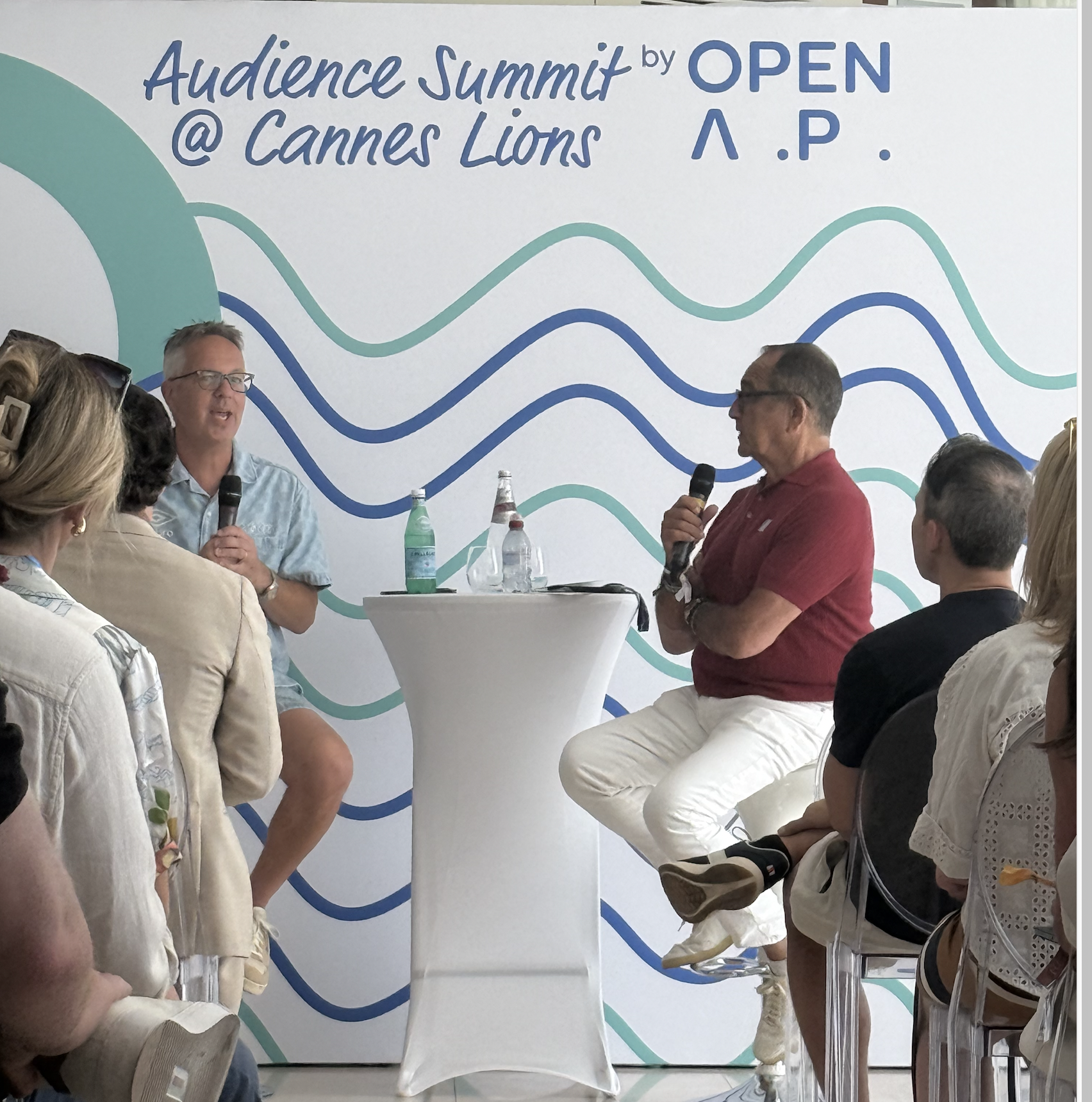
American Eagle CMO, Craig Brommers & 3C Ventures Founder, Michael Kassan
So often I go to industry events and take a few notes, but all the conversations blend into one, and by the time I get home, I’m generally inspired and exhausted and the takeaways aren’t as sharp.
This year, in addition to talking to folks for a special series on Outcomes and AI (coming soon) I took a recorder to OpenAP’s 2026 Audience Summit at Cannes so I could give myself the chance to actually digest conversations away from the conference swirl and pluck through the panel exchanges during the insanely long flight home.
The following is a summary of the event taken from the transcripts, but first some takeaways from it all.
Let me start by saying this— the through-line was clear: the future of premium video advertising will not be won by simply adding more data, more dashboards or more automation. It will be won by connecting audience understanding, creative conviction, trusted infrastructure, outcome measurement (and AI-enabled workflows that actually have a chance to work, not just agentic chat bots)!
Across the conversations, speakers returned to the same challenge: television still has the power to create culture, but the industry needs a simpler, faster and more transparent operating model if it wants to compete with digital platforms, retail media and the walled gardens.
Key Takeaways
Premium video needs a simpler buying infrastructure. Buyers want cleaner workflows, consistent measurement and easier activation. Right now we have more walled gardens creating more complexity and worse insights about performance. It is starting to feel like publishers get this hurdle and are doing what they can to make it easier to engage across TV platforms at least.
Outcomes are getting real. Awareness, attention, consideration and cultural impact have always been valuable business outcomes for television and part of the allure— but that vague promise is becoming something everyone wants to prove. And not just in a cheap way but actually. EG, people understand that a spike in search is just one outcome signal— I was encouraged to hear networks and brands are thinking more holistically about proving the value of ad experiences. If everyone gets cheap on the way they think about outcomes, brands will see through it. The challenge will be in proving the impact of the creative— but one thing at a time.
Audience insight is the starting point and underpins everything else. TV can deliver a lot of highly impactful reach in a short amount of time. But, reach are frequency metrics alone are losing luster. Ratings points aren’t the thing anymore. Knowing who the audience is with better identity, and what they experience is critical to the rest of the value equation. Without good information about who saw and ad— and what kinds of messages were seen, the whole outcome revolution is a lost cause.
Agentic advertising is coming, but governance is essential. Everyone talked about AI in some regard, each with different applications in mind— but one thing everyone agreed on, AI requires trusted data, some kind of operational standards and human oversight. Without good solid data, we are going to swirl in garbage. The AI revolution transforms the usefulness of measurement in the mix, but it also ups the ante on performance.
Collaboration could become a competitive advantage. Networks came together to form OpenAP and create scale and innovation. There will be more of this. It seems like publishers, agencies and data partners are realizing that if they work together on TV experiences, they can compete more effectively with the walled gardens than each network against eachother— and the walled gardens at the same time.
Here is a transcript summary from the day’s convos:
The summit opened with a conversation between 3C Ventures Founder & CEO Michael Kassan and American Eagle CMO Craig Brommers on "The Creative Advantage." Using American Eagle’s recent Sydney Sweeney campaign as a case study, Brommers explained that the campaign drove immediate gains in customer acquisition, jeans sales and traffic despite a brief wave of social-media backlash. The lesson was not that controversy is a strategy, but that marketers need to distinguish between social noise and real consumer response. American Eagle relied on business performance, polling and audience insight to confirm the campaign was resonating with its intended audience.
That conversation established one of the central themes at Cannes: creativity and measurement are no longer separate conversations. Great storytelling still matters, but it must be informed by audience intelligence and connected to business outcomes. Brommers described American Eagle as operating more like an entertainment company, creating brand narratives with recurring characters, plot twists and cultural moments.
The next panel, "Attention, AI and the Future of Marketing," explored the increasingly complex battle for consumer attention. Sources author and ACCESS co-host Alex Heath moderated a discussion with Joe Marchese, CEO, Human Ventures Holdings; Bryson Gordon, CVP, Global Marketing, Microsoft; and Gretchen Saegh-Fleming, CEO, Publicis Collective. The panel challenged the assumption that shorter content is always better, arguing that long-form storytelling is enjoying a resurgence because it offers something increasingly rare: depth, context and human connection.
AI, however, is changing how attention is discovered and measured. Gordon introduced the idea of "agent attention," where brands must consider how they appear when AI assistants answer consumer questions. Marchese argued that shared experiences, culture and relationships cannot be fully captured by attribution models, while Saegh-Fleming described modern marketing as "magic and math"—combining emotional storytelling with data and measurement.
In “Connecting Audiences to Outcomes,” CNBC’s Julia Boorstin spoke with OpenAP CEO David Levy and executives from Warner Bros. Discovery, Paramount, TelevisaUnivision and Fox about the need for common systems that make premium video easier to buy, activate and measure.
Levy outlined OpenAP’s work around a centralized conversion API and agent-ready tools that can help buyers build audiences, plan campaigns, activate across publishers and connect exposure to outcomes. For the publishers, the message was urgent. Ryan Gould, President, US Ad Sales, GTM, Warner Bros. Discovery argued that the economics of premium content are under pressure and that the current ad model is still operating on rules built decades ago. Travis Scoles, EVP, Advanced Advertising, Paramount said the industry has the data and tools to change, but often lacks “permission to change.” Cara Lewis, EVP and U.S. Head of Agency Sales TelevisaUnivision emphasized that measurement systems routinely miss key audiences, particularly U.S. Hispanics, making proprietary audience graphs and better data collaboration critical.
The "From Infrastructure to Activation: The Path to Agentic Advertising" panel expanded the discussion into agentic advertising. OpenAP Chief Business Officer Chris LoRusso contrasted automation with AI agents, explaining that automation follows instructions while agents pursue objectives. Panelists Lisa Herdman, Chief Enterprise Integration Officer, RPA; Ben Hovaness, EVP, Global Specialized Capabilities, Omnicom Media; Martin Wexler, EVP, Product Revenue & Partnerships, Acxiom; and Jovan Dupor, Chief Strategy Officer, Performance, Dentsu Creative agreed AI can eliminate manual workflows and simplify audience planning and optimization, but emphasized that governance, high-quality data and human oversight remain essential. Wexler warned that poor identity data will simply produce bad outcomes faster, while Dupor argued AI should strengthen—not replace—the connection between creative, media and data.
The final session, "Trust, Transparency and the Future of TV Measurement with Warner Bros. Discovery," moderated by Next in Media Founder Mike Shields, featured David Porter, Head of Ad Sales Research, Data and Insights, Warner Bros. Discovery, and CIMM Managing Director Jon Watts. Porter shared research showing that different measurement providers often produce significantly different reach estimates for the same campaign because of varying universe estimates, impression definitions, coverage, identity solutions and personification methodologies. Watts argued that the industry must establish consistent standards while still allowing room for innovation.